
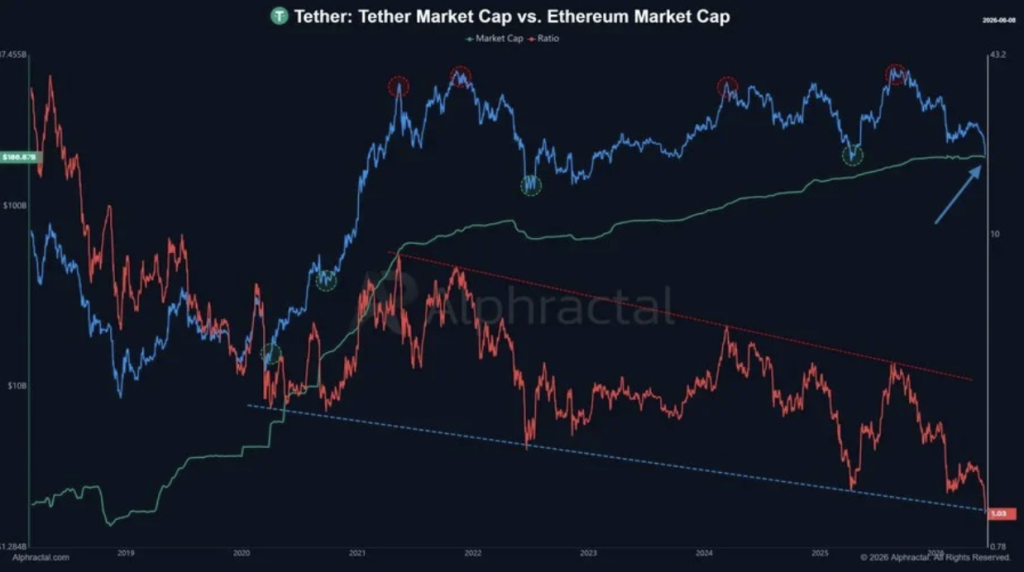
- Ethereum and Tether are approaching a rare near 1:1 market capitalization ratio in 2026.
- Tether’s steady expansion contrasts with Ethereum’s recent price struggles and weaker market performance.
- Analysts are closely watching the ratio, as similar setups have historically appeared near major market turning points.
Ethereum and Tether are inching toward a milestone that, not long ago, would have seemed almost unthinkable. In 2026, the market capitalizations of the two digital assets have moved remarkably close together, shrinking the gap to one of the tightest levels ever recorded. For investors who follow crypto market structure, it’s more than just an interesting statistic. It may offer a glimpse into how capital is moving across the broader digital asset landscape.
Ethereum remains the second-largest cryptocurrency by market value, but Tether’s relentless growth has changed the equation. While ETH has struggled to regain momentum amid a difficult market environment, Tether has quietly continued expanding. Its supply has increased steadily as traders, institutions, and decentralized finance users keep pouring capital into stablecoins. The result is a convergence that has sparked plenty of discussion among analysts and market watchers.
A Rare Market Cap Convergence
Recent data shows Ethereum’s valuation moving closer to Tether’s than at almost any other point in crypto history. The narrowing gap isn’t necessarily driven by explosive growth from Tether alone. Instead, it’s the combination of two opposing forces: Ethereum’s prolonged weakness and Tether’s continued rise.
For much of the current market cycle, ETH has faced persistent selling pressure. Price action has remained sluggish compared to previous bull market recoveries, leaving investors frustrated and, in some cases, cautious. Meanwhile, Tether has benefited from growing demand for stable liquidity. As traders seek safety while remaining active in crypto markets, stablecoins have become an increasingly attractive parking spot for capital.
Why Analysts Are Watching This Ratio
Several analysts have pointed to the Tether-to-Ethereum market cap ratio as a surprisingly useful indicator. While no metric can predict market direction with certainty, historical charts reveal that shifts in this relationship have often occurred around important moments for Ethereum.
Over multiple cycles, the ratio has formed recognizable patterns and trendlines. When those levels were approached in the past, major reversals or trend changes sometimes followed. That’s why traders are paying attention again. The market isn’t guaranteed to repeat history, of course, but crypto participants tend to watch anything that has demonstrated relevance across several cycles.
What makes the current setup particularly interesting is how close the ratio has moved to previous inflection points. Whether that signals opportunity or simply reflects broader market caution remains to be seen.
Stablecoins Continue to Gain Influence
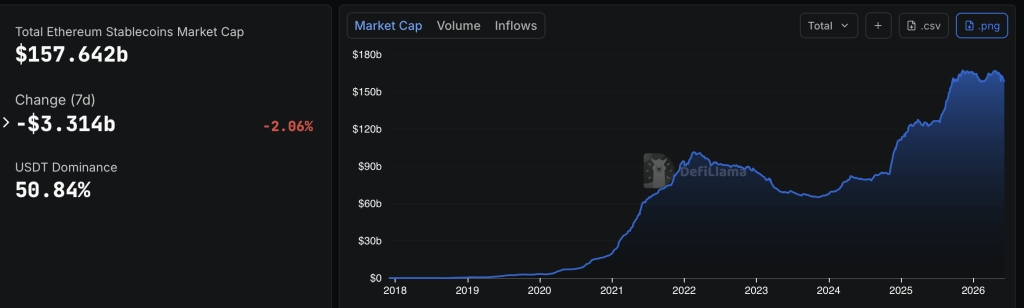
Tether’s rise highlights a larger trend unfolding across the cryptocurrency ecosystem. Stablecoins are no longer just tools for moving money between exchanges. They have become essential infrastructure, supporting trading activity, decentralized finance protocols, cross-border payments, liquidity provision, and increasingly, institutional participation.
As more capital flows into stablecoins, it can signal a market that is waiting rather than committing. Investors may prefer holding digital dollars while they assess risks, monitor macroeconomic developments, or wait for clearer signals before deploying funds into more volatile assets.
In that sense, Tether’s growing market capitalization reflects more than simple adoption. It also reveals a degree of caution among market participants. Billions of dollars remain inside the crypto ecosystem, but much of that capital is choosing stability over speculation for now.
Ethereum Still Holds a Strong Position
Despite recent struggles, Ethereum remains the dominant smart contract network by a wide margin. The blockchain continues to host a vast ecosystem of decentralized applications, tokenized assets, stablecoins, and DeFi protocols. Its infrastructure remains deeply embedded in the broader digital asset industry, providing a strong foundation for future growth.
That said, investors can’t ignore the challenges. Competition from newer blockchain networks continues to intensify, while slower user growth and market uncertainty have weighed on ETH’s valuation. The narrowing gap between Ethereum and Tether serves as a reminder that stablecoin adoption has expanded faster than Ethereum’s market value during this phase of the cycle.
Whether the convergence ultimately marks a warning sign or a potential turning point for ETH remains unclear. What is certain, though, is that the relationship between Ethereum and Tether is becoming one of the most closely watched metrics in crypto markets today.