

- Bitmine launched a $280–300 million preferred stock offering to acquire more ETH and expand staking operations.
- The structure mirrors Michael Saylor’s Bitcoin treasury strategy but uses Ethereum’s staking yield to help fund dividends.
- Despite large unrealized losses from ETH’s recent price drop, Tom Lee remains optimistic about Ethereum’s long-term prospects.
Bitmine Immersion Technologies is taking a page directly from Michael Saylor’s playbook, but with a distinctly Ethereum-focused twist. The company has unveiled a preferred stock offering worth between $280 million and $300 million, structured around the idea of building an Ether treasury while leveraging Ethereum’s staking rewards to support the strategy. According to company disclosures, the offering centers on a 9.50% perpetual preferred stock that will trade on the New York Stock Exchange under the ticker BMNP. Funds raised through the sale are expected to go toward purchasing additional ETH and expanding Bitmine’s validator and staking infrastructure. Each share carries a $100 face value and pays investors a fixed annual dividend of $9.50, distributed weekly in cash.

Tom Lee Brings the Saylor Blueprint to Ethereum
The framework closely mirrors the model popularized by Strategy, formerly known as MicroStrategy, under the leadership of Michael Saylor. Strategy famously issued its own preferred security, STRC, as a way to raise capital for continued Bitcoin accumulation. That product offers a higher yield, reportedly between 11% and 11.5%, and is ultimately backed by the company’s growing Bitcoin reserves rather than any direct income stream.
Bitmine is adapting that same concept for Ethereum. The company plans to issue between 3 million and 3.5 million Series A preferred shares, targeting total proceeds of roughly $280 million to $300 million. If all goes according to plan, the securities could begin trading within about a month of issuance. Similar to Strategy’s structure, the shares feature cumulative dividends and redemption provisions that gradually decline over time. Investors redeeming early may receive up to 110% of face value during the first 18 months, with that premium falling until it reaches par value after three years.
A Key Difference: Ethereum Generates Yield
While the overall framework resembles Strategy’s Bitcoin treasury model, the economics are not exactly the same. Bitcoin itself does not produce income, which means Strategy must rely on capital markets activity, financing arrangements, or occasional asset sales to meet obligations tied to its preferred shares. In fact, the company previously disclosed that it sold 32 BTC to help cover dividend payments.
Ethereum offers something Bitcoin cannot: native yield generation through staking. That feature sits at the center of Bitmine’s strategy. By staking Ether, the company can earn annual returns estimated between 3% and 5%, creating a stream of revenue that can help offset dividend costs. Management argues this reduces pressure to liquidate ETH holdings during periods of market weakness and makes the structure more self-sustaining over the long run.
Bitmine’s Massive Ether Position
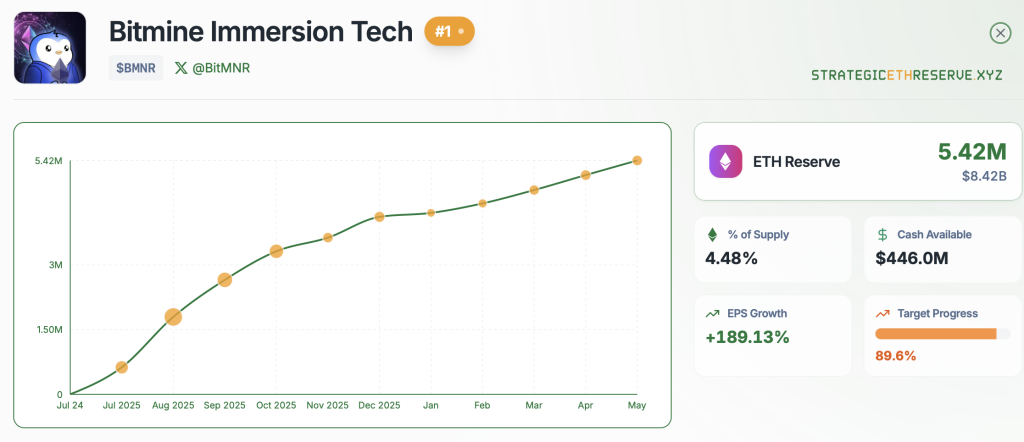
Bitmine’s current Ethereum holdings are already substantial. Company disclosures indicate that roughly 87% of its ETH reserves are actively staked, generating an estimated $258 million in annualized staking revenue. As the company expands its validator network, management believes that figure could eventually exceed $290 million per year.
Those numbers stand in sharp contrast to the expected dividend burden from the new preferred stock. Annual payments are projected to total around $28.5 million, a fraction of the staking income Bitmine expects to generate. The company reported owning approximately 5.4 million ETH as of late May 2026, representing about 4.5% of Ethereum’s total circulating supply. Depending on market prices, that position is currently valued between $10 billion and $11.6 billion, making Bitmine one of the largest corporate ETH holders in the world.
Paper Losses Haven’t Changed the Long-Term Thesis
Even with its enormous Ether reserves, Bitmine has not escaped the recent market downturn. Ethereum’s sharp decline from nearly $5,000 to below $1,800 in early June has left the company facing significant unrealized losses on paper. Those losses have drawn attention, particularly given the size of Bitmine’s exposure to the asset.
Still, Chairman Tom Lee remains firmly committed to the long-term Ethereum narrative. While acknowledging the impact of recent price declines, Lee has continued to emphasize Ethereum’s underlying fundamentals, staking economy, and growing role within the broader digital asset ecosystem. For Bitmine, the bet is straightforward: if Ethereum’s network continues to expand and staking remains a reliable source of yield, the company believes its treasury strategy could prove more resilient than similar models built around non-yielding assets.