
- Cardano founder Charles Hoskinson says Bitcoin’s governance model could make it difficult to respond to future quantum computing threats.
- Hoskinson argues Cardano’s onchain governance allows the network to adapt more quickly to major technological challenges.
- His comments come as the crypto industry increasingly debates how blockchains should prepare for advances in quantum computing.
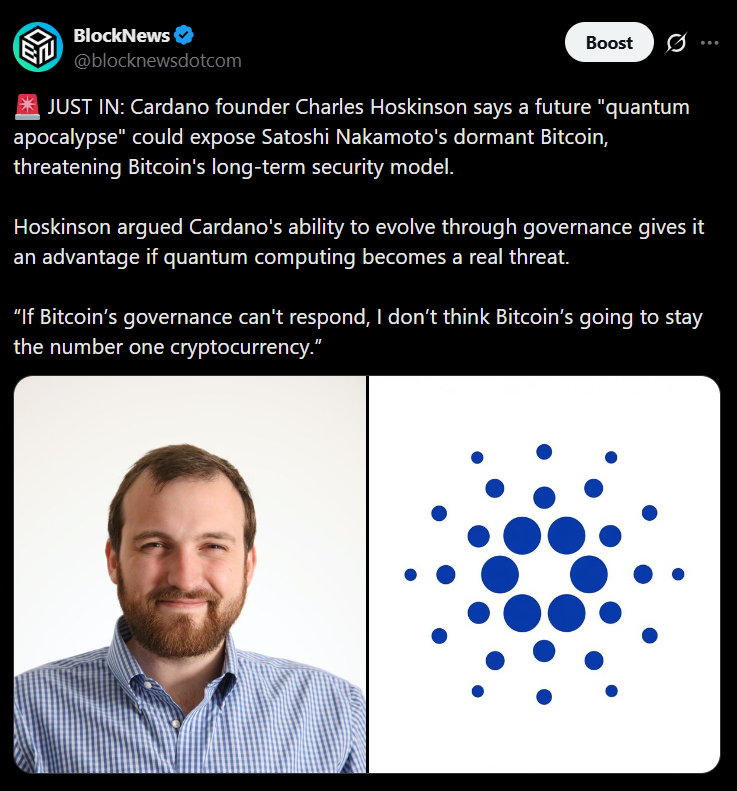
Cardano founder Charles Hoskinson believes the rise of quantum computing could become one of Bitcoin’s biggest long-term challenges, arguing that the network’s governance model may struggle to deliver the upgrades needed to remain secure.
Speaking during an interview on The Starting Block, Hoskinson said Bitcoin’s conservative approach to protocol changes has helped preserve its stability over the years, but that same rigidity could become a weakness if quantum computing reaches a point where existing cryptographic protections need to be replaced.
While quantum computing remains an emerging technology, researchers across the industry continue exploring its potential impact on modern encryption systems.
Hoskinson Questions Bitcoin’s Ability to Adapt
Hoskinson, who began his crypto journey through Bitcoin before co-founding Ethereum and later launching Cardano, said Bitcoin has become increasingly difficult to modify as the network has matured.
He argued that coordinating major protocol upgrades across Bitcoin’s decentralized ecosystem is significantly more challenging than on networks with formal governance mechanisms.
According to Hoskinson, if Bitcoin cannot efficiently respond to future technical threats without compromising its core principles, it could eventually lose its position as the world’s leading cryptocurrency.
Cardano Positions Itself for Future Upgrades
Hoskinson contrasted Bitcoin’s governance model with Cardano’s onchain voting system, which he says allows token holders to collectively approve major protocol changes.
He suggested that if quantum-resistant infrastructure becomes necessary, Cardano could vote on a migration path and implement network-wide changes through its governance framework.

Hoskinson also described Cardano as carrying forward many of Bitcoin‘s original ideals while attempting to solve technical and governance challenges that he believes remained unfinished.
Quantum Computing Remains a Long-Term Debate
Although practical quantum computers capable of breaking Bitcoin’s cryptography do not currently exist, the topic has become an increasingly important discussion throughout the blockchain industry.
Developers across multiple blockchain ecosystems are already researching quantum-resistant cryptographic standards to prepare for future advances in computing technology.
Exactly when—or if—large-scale quantum computers capable of threatening today’s encryption methods will arrive remains uncertain, but many researchers believe planning well in advance is essential.
Major Cardano Upgrade Also on the Horizon
Beyond discussing quantum security, Hoskinson revealed that Cardano is preparing what he described as one of the network’s largest upgrades to date.
According to him, the update is expected to deliver performance improvements of roughly 60 times compared with the current network, though he did not provide a timeline during the interview.
As blockchain ecosystems continue balancing decentralization, security, and adaptability, the debate over governance models is likely to become increasingly important as new technologies reshape the industry’s future.