

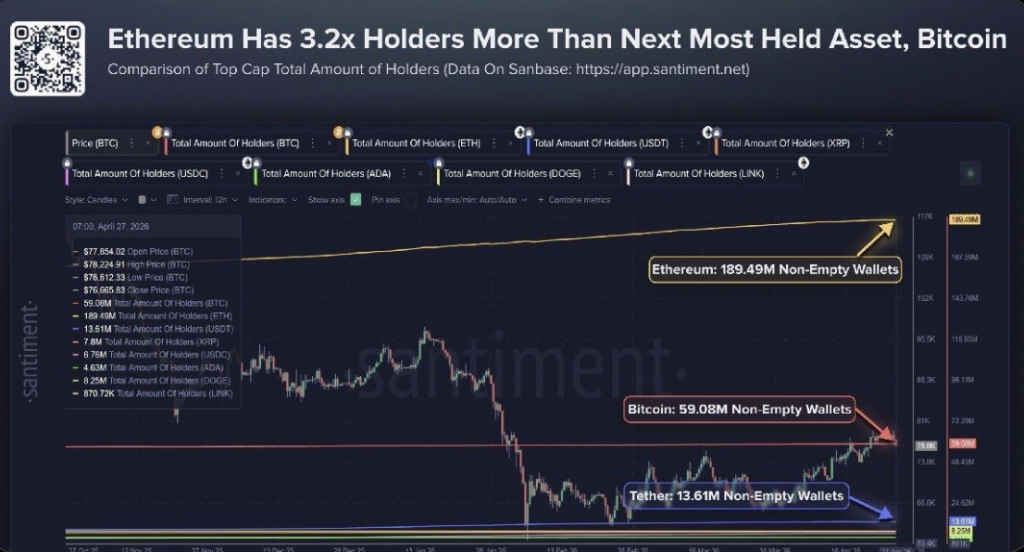
- Ethereum leads all blockchains with 189.49 million non-empty wallets, more than triple Bitcoin’s total.
- ETH has fallen over 30% in the past month, putting pressure on corporate treasury holders such as FG Nexus.
- Ethereum ETFs ended a 17-day outflow streak with $19.3 million in inflows, hinting at possible stabilization.
Ethereum continues to cement its position as the most widely held blockchain asset in the crypto market, leaving Bitcoin far behind in terms of wallet adoption. According to data shared by Lisk Head of Research Leon Waidmann, Ethereum now boasts roughly 189.49 million non-empty wallets, more than three times Bitcoin’s 59.08 million holders. The figures highlight Ethereum’s enormous user base, even as the network’s native asset faces one of its toughest stretches in recent months.
Behind Ethereum and Bitcoin, the rankings drop off considerably. Tether holds third place with 13.61 million wallets, followed by XRP with 7.8 million and USDC with 6.76 million. The gap is striking. While Bitcoin remains the dominant store-of-value asset in crypto, Ethereum’s reach across decentralized finance, token issuance, stablecoins, and smart contracts has helped it attract a much broader user community over the years.
Adoption Remains Strong Despite ETH Price Weakness
What’s particularly interesting is that Ethereum’s network growth has remained resilient even while its market performance has deteriorated. Over the past month, ETH has lost more than 30% of its value, sliding into a prolonged bearish trend. At the time of writing, the asset was trading around $1,620, far below the highs investors had hoped to see earlier in the year.
That decline has created headaches for companies that aggressively accumulated Ethereum as a treasury asset. Nasdaq-listed FG Nexus is among the most notable examples. The firm reportedly suffered losses exceeding $85 million on its Ethereum treasury strategy after selling a significant portion of its holdings below its average purchase price.
FG Nexus had previously positioned ETH as its primary reserve asset and began building its stake around Ethereum’s tenth anniversary. Management had outlined ambitions of becoming one of the largest corporate Ethereum holders. Unfortunately, worsening market conditions appear to have forced a rethink, leading the company to reduce its exposure as prices continued falling.
Analysts See Signs of Extreme Oversold Conditions
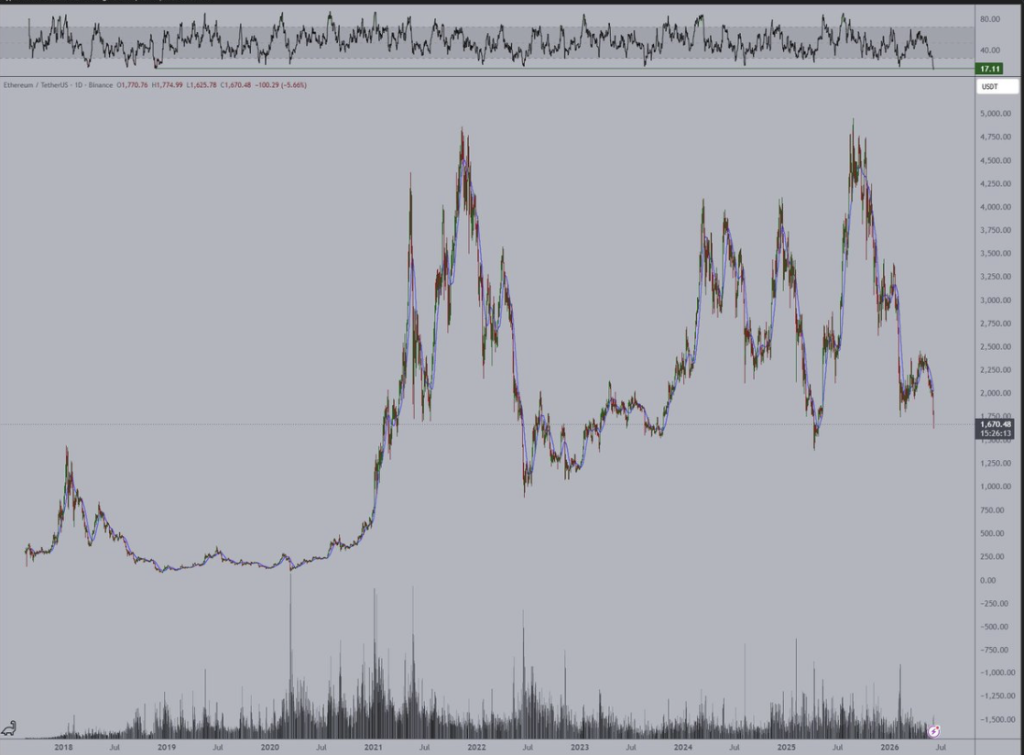
Despite the negative price action, some market observers believe the sell-off may be approaching exhaustion. Crypto analyst Michaël van de Poppe recently pointed out that Ethereum’s daily Relative Strength Index (RSI) has fallen to the lowest level ever recorded. Such readings are rare and often signal that selling pressure has become unusually intense.
Historically, extremely oversold RSI conditions have sometimes preceded major trend reversals. While no indicator guarantees a recovery, van de Poppe argues that the current setup could suggest the broader crypto market is nearing the final stages of its bear cycle. If that assessment proves correct, Ethereum may be closer to a rebound than current sentiment would suggest, though investors remain cautious after weeks of relentless downside.
Ethereum ETFs Show Early Signs of Stabilization
The pressure hasn’t been limited to spot markets. U.S. spot Ethereum ETFs have also experienced sustained outflows as investors reduced exposure to risk assets. However, there may be a small glimmer of optimism emerging from the latest fund flow data.
After enduring 17 consecutive trading days of net outflows, Ethereum ETFs finally returned to positive territory on June 4, recording net inflows of $19.3 million. Interestingly, the entire inflow came from BlackRock’s ETHA fund, while the other nine Ethereum ETFs reported no meaningful activity during the session.
Even so, the broader picture remains mixed. Ethereum ETFs still recorded approximately $168 million in net outflows for the week. According to data from SoSoValue, recent activity could indicate that selling pressure is beginning to ease. Whether that develops into a sustained recovery will largely depend on continued inflows across Ethereum products and the wider crypto market in the weeks ahead.
A Network Growing Faster Than Its Price
Ethereum’s current situation presents an unusual contrast. On one hand, the network continues attracting users at a pace unmatched by any other blockchain, with nearly 190 million non-empty wallets underscoring its role as crypto’s leading smart contract ecosystem. On the other hand, price performance remains weak, corporate treasury bets are under pressure, and ETF demand is still searching for a stable footing.
For now, adoption and market sentiment appear to be moving in opposite directions. But if history has shown anything, it’s that strong network growth often becomes difficult for markets to ignore forever.