

- A U.S. government wallet transferred nearly 98,600 LINK to Coinbase Prime, raising concerns about potential selling activity.
- Binance traders remain strongly bullish, with more than 72% of top accounts holding long positions.
- Rising RSI readings and heavy short liquidations suggest downside momentum may be fading as LINK attempts a recovery.
Chainlink found itself back in the spotlight after a government-linked wallet transferred 98,590 LINK, worth roughly $768,000, to Coinbase Prime. The transaction originated from wallets associated with seized FTX Alameda assets and immediately sparked speculation across the crypto market.
Whenever government-controlled wallets move assets, traders tend to pay attention. Coinbase Prime is commonly used by institutional investors, and transfers to the platform often fuel concerns that tokens could eventually be sold into the market. While the amount involved represents only a tiny fraction of Chainlink’s circulating supply, history shows that government-related transactions can still influence sentiment, sometimes more than fundamentals themselves.
Yet surprisingly, LINK bulls barely flinched.
Traders Continue Betting on Higher Prices
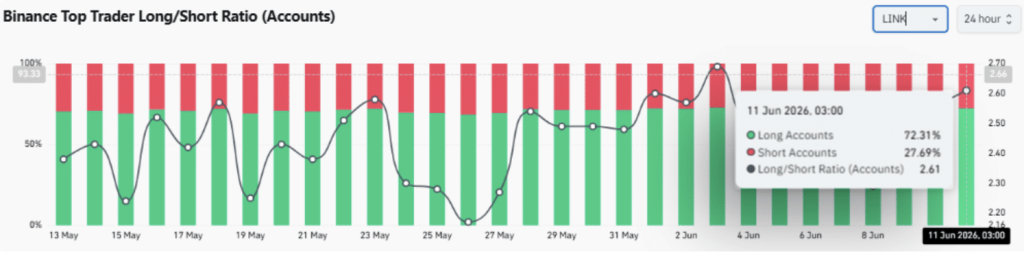
Despite the headlines, Binance traders have maintained a notably optimistic stance on Chainlink. Data from CoinGlass shows Binance’s Top Trader Long/Short Ratio climbed to 2.61, highlighting a strong preference for bullish positions.
More than 72% of top trader accounts remain long on LINK, while fewer than 28% are positioned for downside. That is a significant imbalance, especially considering the token has spent weeks under pressure.
Normally, prolonged weakness causes traders to become more defensive. Instead, many appear to be positioning for a rebound.
The persistence of bullish positioning suggests market participants still believe higher prices are achievable, even with uncertainty surrounding the government transfer. Of course, there is another side to that story. Crowded long trades can increase volatility if support levels break, creating the potential for sharp liquidations. For now, though, traders seem willing to absorb negative news rather than abandon their positions.
LINK Attempts to Recover Key Support
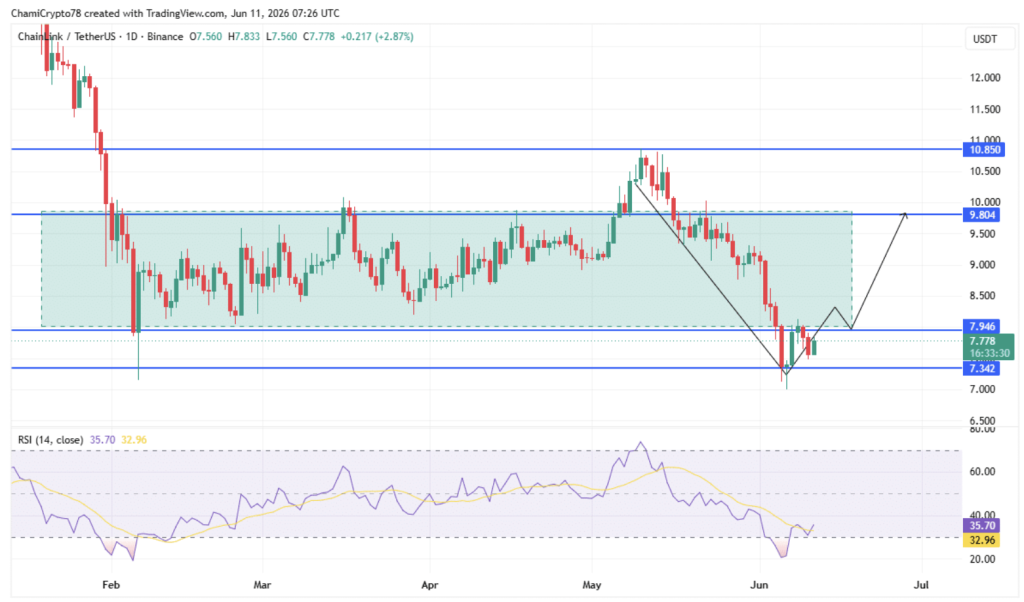
At the time of writing, Chainlink is trading around $7.78 after bouncing from recent lows near $7.34. That recovery may not look dramatic on the surface, but it carries some technical significance.
The $7.34 area attracted buyers who stepped in and halted the latest wave of selling pressure. Since then, LINK has been pushing back toward the $7.95 region, a level that previously served as the lower boundary of a broader multi-month consolidation range.
If buyers can reclaim and hold that zone, confidence may begin to improve.
Above current levels, resistance remains clustered around $9.80, with a larger barrier sitting near $10.85. Those levels continue to define the upside path if recovery momentum strengthens.
RSI Signals Selling Pressure Is Easing
Technical indicators also suggest the bears may be losing some control.
Chainlink’s Relative Strength Index recently recovered to 35.70 after dipping close to oversold territory. While the RSI remains below the neutral 50 level, the move higher indicates that selling momentum has weakened compared to previous weeks.
That doesn’t automatically signal a trend reversal. However, it does suggest sellers are no longer dominating the market with the same intensity.
If buyers continue defending the $7.34 to $7.95 support region, LINK could gradually build a stronger recovery structure. The process may take time, but the technical backdrop appears less aggressive than it did earlier in the month.
Short Sellers Feel the Pressure
One of the more interesting developments is happening in the derivatives market.
Recent liquidation data reveals a major imbalance between bearish and bullish traders. During the latest trading session, short liquidations reached approximately $57,270, while long liquidations totaled only around $5,040.
That’s a substantial difference.
The data suggests traders betting against LINK were caught off guard as the token rebounded from recent lows. In many cases, forced liquidations of short positions can add fuel to a recovery as traders rush to close positions.
Binance accounted for a large portion of that activity. The exchange recorded roughly $38,350 in short liquidations compared to only about $3,930 in long liquidations.
Those figures indicate bearish traders faced significantly more pressure than their bullish counterparts.
Can LINK Sustain the Recovery?
The market remains cautious, and uncertainty surrounding the government-linked transfer has not completely disappeared. Investors will likely continue monitoring whether additional assets tied to seized FTX holdings are moved in the coming weeks.
Still, the reaction from traders has been notable.
Rather than retreating, many have doubled down on bullish positioning. Technical indicators are showing signs of stabilization, support levels are holding for now, and short sellers are beginning to feel pressure as the recovery develops.
Chainlink is not out of danger yet. Resistance levels remain overhead, and broader market conditions continue to influence sentiment across crypto. But if buyers can maintain control around current support zones, the recent rebound may have more room to develop than many expected.