

- Bitcoin climbed above $63,800 as easing tensions between the U.S. and Iran boosted risk appetite across global markets.
- Spot Bitcoin ETFs continue to see heavy outflows, with more than $2 billion leaving the sector in June alone.
- Corporate buyers and on-chain data suggest long-term investors remain confident despite recent market weakness.
Bitcoin is trading near $63,883, up a modest 0.76% over the last 24 hours. On the surface, that doesn’t sound particularly exciting. But underneath the calm price action, several competing forces are shaping the market, and they paint a far more interesting picture than the daily candle suggests.
ETF investors continue pulling billions of dollars from Bitcoin products. At the same time, institutional buyers are quietly accumulating, geopolitical tensions have eased, and on-chain data shows holders remain remarkably resilient. Put it all together, and the BTC price story becomes much bigger than a small green number on a chart.
Bitcoin Gets A Boost From Improving Sentiment
A major factor behind Bitcoin’s recent recovery has been the cooling of tensions between the United States and Iran. As fears of a broader conflict eased, investors moved back into risk assets.
The S&P 500 gained roughly 1.75%, oil prices retreated, and Bitcoin jumped from around $61,100 to more than $63,400 in a relatively short period.
That renewed optimism wasn’t limited to traditional markets. Within crypto, investors appeared to rotate back into larger and more established assets. Bitcoin dominance climbed to 58.6%, while the Altcoin Season Index dropped by 8.16%, signaling that traders preferred BTC over smaller, riskier cryptocurrencies.
For now, the macro backdrop is helping Bitcoin breathe a little easier. Still, not everything is moving in its favor.
ETF Outflows Continue To Weigh On The Market
One of the biggest headwinds remains the spot Bitcoin ETF sector.
Since the start of June, roughly $2.1 billion has flowed out of Bitcoin ETFs. That follows another $2.4 billion in outflows during May. Combined ETF assets have fallen from approximately $109 billion to around $77 billion since mid-May, closely tracking Bitcoin’s slide from near $81,000 to below $60,000.
The selling doesn’t necessarily mean investors have suddenly turned bearish on Bitcoin.
Part of the movement appears tied to arbitrage funds unwinding positions, while some capital has shifted toward booming AI and technology stocks. Even so, when billions leave ETFs, the market still has to absorb that selling pressure somehow. That creates friction, even in an otherwise healthy environment.
Corporate Buyers Keep Accumulating
While ETF investors head for the exits, another group continues buying.
Bitcoin Corporation America, a subsidiary of Hut 8, recently added 623 BTC over a seven-day period, bringing its total holdings to 4,941 BTC. Of that amount, 542 BTC came from open-market purchases, while the remainder was generated through mining operations.
That kind of accumulation stands out because it suggests some institutions remain focused on the long-term picture rather than short-term volatility.
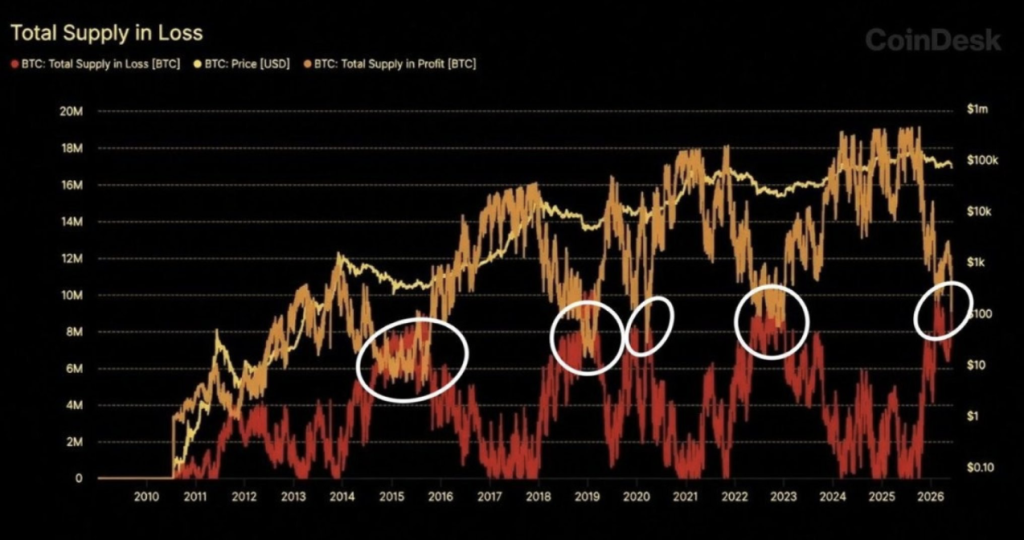
On-chain analytics firm Whale Factor highlighted another encouraging trend. Despite months of price weakness, the majority of Bitcoin holders remain in profit. Historically, major market bottoms have often formed after retail investors lose interest and prices drift sideways for extended periods.
The current setup shares some similarities with those earlier accumulation phases.
Technical Indicators Show Signs Of Stabilization
From a technical perspective, Bitcoin remains in a challenging position, though there are signs that selling pressure is fading.
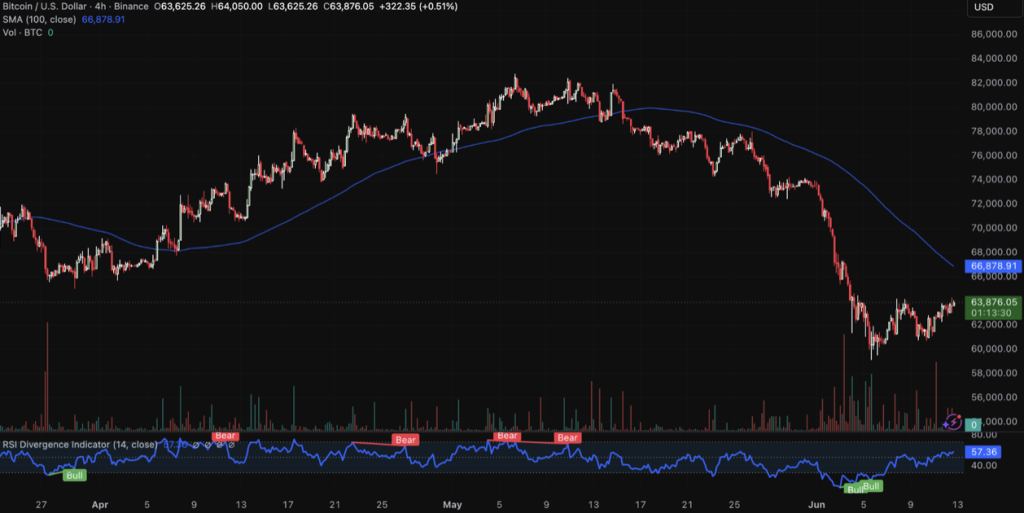
BTC currently trades around $63,876, which places it roughly 4.5% below its 100-day simple moving average near $66,879. That means the broader trend still leans bearish for now.
However, momentum indicators are beginning to tell a different story.
Several bullish divergences have appeared on the Relative Strength Index over the past month. The RSI currently sits around 57.36, suggesting bearish momentum has weakened even as Bitcoin struggles to break above key resistance zones.
It’s not a confirmed trend reversal just yet, but it does hint that sellers may be losing some control.
Developers Are Already Looking Toward The Future
Beyond short-term price action, Bitcoin developers continue preparing for long-term challenges.
One proposal discussed earlier this year focused on quantum-resistant transaction methods designed to protect the network from future advances in quantum computing. Preliminary estimates suggest such transactions could cost between $75 and $150 each, highlighting the complexity of the problem.
While practical quantum threats may still be years away, the discussion shows the ecosystem is actively evaluating solutions well before they become urgent.
That forward-thinking approach remains one of Bitcoin’s strengths.
Where Bitcoin Could Go Next
Bitcoin currently sits between two powerful forces.
On one side, ETF outflows continue creating selling pressure. On the other, institutional buyers keep accumulating, geopolitical risks have eased, and technical indicators suggest bearish momentum is weakening.
The key level remains $63,000.
As long as buyers continue defending that support zone, Bitcoin has a realistic chance of challenging the 100-day moving average near $66,879. A successful breakout there could open the door to a move back toward $70,000.
If support breaks, however, attention will quickly shift back toward $60,000. Upcoming Federal Reserve commentary and future ETF flow data will likely play a major role in determining which direction the market chooses next.
For now, Bitcoin may not be exploding higher, but it also isn’t behaving like a market that’s ready to give up. And sometimes, that quiet resilience tells the most important story of all.