
- Bitcoin has shed roughly $1.2 trillion in value since reaching its all-time high of $126,080 last year.
- Mark Cuban says Bitcoin failed to deliver as the hedge he expected, prompting him to reduce his holdings.
- Analysts point to capital rotating into AI investments, inflation concerns, and economic uncertainty as key drivers behind the decline.
Bitcoin‘s remarkable rally following Donald Trump’s return to the White House has largely unraveled, leaving investors questioning what went wrong. After reaching an all-time high of $126,080 in October last year, the world’s largest cryptocurrency has experienced a prolonged decline, briefly falling to the $60,000 level last week and remaining near yearly lows.
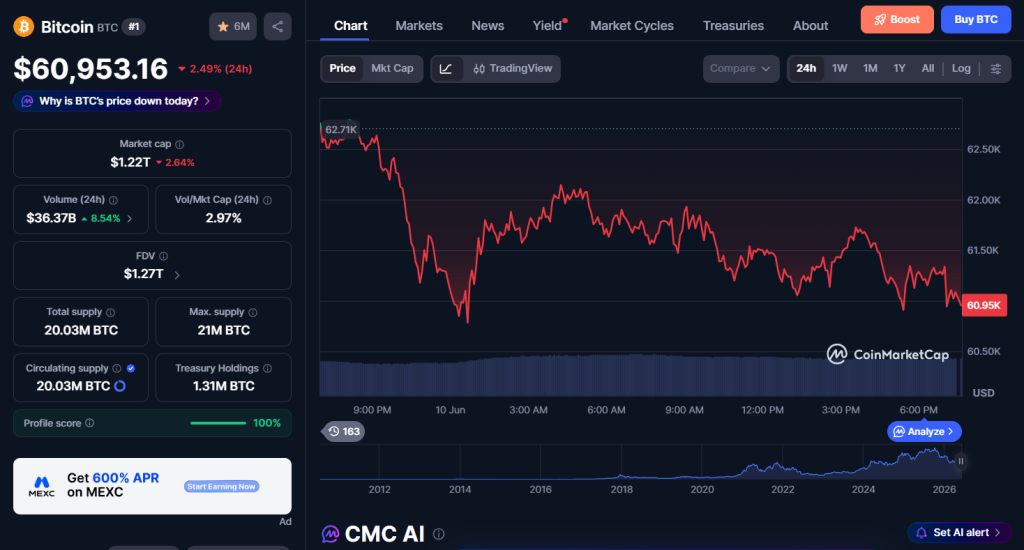
The pullback has erased a significant portion of the gains generated during the post-election enthusiasm that swept through digital asset markets. While many crypto supporters expected pro-crypto policies and a more favorable regulatory environment to fuel another major bull run, market reality has turned out very differently.
Bitcoin’s Hedge Narrative Is Under Pressure
One of the strongest criticisms of Bitcoin’s recent performance has come from billionaire entrepreneur Mark Cuban. Once a vocal supporter of cryptocurrency and digital assets, Cuban recently revealed that he had significantly reduced his Bitcoin holdings after becoming disappointed with the asset’s performance during periods of economic uncertainty.
According to Cuban, Bitcoin failed to behave like the hedge he originally expected it to be. For years, many advocates promoted Bitcoin as a form of digital gold that could protect investors during inflationary periods and market instability. However, recent market conditions have challenged that narrative.
“I think Bitcoin has lost the plot,” Cuban said, adding that the cryptocurrency had not delivered the protection he anticipated. His comments marked a notable shift from someone who was previously one of the industry’s most recognizable supporters.
Investors Are Chasing AI Instead
Another major factor behind Bitcoin’s struggles may be the rapid rise of artificial intelligence as the dominant investment theme. According to Jonathan Bier, CEO of Farside Investors, speculative capital that once flowed into cryptocurrencies is increasingly moving toward AI-related opportunities.
The AI boom has attracted enormous amounts of capital from both retail and institutional investors. As technology companies race to build new AI models, infrastructure, and applications, many investors appear to be reallocating funds away from digital assets and toward the sector generating the strongest growth narrative.

This shift highlights a reality often overlooked by market participants: risk capital tends to chase the most exciting opportunity available. Right now, for many investors, that opportunity appears to be AI rather than crypto.
Economic Uncertainty Is Adding Pressure
Beyond competition from AI, broader macroeconomic concerns continue weighing on Bitcoin and other cryptocurrencies. Inflation uncertainty, interest rate expectations, and mixed economic data have created a challenging environment for risk assets across the board.
Investors remain focused on the Federal Reserve’s next moves, while employment data and economic growth concerns have added another layer of uncertainty. In periods like this, traders often become more defensive, reducing exposure to volatile assets such as cryptocurrencies.
The result has been increased selling pressure across the digital asset market, even as policymakers maintain a relatively supportive stance toward the industry.
Bitcoin Faces a Critical Test
Despite the recent weakness, Bitcoin remains one of the most closely watched assets in global financial markets. The current downturn has sparked important questions about its long-term role as a store of value, inflation hedge, and portfolio diversifier.
For now, investors appear divided. Some view the correction as a temporary setback driven by liquidity shifts and economic uncertainty. Others believe Bitcoin must prove it can deliver on its original investment thesis before confidence fully returns.
Either way, the market’s attention is no longer focused solely on regulation or adoption. Increasingly, the question is whether Bitcoin can reclaim its narrative in a world where AI has become the dominant destination for speculative capital.