

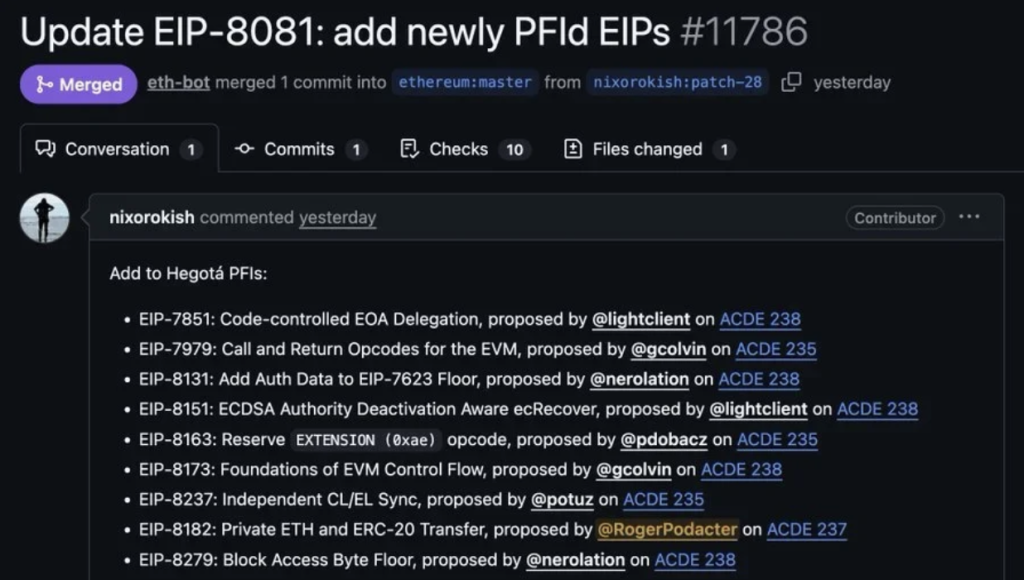
- Ethereum developers have formally proposed EIP-8182 for consideration in the upcoming Hegota hard fork.
- The proposal would introduce optional native privacy transfers directly at Ethereum’s Layer 1 protocol.
- Security, compliance, and community feedback will play key roles in determining whether the feature is ultimately approved.
Ethereum’s development roadmap continues to evolve, and one of the latest proposals is already generating discussion across the crypto community. Developers have formally submitted EIP-8182 for consideration in the upcoming Hegota hard fork, a move that could bring optional privacy transfers directly into Ethereum’s core protocol.
The proposal is still in the review stage, so nothing is guaranteed yet. However, its inclusion in the Proposal for Inclusion (PFI) process marks an important milestone. If eventually approved, EIP-8182 would give Ethereum users access to native privacy features at the protocol level rather than relying entirely on external privacy tools and applications.
For a network that has long balanced transparency with user freedom, the conversation around privacy is becoming increasingly difficult to ignore.
EIP-8182 Enters Formal Review
Ethereum developer Tom Lehman recently confirmed that EIP-8182 has officially entered the hard fork review process. The proposal is now being evaluated alongside several other upgrades being considered for Hegota, Ethereum’s next major network update.
This stage is critical because it allows core developers, researchers, and community members to examine the proposal from every angle. Technical feasibility, security implications, network performance, and potential risks all become part of the discussion before any final decision is made.
Inclusion in the PFI stage doesn’t mean approval is inevitable. Many proposals enter review and never make it into production. Still, reaching this point signals that developers view the concept as serious enough to warrant deeper evaluation.
Bringing Privacy Directly to Layer 1
The most notable aspect of EIP-8182 is its focus on native privacy transfers. Rather than building privacy through separate protocols or third-party services, the proposal would integrate optional privacy functionality directly into Ethereum’s Layer 1 infrastructure.
That distinction matters.
Today, users seeking greater transaction privacy often rely on external applications, privacy-focused protocols, or additional tools built on top of Ethereum. EIP-8182 aims to make privacy a built-in option available at the network level itself.
Importantly, the feature would remain optional. Standard Ethereum transactions would continue functioning exactly as they do today, while users requiring additional confidentiality could choose to use privacy transfers when appropriate.
Developers behind the proposal also aim to introduce these capabilities without adding extra protocol-level fees, making the feature more accessible to a broader range of users.
Privacy Continues to Be a Growing Topic
Privacy has become one of the most debated issues in the blockchain industry. Public blockchains offer transparency, which many consider a strength. Yet that same transparency can create challenges for users who prefer not to expose every financial transaction to the public.
As adoption grows, individuals, businesses, and institutions are increasingly asking whether blockchain networks can provide stronger privacy protections without sacrificing security or decentralization.
EIP-8182 reflects that broader discussion.
If implemented, Ethereum users would gain another tool for protecting sensitive transaction information while continuing to operate on a public blockchain. The proposal doesn’t seek to eliminate transparency altogether. Instead, it attempts to give users greater control over how much information is visible.
That balance between openness and privacy is likely to remain one of the central debates throughout the review process.
Security and Compliance Questions Remain
As with any privacy-related upgrade, EIP-8182 will face significant scrutiny. Developers, regulators, and ecosystem participants will inevitably examine how the feature interacts with existing infrastructure and whether it introduces new risks.
Security will be a major focus. Any protocol-level privacy feature must prove that it cannot be abused, exploited, or used to undermine network integrity. Compliance concerns are also expected to enter the conversation, particularly as regulators around the world continue increasing their attention on digital assets.
User adoption will matter as well. Even technically impressive features can struggle if they fail to deliver a smooth experience or solve a meaningful problem for everyday users.
For now, those questions remain unanswered. The review process exists precisely to address them before any implementation moves forward.
Hegota Continues Taking Shape
EIP-8182 is only one of several proposals currently competing for inclusion in the Hegota hard fork. Ethereum developers continue reviewing a range of upgrades designed to improve functionality, efficiency, scalability, and user experience across the network.
Historically, Ethereum upgrades have involved extensive testing, community discussion, and developer consensus before activation. That process can take months and occasionally longer, particularly for proposals that touch sensitive areas such as privacy.
As Hegota moves closer to completion, developers will ultimately decide which upgrades offer the greatest benefit to Ethereum’s long-term future. EIP-8182 has now entered that conversation, and its progress will be closely watched by both privacy advocates and the broader Ethereum community.