

- Ethereum funding rates turned positive again as leveraged bullish positioning increased.
- Spot demand recovery remains weaker than derivatives market optimism.
- ETF outflows and tighter macro liquidity continue pressuring Ethereum’s broader recovery.
Ethereum sentiment has slowly started improving again after the recovery attempt that followed April’s broader market rebound. Traders became more optimistic as ETH stabilized above local lows, though underneath the surface, derivatives positioning started growing far more aggressive than actual spot demand recovery. That disconnect is now getting attention because leveraged bullish exposure keeps rising while Ethereum still struggles to reclaim stronger momentum across spot markets.
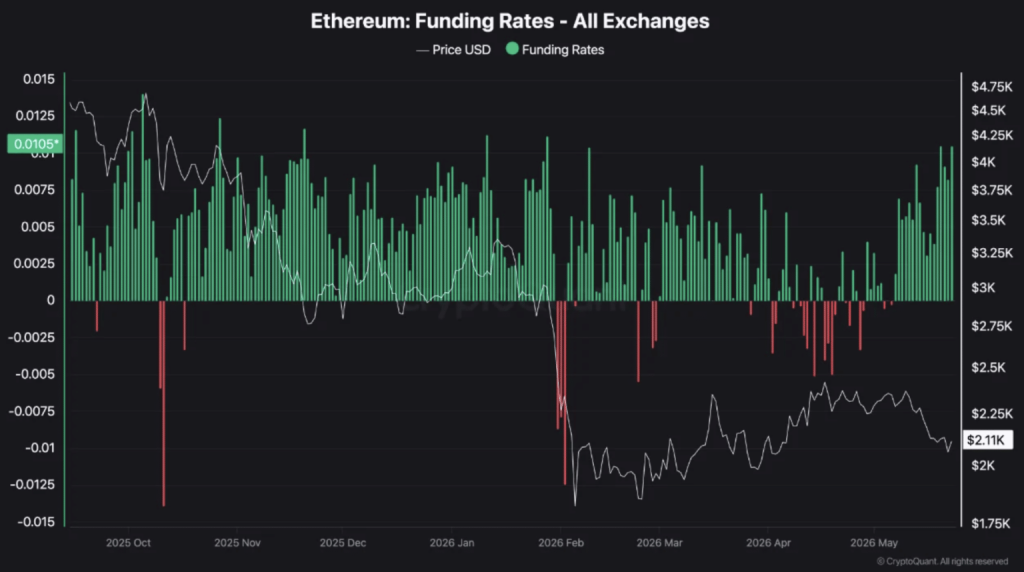
Funding rates eventually flipped positive again, climbing toward roughly 0.0105% while ETH traded closer to the broader $2,114 region. That’s a noticeable shift compared to conditions seen back on April 17, when Ethereum traded near $2,420 while funding rates remained negative around -0.0040%.
The change suggests traders are increasingly willing to open long positions despite weaker overall price continuation. In simple terms, bullish confidence is rebuilding faster than actual market strength. That doesn’t always end well, especially in volatile crypto markets where leverage can amplify both rallies and liquidations pretty quickly.
Ethereum’s Current Setup Resembles Earlier Reversal Periods
What’s making some analysts cautious is that similar conditions appeared before previous market pullbacks too. Comparable funding behavior developed near Ethereum’s October 2025 highs around $4,120 and again near the January 2026 region close to $3,000. In both cases, leveraged bullish positioning expanded aggressively before sharper declines eventually followed.
That pattern doesn’t automatically guarantee another correction is coming now, obviously. Markets never repeat perfectly. Still, it does highlight how leveraged traders continue rebuilding exposure much faster than genuine spot demand seems to be recovering.
Without stronger spot buying absorption underneath, growing long exposure could end up increasing Ethereum’s volatility instead of supporting a sustainable breakout higher. Right now, the market feels a little fragile. Optimism exists, but conviction still seems heavily tied to leverage rather than broad spot accumulation.
Spot Market Recovery Still Looks Incomplete
Positive funding rates initially reflected stronger bullish sentiment before Ethereum’s spot market started attracting more aggressive buyers again. However, the recovery struggled once ETH approached larger resistance zones across exchanges.
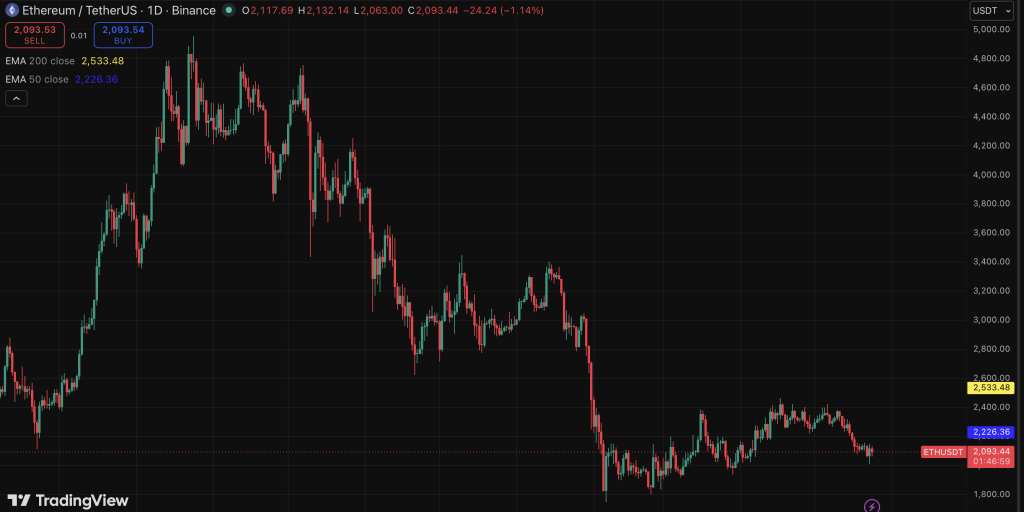
Spot CVD gradually improved across Binance and Coinbase, which suggests buying activity has been returning steadily. But despite that improvement, Ethereum remained trapped beneath the broader $2,150 to $2,200 resistance region. That reaction indicates larger passive sellers are still absorbing incoming buy pressure without giving up control of overhead liquidity.
In other words, buyers are stepping in, but sellers continue meeting demand almost every time ETH pushes higher. That’s part of the reason momentum has remained sluggish even as derivatives activity grows increasingly aggressive.
Open Interest also stayed elevated throughout the recovery phase, while long positioning kept expanding across perpetual futures markets. At the same time, realized volatility continued compressing, which often signals pressure building beneath tighter trading conditions.
Usually, when volatility compresses while leverage expands, markets eventually produce a larger directional move. The only real question is whether that expansion breaks upward or downward once liquidity conditions shift.
Macro Pressure and ETF Outflows Add More Uncertainty
Ethereum’s recovery has also been dealing with broader macroeconomic pressure in the background. Rising Treasury yields and persistent dollar strength pushed many market participants toward a more defensive posture across risk assets generally.
As yields climbed near the 4.56% region, tighter liquidity conditions started weighing on crypto sentiment again. Ethereum felt that pressure fairly heavily, especially as institutional demand softened across ETF markets.
Spot Ethereum ETFs eventually recorded around $215 million in weekly outflows, while daily selling repeatedly exceeded $28 million during several sessions. Those outflows weakened institutional absorption just as ETH remained sensitive to tighter liquidity and weaker overall market appetite.
Exchange flow data reflected softer conviction too. Cold-storage outflows slowed noticeably, while occasional inflows appeared during recovery attempts. That doesn’t necessarily signal panic selling, but it does suggest investors are becoming more cautious while waiting for stronger confirmation from the market.
Still, there are some signs buyers haven’t fully disappeared. Spot taker activity improved gradually during recent sessions, showing traders continue stepping in despite rising macro pressure and weaker momentum continuation.
Ethereum Faces a Delicate Balancing Point
At the moment, Ethereum sits in a pretty delicate position. Sentiment has improved compared to earlier weakness, and leveraged traders clearly expect further upside. But spot demand still hasn’t fully matched that optimism, leaving ETH vulnerable if momentum fades again.
If passive selling weakens and spot demand strengthens near resistance, Ethereum could quickly accelerate higher as compressed positioning finally breaks upward. But if leverage keeps expanding without enough real buying underneath, volatility risks probably rise sharply.
That’s the challenge facing ETH right now. The market still shows signs of recovery, but the foundation supporting the move looks less stable than many bulls probably want to admit.