

- The Ethereum Foundation has now seen eight major departures since February, including five in May alone.
- Community concerns are growing around delayed upgrades, leadership restructuring, and Ethereum’s long-term direction.
- ETH remains under technical pressure with ETF outflows rising and support near $2,000 becoming increasingly important.
Ethereum is heading into a pretty uncomfortable stretch right now, and the pressure surrounding the Ethereum Foundation seems to be growing almost by the week. Over the past few days alone, researchers Carl Beek and Julian Ma announced they were leaving the Ethereum Foundation, adding even more names to an already expanding list of high-profile departures.
Since February, at least eight major contributors or leaders have exited the organization, including Tim Beiko, Josh Stark, Trent Van Epps, Alex Stokes, Barnabé Monnot, and former co-executive director Tomasz Stanczak. What’s catching the community’s attention most, though, is the timing. Five of those departures happened during May alone.
Individually, most of the exit messages appeared respectful and professional. Nobody’s openly declaring chaos inside the Foundation. But collectively, the growing list has sparked obvious concerns across the Ethereum ecosystem, especially as the network approaches critical development phases and delayed upgrades.
Community Worries Grow Around Ethereum’s Direction
A lot of the anxiety centers around Glamsterdam, Ethereum’s upcoming upgrade that has already been pushed back into Q3 2026. Losing experienced protocol researchers and core contributors while major roadmap decisions remain unfinished naturally makes people nervous.
Some community members now believe the departures may reflect deeper internal disagreements tied to the Ethereum Foundation’s recent restructuring efforts. Others think the issue is more philosophical — a growing divide around Ethereum’s long-term direction, priorities, and messaging.
The debate intensified after Bankless co-founder David Hoffman revealed he had sold his entire ETH position despite previously saying that 99% of his net worth was held in Ethereum. That announcement hit the community harder than many expected because Hoffman had long been viewed as one of Ethereum’s most committed public advocates.
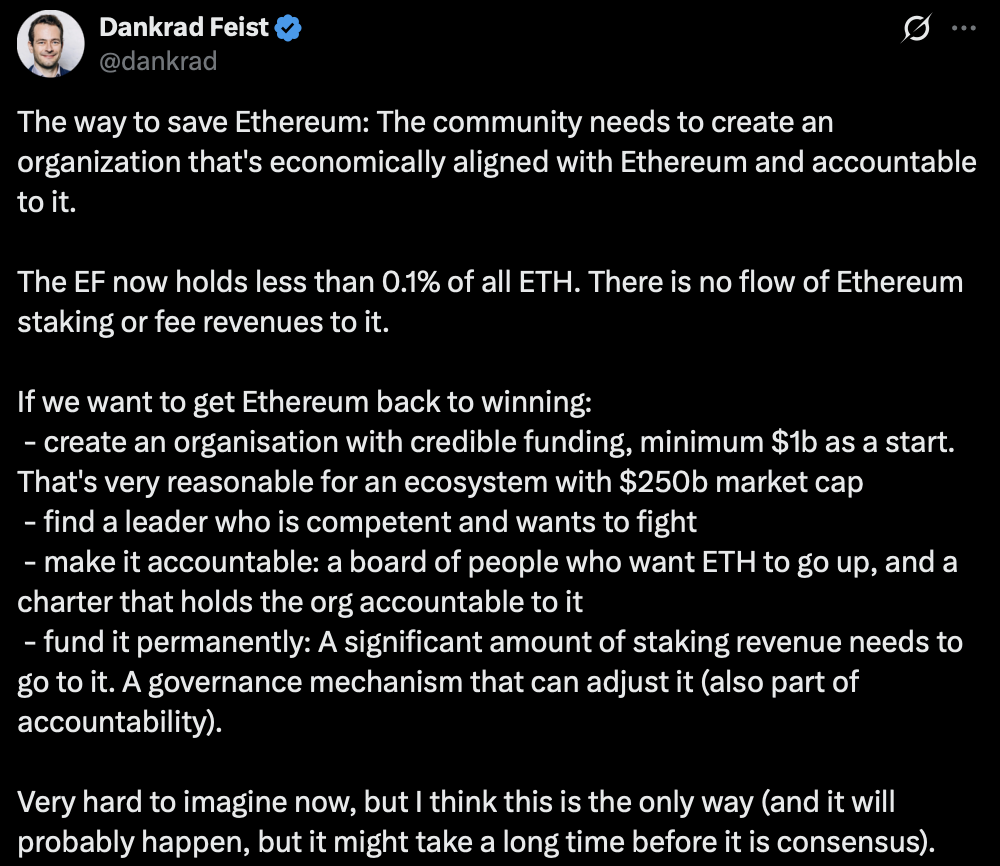
Meanwhile, former Ethereum Foundation researcher Dankrad Feist proposed creating a completely new organization funded with at least $1 billion worth of ETH. According to Feist, the goal would be building an entity economically aligned with Ethereum through large-scale staking while potentially operating with clearer incentives and structure.
That idea alone shows how seriously parts of the ecosystem are beginning to question Ethereum’s current organizational model.
Galaxy Digital Calls for a Clearer ETH Narrative
Institutional voices are also weighing in now. Galaxy Digital recently outlined several recommendations for how the Ethereum Foundation could stabilize confidence and sharpen Ethereum’s positioning moving forward.
Lucas Tcheyan, Galaxy Digital’s VP of Research, argued Ethereum needs to stop trying to sell itself as everything simultaneously. According to him, the current messaging has become too fragmented and confusing for the market to fully price properly.
Right now, ETH gets described as “ultrasound money,” a Layer 2 settlement asset, institutional reserve collateral, AI-agent infrastructure, privacy infrastructure, a tech investment proxy, and a generic world computer all at once. Tcheyan warned that trying to push every narrative simultaneously may eventually dilute them all.
Instead, Galaxy believes Ethereum should focus more aggressively on areas where it already holds strong advantages — things like high-value DeFi activity, tokenized real-world assets, stablecoin settlement infrastructure, and privacy-focused financial systems. In other words, narrow the focus and dominate the verticals where Ethereum still has the strongest moat.
Honestly, that criticism reflects a growing sentiment in crypto right now. A lot of investors still believe in Ethereum long term, but they increasingly want a clearer explanation for why ETH itself captures value inside the ecosystem.
ETH Price Action Continues Looking Weak
At the same time all this governance and leadership uncertainty is unfolding, Ethereum’s market performance has also deteriorated noticeably. ETH has suffered major distributions over the past several weeks following stronger-than-expected inflation data and rising Treasury yields, both of which have pressured risk assets broadly.
BitMine Chairman Thomas Lee recently linked Ethereum’s weakness partly to rising oil prices feeding inflation concerns, which in turn impacts Federal Reserve expectations around interest rates. That macro pressure has spilled directly into crypto markets, and Ethereum has been one of the weaker major assets recently.
US spot Ethereum ETFs have now recorded nine consecutive days of net outflows while ETH itself has dropped roughly 12% over the past three weeks. That combination isn’t exactly helping confidence.
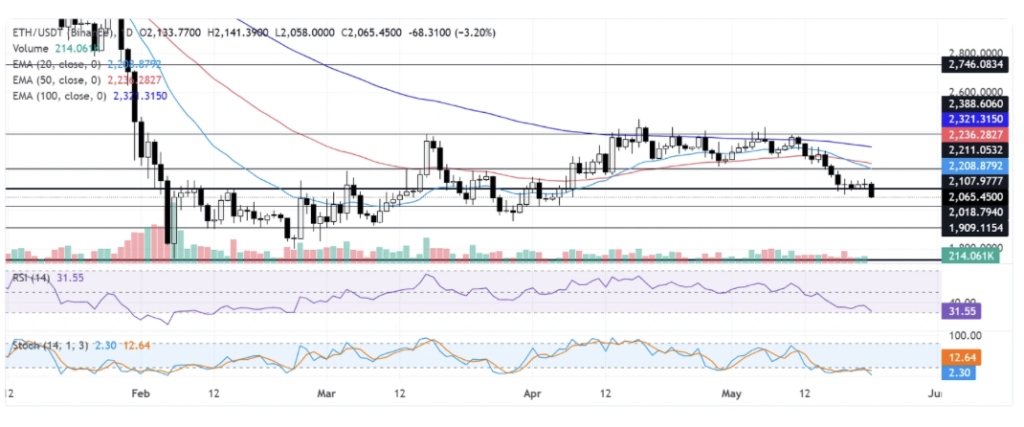
Technically, the chart still looks heavy. ETH remains below its 20-day, 50-day, and 100-day Exponential Moving Averages, currently sitting around $2,208, $2,236, and $2,321 respectively. That stacked resistance structure usually suggests rallies may continue facing strong selling pressure overhead.
Momentum indicators also remain weak. The RSI sits near 31, approaching oversold territory, while the Stochastic Oscillator stays deeply depressed. That could mean downside momentum is becoming stretched, but for now, sellers still appear to control the trend.
Key Ethereum Levels Traders Are Watching
On the upside, Ethereum faces immediate resistance near the $2,107 region, followed by a heavier supply zone between roughly $2,211 and $2,321 where multiple moving averages now cluster together. Beyond that, the next larger resistance level sits near $2,388.
On the downside, traders are closely watching support around $2,018 first. If that level breaks, attention likely shifts toward the more important $1,909 floor. And if bearish momentum accelerates further, deeper downside zones near $1,741, $1,524, and even $1,404 could eventually come into focus.
Right now, Ethereum feels stuck in a difficult middle ground — facing leadership uncertainty, shifting narratives, institutional outflows, and weakening technical momentum all at the same time. The ecosystem still remains enormous and deeply influential across crypto, obviously. But the next few months may end up being some of the most important for Ethereum’s identity in years.