

- A heat-related AWS outage in Virginia disrupted Coinbase trading for nearly six hours
- Coinbase confirmed customer funds remained safe during the service interruption
- The outage arrived alongside weak earnings, layoffs, and growing infrastructure concerns
Coinbase users were suddenly locked out of trading for nearly six hours this week after a major AWS infrastructure failure hit Northern Virginia, exposing just how dependent even the largest crypto exchanges still are on centralized cloud providers. The disruption began on May 7 after unusually high temperatures reportedly triggered power interruptions and hardware failures inside AWS availability zone use1-az4, one of the company’s oldest and most critical data center hubs.
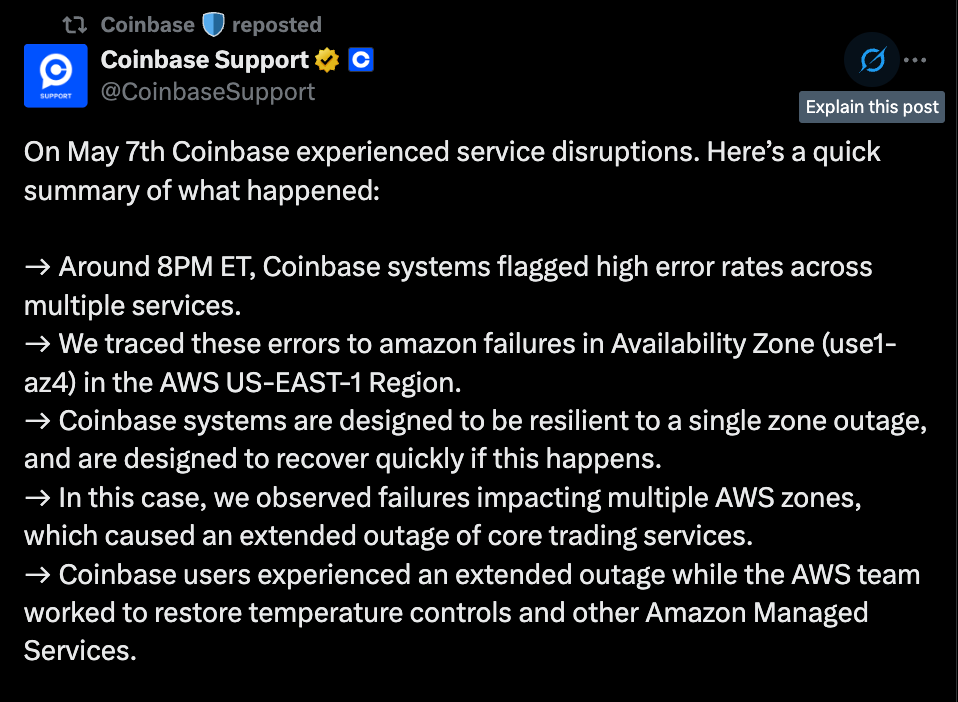
What started as a localized infrastructure problem quickly cascaded into broader service failures that eventually impacted Coinbase operations worldwide. For a market built around decentralization narratives, the irony was… pretty hard to miss.
Coinbase Entered “Cancel Only” Mode
As the outage spread across multiple AWS zones, Coinbase shifted its platform into “Cancel Only” mode while engineers worked to stabilize systems. Users could cancel open orders, but normal trading functionality remained heavily restricted for hours as error messages and failed transactions piled up across the exchange.
Coinbase later confirmed the outage affected trading access and transaction processing rather than asset custody itself. The company repeatedly emphasized that customer funds stayed secure throughout the disruption, even though many traders spent hours staring at frozen screens wondering what exactly was happening.
Services were eventually restored around 1 AM PDT after AWS engineers stabilized the affected infrastructure. Still, for users caught during volatile market conditions, six hours can feel like an eternity in crypto.
The Timing Couldn’t Have Been Worse
What made the entire situation even more painful for Coinbase was the timing. The outage landed the same day the company released weaker-than-expected Q1 2026 earnings, reporting a loss of $1.49 per share compared to analyst expectations for a $0.27 profit.
Revenue also missed forecasts, coming in around $1.41 billion versus expectations closer to $1.52 billion. Just two days earlier, Coinbase had already announced layoffs impacting roughly 14% of its workforce, adding another layer of uncertainty around the company’s near-term outlook.
From the outside, it almost felt like one bad headline immediately stacked onto another without pause. Crypto markets have a weird sense of timing sometimes.

Coinbase Still Shows Signs Of Strength
Despite the rough quarter and outage chaos, Coinbase still posted some notable positives underneath the surface. The exchange reportedly reached an all-time high crypto trading market share of 8.6% during Q1, while retail derivatives revenue surpassed a $200 million annualized pace.
That suggests user engagement and trading activity remain relatively strong despite broader market volatility and operational setbacks. The fundamentals underneath the business may still be healthier than the headline numbers initially suggest.
But incidents like this outage raise a bigger issue the crypto industry keeps circling around without fully addressing.
Crypto Still Depends On Centralized Infrastructure
For years, crypto companies promoted decentralization as an alternative to traditional financial fragility. Yet many of the industry’s largest exchanges and platforms continue relying heavily on centralized infrastructure providers like AWS, Google Cloud, and Microsoft Azure.
That creates an uncomfortable reality where a physical overheating issue inside one Virginia data center can temporarily disrupt trading activity for millions of users globally. It’s not exactly the censorship-resistant vision many early crypto advocates imagined.
And honestly, as institutional adoption grows, these infrastructure questions probably become even more important. Because if crypto wants to function like global financial infrastructure, it may eventually need infrastructure that’s far less dependent on a single overheated building somewhere in Northern Virginia.