
- Circle moved a record-breaking $4 billion worth of USDC to Coinbase through HyperEVM, marking the largest USDC transfer ever recorded.
- The transaction represented roughly 5.3% of USDC’s entire circulating supply and served as a major test for Hyperliquid’s infrastructure.
- The move suggests institutional stablecoin activity is expanding beyond Ethereum into newer blockchain ecosystems.
Circle just executed the largest USDC transfer in history, and the implications go far beyond a single transaction. On June 12, the stablecoin issuer routed approximately $4 billion worth of USDC to Coinbase-linked addresses using HyperEVM, Hyperliquid’s smart contract environment.
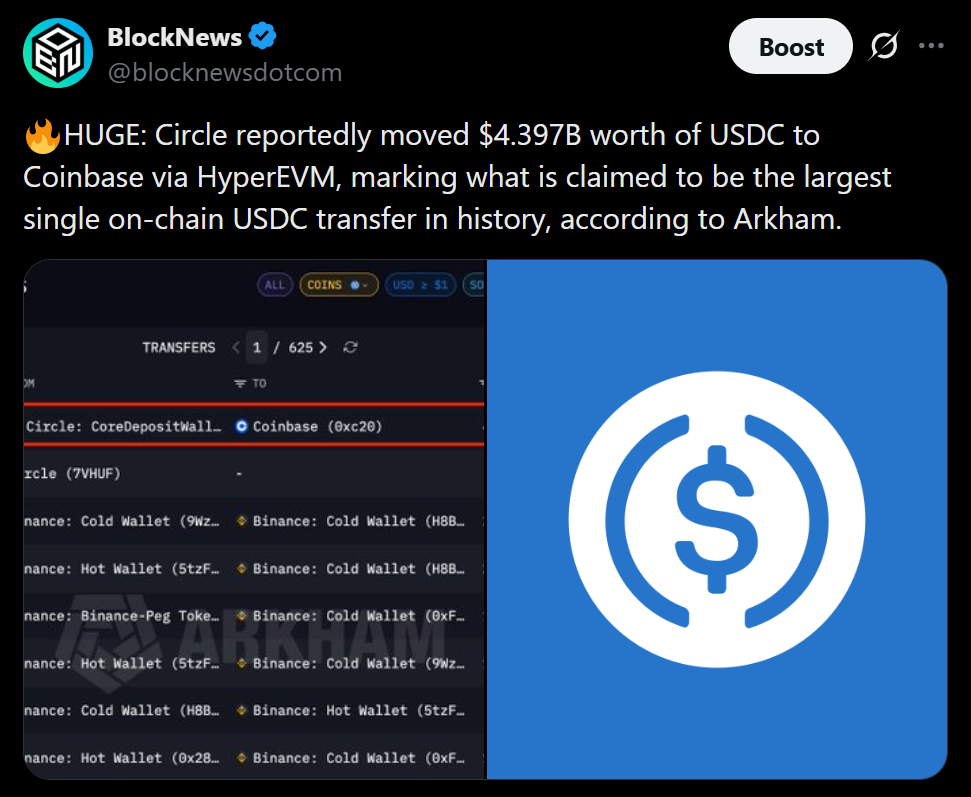
The sheer size of the transfer immediately caught the market’s attention. At roughly 5.3% of USDC’s $76 billion circulating supply, the movement represented one of the largest stablecoin transactions ever recorded on-chain. More importantly, it highlighted a growing trend that could reshape blockchain infrastructure: major institutions are increasingly willing to move enormous amounts of capital outside Ethereum’s ecosystem.
A Historic Stablecoin Transaction
The transfer established a new benchmark for USDC activity.
While billion-dollar stablecoin transactions have become more common in recent years, a single $4 billion movement stands in a category of its own. The transaction was completed through HyperEVM, a relatively new environment built on Hyperliquid’s Layer-1 blockchain.
For many market observers, the significance wasn’t simply the amount transferred. It was where the transfer occurred.
Institutional-grade stablecoin activity has historically been concentrated on Ethereum and a handful of established networks. Seeing this level of capital move through Hyperliquid signals growing confidence in alternative blockchain infrastructure.
Circle and Coinbase Continue Expanding USDC
The transaction also highlights the increasingly strategic relationship between Circle and Coinbase.
The two companies helped establish USDC through the CENTRE Consortium and continue sharing economic benefits tied to the stablecoin’s reserve structure. Circle manages issuance and deployment, while Coinbase plays a significant role in treasury operations and distribution.
As USDC expands across more blockchain networks, both companies benefit from increased adoption and transaction activity. Every new ecosystem that supports institutional-grade USDC operations strengthens the stablecoin’s position within the broader financial system.

The recent appointment of Circle as Hyperliquid’s official USDC deployer further formalized that relationship.
A Sign of Where Stablecoins Are Heading
The broader takeaway may be even more important than the record itself.
For years, Ethereum dominated discussions around stablecoin infrastructure. While Ethereum remains the largest platform for tokenized dollars, the market is increasingly becoming multi-chain. Institutions now appear willing to utilize newer networks when the infrastructure, compliance framework, and liquidity mechanisms meet their standards.
The Circle transfer demonstrates that stablecoins are evolving from a crypto-native product into a foundational piece of financial infrastructure capable of operating across multiple ecosystems.
The Next Test for Hyperliquid
A single successful transaction does not guarantee long-term success. The real challenge now is sustaining that level of institutional confidence over time.
Hyperliquid will need to continue demonstrating reliability, scalability, and operational efficiency as transaction volumes grow. The AQAv2 system, liquidity management processes, and overall network performance will remain under scrutiny.
Still, the message from this transfer is difficult to ignore. When one of the world’s largest stablecoin issuers moves $4 billion through a newer blockchain network, it signals that institutional capital is becoming increasingly comfortable exploring alternatives beyond traditional crypto infrastructure.
For Hyperliquid, that may be the most important milestone of all.