

- AAVE fell 12% in 24 hours as trading volume jumped more than 75% during the selloff.
- Buyers remained active, but strong selling pressure continued pushing prices lower.
- Key support has broken, putting $50 in focus unless bulls can quickly regain momentum.
AAVE suffered one of its steepest daily pullbacks in recent weeks, dropping roughly 12% over the past 24 hours and falling toward the $61 level. The decline wiped out a significant portion of the token’s recent recovery and pushed it deeper into a broader bearish trend that has been developing for months.
What stood out wasn’t just the price drop. Trading activity exploded alongside the selloff. Volume surged more than 75%, reaching approximately $474 million as traders rushed to reposition themselves. Normally, elevated volume can signal growing interest or the arrival of fresh buyers. In this case, however, it appeared to reflect an increasingly aggressive battle between sellers trying to exit and buyers attempting to catch what they hoped was a bargain.
So far, the sellers have been winning.
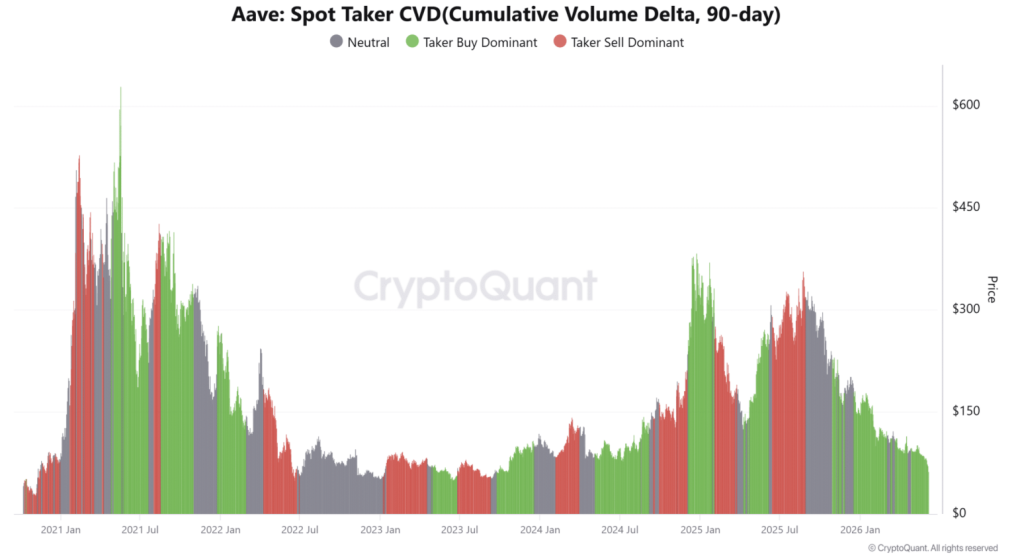
Buyers Keep Showing Up, But Price Keeps Falling
Interestingly, market data suggests buyers haven’t disappeared. Spot Taker CVD metrics remained buyer-dominant throughout much of the decline, indicating that a considerable number of traders were actively purchasing AAVE as prices weakened.
That’s usually considered a positive sign. Yet the market delivered a different message.
Despite the steady stream of buying activity, AAVE continued moving lower. The disconnect reveals an uncomfortable reality: demand exists, but it hasn’t been strong enough to absorb the amount of supply entering the market. Buyers have been stepping in repeatedly, but every attempt to stabilize the price has been met with fresh selling pressure.
It’s a classic sign of a market still struggling to find a floor. People are buying, sure, but they’re not buying enough to shift momentum back in their favor.
Critical Support Gives Way
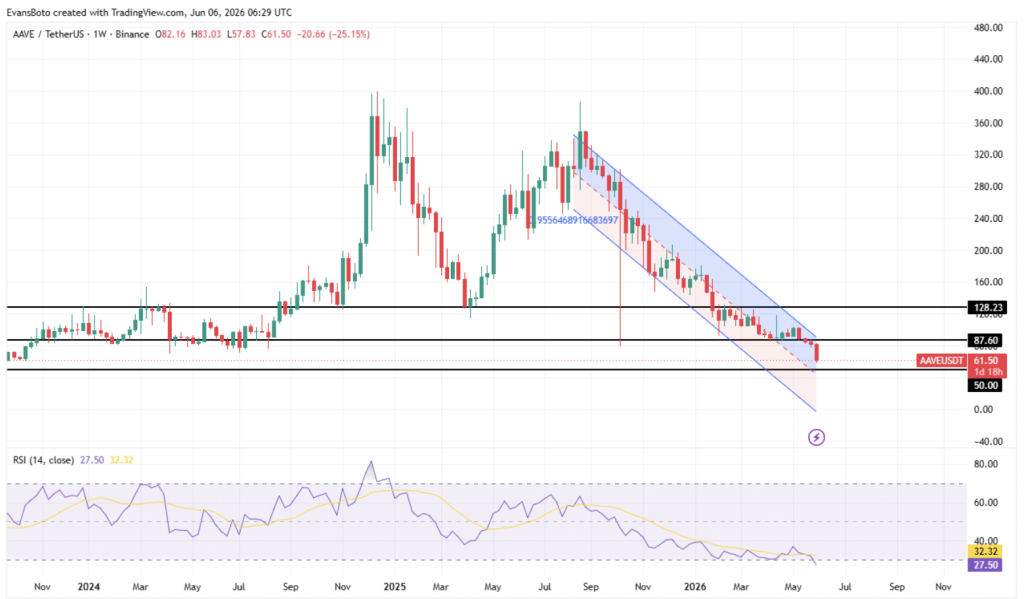
From a technical perspective, the situation has become increasingly fragile. AAVE recently broke below the important $87.60 support zone after spending months trapped inside a descending channel. That breakdown reinforced an already bearish structure characterized by a consistent pattern of lower highs and lower lows.
The asset also remains far beneath the major resistance area near $128, a level that now feels distant given current conditions. With support broken, traders are beginning to focus on the next significant downside target near $50.
Momentum indicators paint a similarly cautious picture. The Relative Strength Index has dropped to around 27.5, placing it firmly in oversold territory. While oversold readings sometimes precede relief rallies, they can also persist for extended periods during strong downtrends. Simply put, being oversold doesn’t automatically mean a reversal is coming tomorrow.
If buyers manage to defend current levels, AAVE could see a temporary bounce. If not, the path toward $50 becomes increasingly difficult to ignore.
Liquidity Zones Suggest a Short-Term Recovery Could Happen
Despite the broader weakness, there are signs that a short-term recovery attempt could still emerge. Liquidation heatmap data shows several large clusters of leveraged positions sitting above the current market price.
The first major concentration appears between $64 and $66, while another notable zone sits around the $69 to $70 range. Markets often gravitate toward these liquidity pockets, particularly after sharp moves lower, as traders hunt for stop orders and liquidation events.
Recent price action has already shown AAVE attempting to recover from intraday lows, giving additional relevance to these levels. If buyers maintain pressure, the token could move higher and sweep some of this overhead liquidity before deciding its next major direction.
The Next Few Days Could Be Crucial
Right now, AAVE sits at a critical crossroads. On one side, oversold technical indicators and buyer activity suggest the market may be approaching exhaustion after an intense selloff. On the other, broken support levels and persistent selling pressure continue to dominate the larger trend.
The bulls still have a chance to stage a recovery. But they need to reclaim key levels quickly and prove that recent buying interest represents genuine accumulation rather than short-term speculation.
Until that happens, the bears remain firmly in control, and the possibility of another leg lower toward $50 remains very much on the table.