

- Large XRP holders are moving more coins across exchanges, while Binance is seeing a noticeable decline in whale activity.
- On-chain data suggests whale transactions are becoming more distributed instead of concentrated on a single exchange.
- XRP remains under price pressure, but some analysts still believe a long-term rally toward $5 or higher remains possible.
Large XRP investors are becoming increasingly active across centralized exchanges, but interestingly, much of that activity is no longer centered on Binance.
Fresh on-chain data shows whale-sized transfers now account for a much larger share of exchange movements than they did just a couple of months ago. At the same time, Binance has seen its dominance in those transactions steadily decline, hinting that major holders may be spreading their activity across multiple trading platforms.
The shift comes as XRP continues fighting to hold key support levels following another difficult month for the cryptocurrency.
Whale Activity Expands Beyond Binance
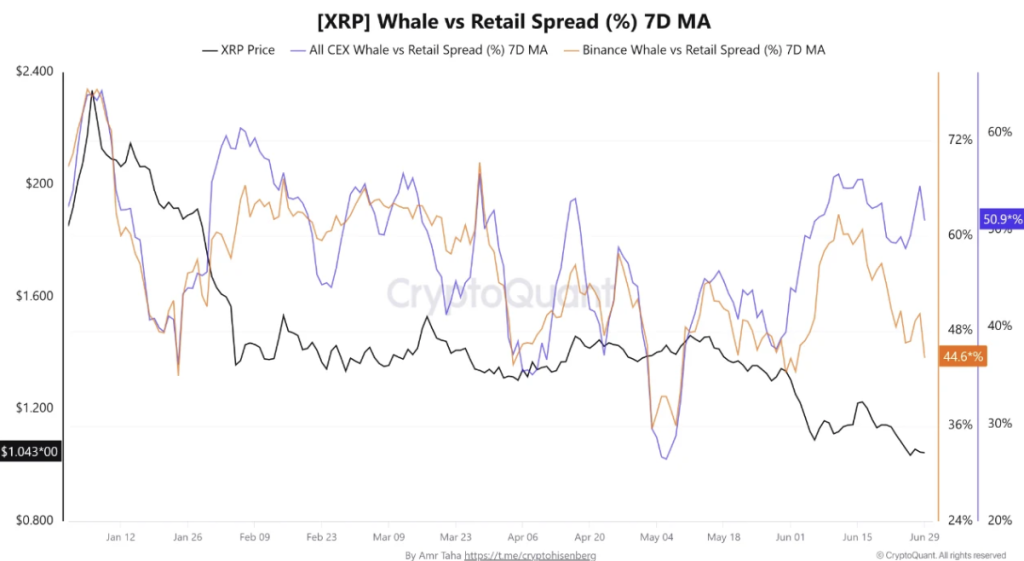
According to data shared by CryptoQuant, the seven-day moving average of XRP’s Whale vs. Retail Spread across all centralized exchanges climbed from 26% on May 6 to 50.9% by June 29.
That’s an increase of nearly 25 percentage points in less than two months.
The metric measures the difference between exchange outflows involving transfers larger than 100,000 XRP and those worth 100,000 XRP or less. Higher readings generally indicate that whale-sized transactions are accounting for a greater share of exchange activity than retail movements.
In simple terms, bigger players are becoming much more active.
However, Binance tells a different story.
CryptoQuant found that Binance’s own Whale vs. Retail Spread fell sharply from 62% on June 11 to 44.6% by June 29.
That puts the exchange roughly 6.3 percentage points below the broader centralized exchange average.
The divergence suggests whale transactions are becoming less concentrated on Binance and increasingly distributed across multiple exchanges instead.
While the data doesn’t reveal whether those transfers represent buying, selling, or internal wallet movements, it does indicate that large holders are changing where they move their XRP.
XRP Continues Fighting Heavy Selling Pressure
The shift in whale activity comes during a difficult stretch for XRP’s price.
After trading above $1.30 earlier in the month, the token gradually lost momentum and slid toward the $1.05 area. A brief rebound in mid-June gave bulls some hope, but the recovery quickly faded as sellers regained control.
The prolonged weakness also affected XRP’s standing among the largest cryptocurrencies.
During the decline, the token briefly slipped behind both BNB and USDC in market capitalization rankings as broader market pressure continued weighing on prices.
Analysts are now watching one critical support level.
According to Ali Martinez, XRP remains near the important $1.06 support zone. If buyers fail to defend that area, additional downside targets around $0.80, $0.62 and even $0.51 could come into focus.
Losses Mount, But Long-Term Optimism Remains
On-chain metrics suggest many XRP holders are already feeling the effects of the correction.
Glassnode recently reported that investors are now realizing significantly more losses than profits, a pattern often seen during periods of market capitulation.
Historically, these phases can signal growing fear across the market. While they don’t guarantee an immediate reversal, they often appear as weaker hands exit positions and longer-term investors begin accumulating.
Some analysts believe that process may already be underway.
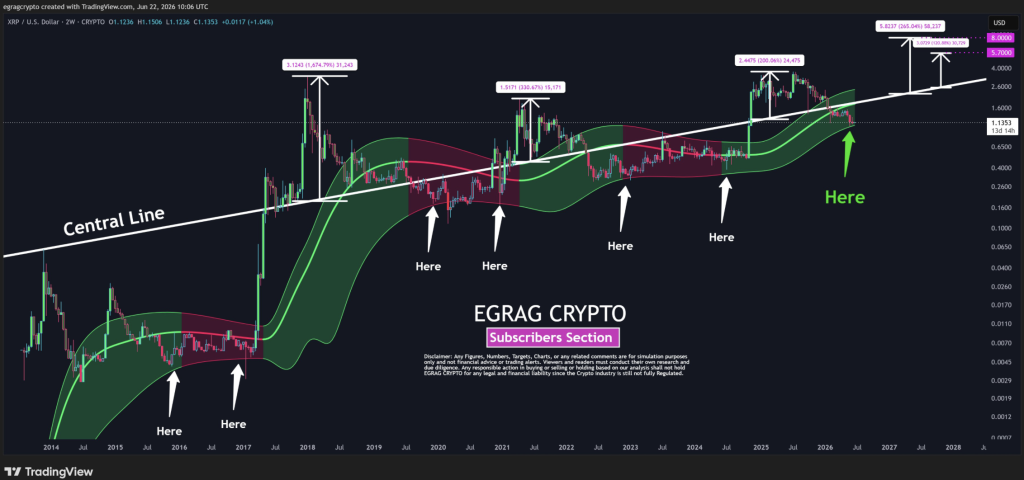
Crypto analyst EGRAG CRYPTO continues to maintain a bullish long-term outlook, arguing that if XRP follows historical cycles tied to what he calls its “Central Line,” the token could eventually revisit much higher price levels.
Based on previous market cycles, his projections place XRP between approximately $5.70 and $8 over the longer term.
Those targets remain well above current prices and depend on XRP first reclaiming key resistance levels. For now, traders are likely to keep a close eye on whale movements, exchange flows, and whether buyers can successfully defend the crucial support zone around $1.