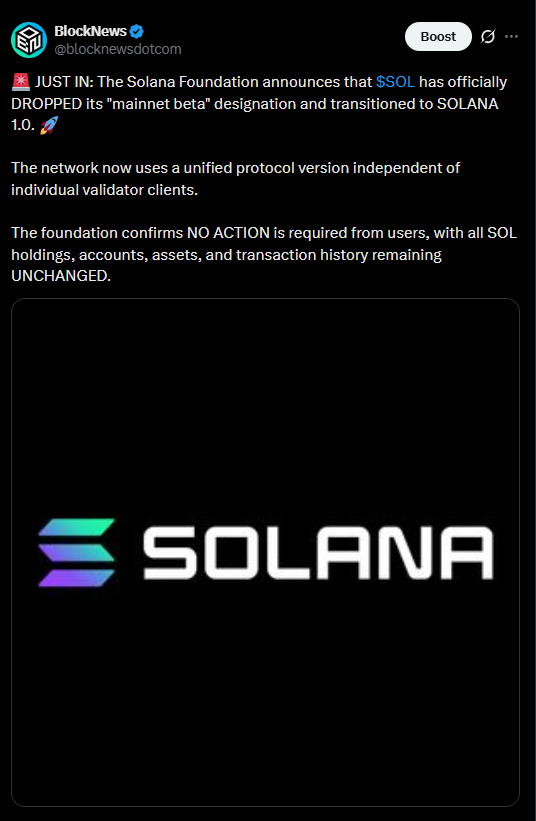
- The Solana Foundation has officially retired the network’s “mainnet beta” designation and introduced Solana 1.0 as its standardized protocol version.
- The announcement follows major infrastructure upgrades, including Alpenglow, which targets transaction finality of approximately 150 milliseconds, and the introduction of the Firedancer validator client.
- Solana continues attracting institutional interest, with DTCC planning to connect its tokenization service to the blockchain in the second half of 2027.
The Solana Foundation has officially removed the blockchain’s long-standing “mainnet beta” designation, introducing Solana 1.0 as the network’s new protocol version.
According to an announcement on Monday, the change reflects improvements in Solana’s performance, reliability and developer infrastructure.
The foundation explained that Solana 1.0 establishes a common protocol version that operates independently of individual validator software releases.
The update marks an important milestone for the blockchain, which has undergone significant technical development since its original mainnet beta launch.
However, the announcement is primarily a change in network terminology rather than a new blockchain deployment or an immediate technical upgrade.
Solana 1.0 Officially Replaces Mainnet Beta
The Solana Foundation said the decision to retire the beta designation recognizes years of improvements to the blockchain’s infrastructure.
“Solana 1.0 recognizes the progress on network performance, resilience, and developer experience,” the foundation stated.
Under the new naming structure, Solana’s protocol version will be separate from the version numbers used by individual validator clients.
This distinction is intended to simplify communication between developers, validators and infrastructure providers.
Previously, different validator software releases could create confusion when discussing the network’s overall development progress.
With Solana 1.0, participants now have a shared reference point for identifying protocol changes regardless of which validator client they operate.
The foundation confirmed that users do not need to take any action following the announcement.
Existing SOL balances, wallet accounts and transaction histories remain unchanged.
Developers and validator operators must still follow the release instructions associated with their specific software.
The foundation also clarified that introducing Solana 1.0 does not automatically activate every planned network improvement.
Alpenglow and Firedancer Strengthen Solana Infrastructure
The naming change follows several major upgrades designed to improve Solana’s transaction processing and network resilience.
In October 2026, Solana activated Alpenglow on its mainnet.
The consensus upgrade targets transaction finality of approximately 150 milliseconds, compared with the previous 12.8 seconds.
Faster finality can improve transaction settlement efficiency and support applications requiring rapid confirmation.
Another important development was the introduction of Firedancer, an independently developed validator client created by Jump Crypto.
Firedancer launched on Solana‘s mainnet in December 2025, providing an alternative to the existing Agave validator software.
The two clients operate using separate codebases, development schedules and version numbers.
Having multiple independently developed validator clients can help reduce the network’s dependence on a single software implementation.
The Solana Foundation said the new protocol naming system will provide greater consistency as these different validator clients continue evolving.
Solana Attracts Institutional Tokenization Projects
Beyond its technical improvements, Solana has continued attracting financial institutions exploring blockchain-based products.
Last week, the Depository Trust & Clearing Corporation announced plans to connect its tokenization service to Solana during the second half of 2027.
The initiative could expand the use of blockchain infrastructure for tokenized financial securities.
Formation Securities has also notified the U.S. Securities and Exchange Commission of plans to establish a tokenized securities trading platform on Solana.
The company is targeting an early 2027 launch.
Meanwhile, asset manager Schroders introduced a tokenized emerging-markets debt fund on Solana through Centrifuge earlier this month.
Other developments include USDC account services for U.S. Samsung Galaxy users and an integration with Polygon Labs’ Open Money Stack.
These initiatives highlight growing interest in Solana as infrastructure for payments, tokenized assets and institutional financial applications.
For Solana, removing the mainnet beta designation represents a symbolic transition toward a more established blockchain ecosystem.
However, continued adoption will depend on network reliability, developer activity and the successful deployment of future upgrades.
Investors and developers will now be watching how Solana 1.0 supports the network’s next phase of infrastructure development and institutional expansion.