

- Binance whale XRP withdrawals surged to 57.6%, showing large holders remain highly active near the $1.33–$1.42 range.
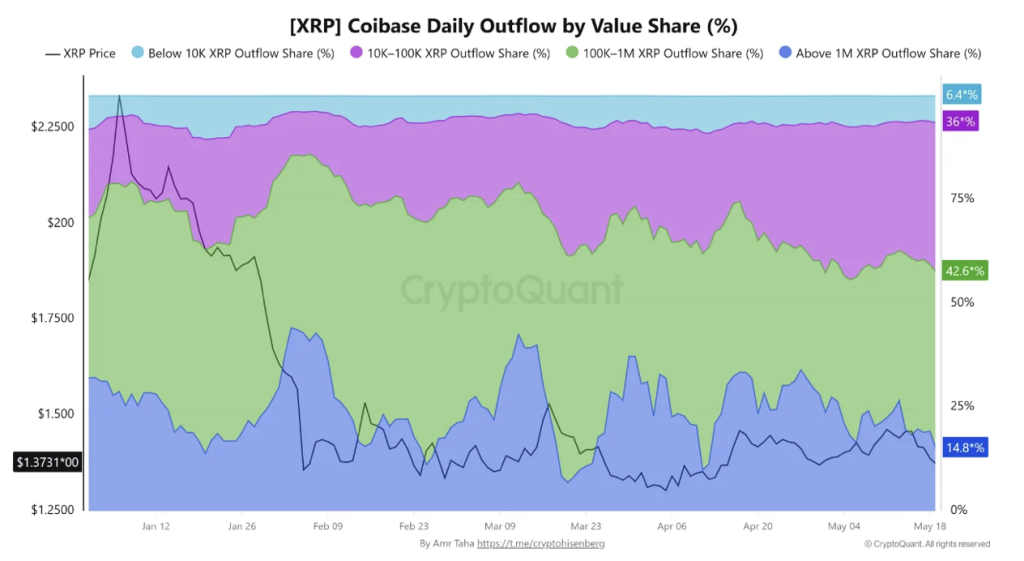
- Coinbase data shows the opposite trend, with smaller and mid-sized participants driving more activity instead of whales.
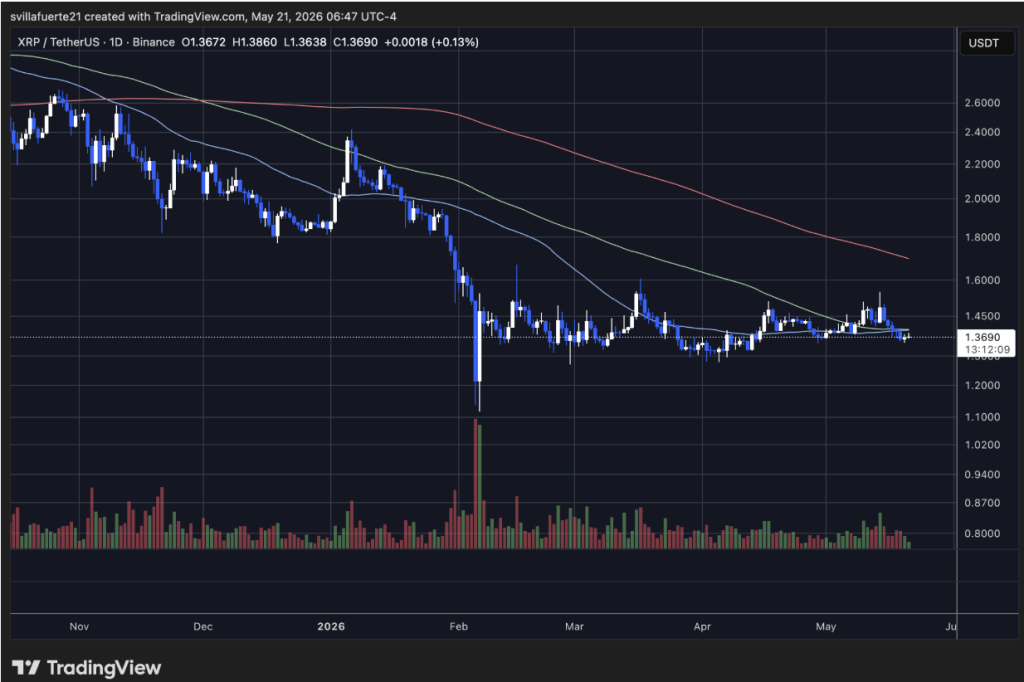
- XRP remains stuck below key resistance at $1.45, while the $1.30 support zone continues acting as the market’s main defensive level.
XRP keeps drifting below the $1.40 level, and honestly, the market is starting to feel exhausted. Bulls have tried several times to reclaim momentum, yet every push higher seems to fade before anything meaningful can happen. The broader recovery narrative is still technically alive, but price action has become frustratingly repetitive, almost stuck in neutral while traders wait for something — anything — to shift sentiment.
What makes the current setup more interesting, though, is that on-chain exchange data is starting to reveal behavior the chart itself doesn’t immediately show. According to CryptoQuant, Binance has seen a sharp rise in whale-sized XRP withdrawals, specifically transactions involving more than 1 million XRP. That category now accounts for 57.6% of daily outflows, the highest reading since the major spike back on March 28 when it briefly touched 66%. Similar activity also appeared in late April near the 60% zone, and all of these spikes happened while XRP traded between roughly $1.33 and $1.42.
That repetition matters more than it first appears. Large holders are repeatedly pulling XRP off Binance whenever price enters this range, and they’ve done it multiple times now, not just during a single isolated event. Sometimes whale withdrawals suggest accumulation or self-custody moves, other times it’s positioning ahead of volatility. Either way, big players clearly care about this price zone. The pattern feels intentional, even if the exact motive isn’t fully obvious yet.
![[XRP] Binance Daily Outflow by Value Share (%)](https://blocknews.com/wp-content/uploads/2026/05/Xrp-binance-daily-outflow-by-value-share--1024x558.png)
Coinbase Is Showing the Exact Opposite Behavior
Here’s where things get a little weird. Coinbase data is telling a completely different story from Binance, and the split between the two exchanges may actually be the most important signal in the market right now. While Binance is seeing aggressive whale withdrawal dominance, Coinbase has watched that same category fall to just 14.8%, its lowest reading since April 11.
At the same time, mid-sized wallet activity on Coinbase has climbed sharply. Outflows between 10,000 and 100,000 XRP jumped from 19% to 36% between April and May, showing that smaller participants are becoming far more active there. So instead of whales controlling movement, Coinbase is increasingly seeing retail and mid-tier traders shifting coins around. Same asset, same market conditions, but entirely different participant behavior depending on the venue.
That divergence creates a really interesting structural picture. Binance appears to be dominated by large holders quietly repositioning, while Coinbase activity looks more fragmented and retail-driven. And when two of the world’s biggest exchanges start showing opposite behavioral trends at the exact same price level, traders usually pay attention. It doesn’t automatically mean XRP is about to explode higher or collapse lower, but it does suggest something is building under the surface.
XRP Price Action Still Looks Compressed
From a technical perspective, XRP still hasn’t escaped the range that’s been controlling price since March. The asset continues hovering near $1.36 after failing again below the $1.45 resistance area. Momentum indicators have softened, volume has dried up, and volatility has cooled significantly compared to the violent selloff seen earlier this year.
Still, there’s one detail bulls can point to with some confidence: the $1.30 to $1.33 support region keeps holding. Every meaningful dip into that zone since February has attracted buyers fairly quickly, preventing XRP from completely breaking down even while the broader crypto market struggled. That repeated defense has started to give the chart a structure that looks more like accumulation than outright weakness, though it’s still too early to call it a confirmed base.
The problem is that buyers haven’t been able to reclaim the 200-day moving average near $1.50. Until that changes, XRP remains structurally range-bound and vulnerable to more sideways action. If bulls can finally break above $1.45 with real momentum, the next move toward $1.60 could happen fairly fast. But if the $1.30 floor eventually cracks, the market may revisit the February lows sooner than many expect.
Market Feels Like It’s Waiting for a Trigger
Right now, XRP almost feels suspended in a low-energy equilibrium phase. Panic selling has mostly disappeared, but strong buying conviction hasn’t returned either. Traders are watching whale activity closely because, frankly, the largest participants seem far more decisive than everyone else at the moment.
CryptoQuant’s analysis wisely stops short of labeling the data outright bullish or bearish, and that restraint makes sense. Whale withdrawals alone don’t guarantee upside. Sometimes large holders move assets to cold storage before accumulation phases, other times they reposition ahead of heavy volatility. What the data does confirm, however, is that the biggest XRP holders continue reacting aggressively around the same price zone again and again.
And that probably makes the $1.33 to $1.42 region the most important area on the chart right now. Whales keep showing up there. The market notices patterns like that eventually, even if price hasn’t fully responded yet.