

- a16z crypto believes tokenized assets could grow more than 100x by 2030
- Market projections for tokenized real-world assets now range from $2 trillion to over $30 trillion
- Major institutions are increasingly moving Treasuries, funds, and credit markets onto blockchain rails
For years, tokenization sounded like one of those crypto concepts people politely pretended to understand before immediately going back to trading memecoins named after amphibians.
Now Wall Street is starting to realize the idea may actually be enormous.
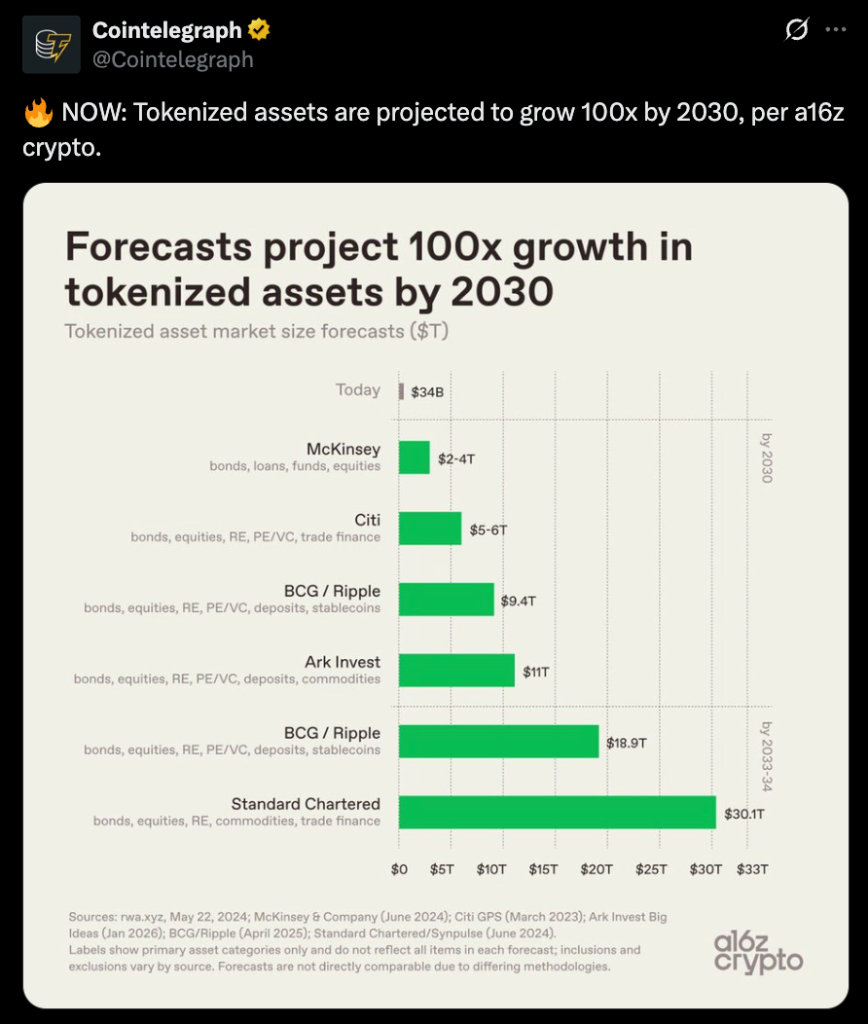
According to a recent report from a16z crypto, tokenized real-world assets could expand more than 100x by the end of the decade. The sector currently sits around the $30 billion range, but some long-term forecasts now estimate the opportunity could eventually surpass $30 trillion globally.
That is not “interesting niche market” territory anymore. That is potentially a structural redesign of how financial assets move around the world.
Treasury Bills Quietly Became Crypto’s Killer App
One of the biggest drivers behind the tokenization boom lately has been tokenized U.S. Treasuries.
Institutions increasingly recognize that blockchain infrastructure can make settlement faster, collateral more efficient, and financial markets accessible around the clock instead of operating like it is still somehow 1987.
In practical terms, tokenization allows traditionally illiquid or operationally cumbersome assets to move more flexibly across digital infrastructure while reducing layers of intermediaries, reconciliation delays, and administrative overhead.
And honestly, large financial institutions care deeply about boring efficiency improvements. “Faster settlement” may not sound exciting on crypto Twitter, but it sounds extremely exciting inside trillion-dollar capital markets.
BlackRock And Wall Street Are Already Moving In
This trend is no longer limited to crypto-native startups talking to each other inside conference panels.
Major firms including BlackRock, Franklin Templeton, and several large asset managers have all expanded aggressively into tokenized products over the past year. Companies like Ondo Finance and other blockchain-native infrastructure providers are also building systems specifically designed to bridge traditional finance assets directly onto public blockchain rails.
Stablecoins quietly became foundational to this entire transition too. They effectively function as instant digital settlement infrastructure connecting tokenized markets globally without relying on slow legacy banking systems underneath every transaction.
Ironically, stablecoins may end up becoming one of crypto’s most important mainstream products while memecoin traders continue debating whether cartoon animals qualify as investment theses.
Crypto’s Next Bull Market May Look Completely Different
What makes the tokenization narrative especially important is that it shifts crypto’s long-term story away from pure speculation and toward infrastructure modernization.
The next major growth phase for blockchain may not come primarily from retail traders chasing volatility. It could emerge from bonds, money market funds, private credit, equities, treasury products, and institutional collateral systems gradually migrating onto blockchain rails because they simply function more efficiently there.
That changes the conversation dramatically.
Instead of asking whether crypto replaces traditional finance, many institutions increasingly appear focused on quietly integrating blockchain infrastructure directly into traditional finance itself.
Blockchain Is Becoming Financial Plumbing
The broader pattern becoming visible now is that blockchain technology increasingly resembles invisible financial plumbing rather than purely speculative software.
Most end users likely will not care whether a treasury fund, bond settlement system, or tokenized equity product operates onchain eventually. They will care whether transactions settle faster, markets stay open longer, and systems operate more efficiently with lower friction.
And that is exactly the type of problem tokenization solves well.
Ironically, crypto’s biggest long-term success story may involve fewer laser-eye profile pictures and far more compliance teams, treasury managers, and back-office accountants quietly rebuilding global financial infrastructure underneath the surface.
Which honestly, could end up being much bigger than speculation ever was.