

- Solana processed more blockchain transactions than the rest of the crypto market combined last week.
- The network continues outperforming Ethereum in speed and transaction costs after major upgrades.
- Despite Solana’s technical edge, institutions like BlackRock still prefer Ethereum due to deeper liquidity and trust.
What actually pushes a major institution to launch products on one blockchain instead of another? That question keeps getting louder as traditional finance slowly moves deeper into crypto. Usually, institutions focus on a few core things first — transaction speed, network fees, settlement finality, and overall reliability. The logic behind it is pretty straightforward. Faster networks with lower costs can process larger amounts of activity smoothly, which naturally creates a better experience for users and businesses moving serious money around.
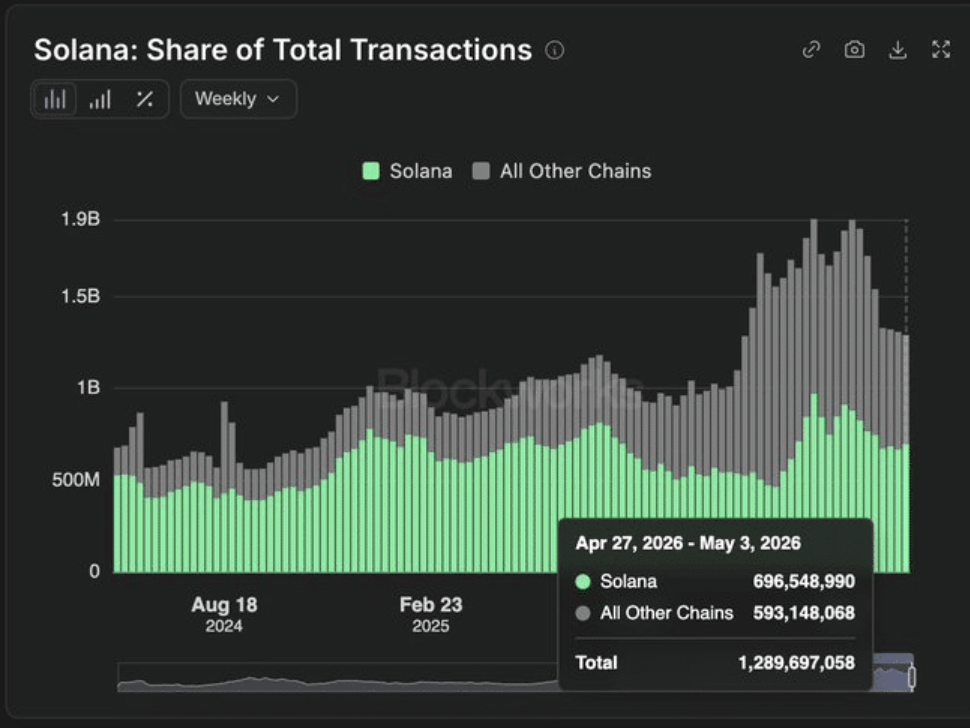
From that angle alone, Solana [SOL] looks incredibly hard to ignore right now. Over the past week, Solana processed roughly 696 million transactions, according to Token Terminal data. To put that into perspective, every other blockchain combined handled around 593 million during the same period. One network alone generated more on-chain activity than the rest of the market combined, accounting for around 54% of total blockchain transactions. That’s not a small lead either, it’s massive.
Solana’s Technical Advantage Over Ethereum Keeps Expanding
A huge part of Solana’s growth comes down to raw efficiency. High transaction throughput is usually tied directly to stronger infrastructure, and Solana keeps widening the gap in several areas. Compared to Ethereum [ETH], the differences become even more obvious. Data from Chainspect recently showed Solana transaction costs sitting nearly 100% lower than Ethereum’s, which remains one of the biggest criticisms surrounding ETH.
Then there’s settlement speed. Solana’s recent Alpenglow upgrade reportedly reduced finalization times from around 12.8 seconds to nearly 100 to 150 milliseconds. That’s incredibly fast, pushing the network closer to near-instant transaction settlement. For developers and users, that kind of responsiveness matters a lot because it creates an experience that feels less like traditional blockchain friction and more like modern internet infrastructure. Honestly, it’s hard not to see why people continue calling Solana one of the strongest Layer-1 competitors in crypto right now.
So Why Did BlackRock Still Choose Ethereum?
Despite all those advantages, institutions still appear hesitant to fully embrace Solana for major financial launches. BlackRock’s latest move highlighted that disconnect pretty clearly. The asset management giant recently announced plans to launch two tokenized money market funds, including one linked to a massive $6.1 billion Treasury liquidity vehicle aimed mainly at stablecoin users rather than traditional banking customers.
The bigger story, though, is where BlackRock chose to launch the product — Ethereum.
That decision surprised a lot of people considering Solana’s stronger transaction efficiency and lower operating costs. Naturally, it raises a bigger question around whether institutions still see Solana as fundamentally undervalued despite its technical edge. But for institutions, performance alone doesn’t always win the argument. Liquidity and trust tend to matter just as much, sometimes even more.
Ethereum’s Liquidity Advantage Still Carries Institutional Weight
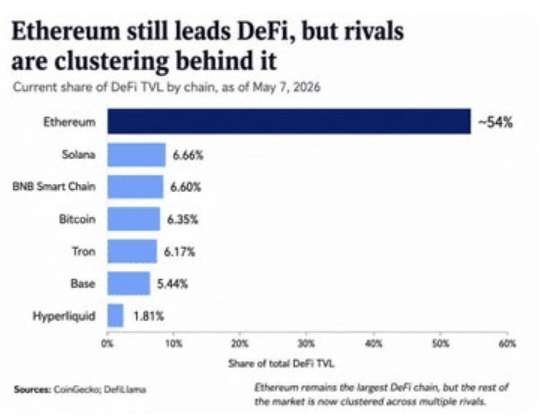
Ethereum continues dominating total value locked, or TVL, across decentralized finance. According to DeFiLlama data, Ethereum currently controls more than 50% of all on-chain liquidity, while Solana holds roughly 6.7%. That’s still a very large gap, even with Solana’s rapid growth over the last year.
For institutional players launching billion-dollar financial products, deeper liquidity creates a stronger sense of stability and confidence. Large pools of capital make it easier to enter and exit positions without disrupting markets too heavily, and institutions care deeply about that kind of predictability. Trust also plays a major role here. Ethereum has spent years building credibility with large investors, regulators, and financial firms, while Solana, despite its technical strengths, is still fighting to earn the same level of institutional comfort.
So in many ways, Solana’s perceived undervaluation may not really come from weaker infrastructure at all. The network clearly performs at an extremely high level technically. Instead, institutions still appear willing to pay a premium for Ethereum’s liquidity depth, ecosystem maturity, and long-established reputation inside the financial world.