
- The SEC says many crypto assets fall outside securities laws, but certain vaults and onchain lending products may still be regulated.
- Officials emphasized that moving financial products onto blockchain does not automatically exempt them from federal securities laws.
- The agency is encouraging developers to work with regulators early to build compliant products rather than assume decentralized technology avoids oversight.
The U.S. Securities and Exchange Commission has issued fresh guidance reminding the crypto industry that decentralization alone does not determine whether a product falls under federal securities laws.
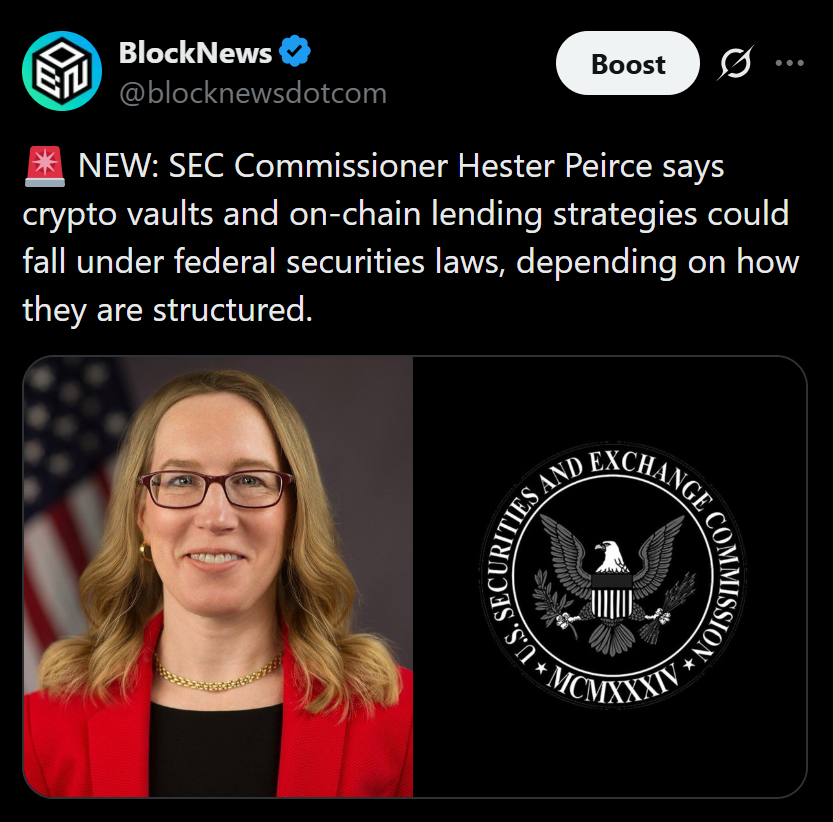
In a new statement, the SEC acknowledged the significant progress made over the past year in clarifying how securities laws apply to digital assets. While many cryptocurrencies and blockchain activities may fall outside the agency’s jurisdiction, the SEC stressed that certain products—particularly crypto vaults and onchain lending strategies—could still qualify as securities depending on how they operate.
The message reinforces the agency’s evolving approach: encouraging innovation while making clear that existing investor protection laws continue to apply where appropriate.
Tokenized Assets Do Not Automatically Escape Regulation
The SEC reiterated a principle it has emphasized before: placing financial products on a blockchain does not change their legal status.
According to the agency, tokenized securities remain securities, regardless of whether they exist on traditional financial infrastructure or decentralized networks.
Regulators said projects should evaluate the economic reality of their products rather than assume blockchain technology alone removes them from securities oversight.
Crypto Vaults Face Case-by-Case Review
The statement specifically addressed crypto vaults, which allow users to earn yield by deploying digital assets through activities such as staking, lending, and other automated strategies.
The SEC noted that vault structures vary significantly. Some rely almost entirely on immutable smart contracts, while others involve managers making ongoing decisions about asset allocation, investment strategies, or protocol selection.
Where users contribute assets with an expectation of profits generated through another party’s managerial efforts, the SEC indicated those arrangements could fall within existing securities laws or investment company regulations.
Onchain Lending May Also Trigger Securities Rules
The agency also highlighted decentralized lending protocols as another area requiring careful legal analysis.
Projects that determine interest rates, collateral requirements, loan-to-value ratios, liquidation thresholds, or other lending parameters may need to consider whether their activities create securities-related obligations.
The SEC emphasized that each protocol must be evaluated based on its individual facts and structure rather than broad labels such as “DeFi” or “onchain.”
SEC Encourages Developers to Engage Early
Rather than discouraging innovation, the SEC invited developers and protocol operators to engage with regulators during the design process.
Officials said existing securities laws were intentionally written to remain adaptable as technology evolves and acknowledged that certain regulations may eventually require updates to better accommodate blockchain innovation.
The agency also invited industry participants to provide feedback on how rules governing crypto vaults, decentralized lending, and other emerging technologies could evolve while continuing to protect investors and maintain fair, orderly markets.