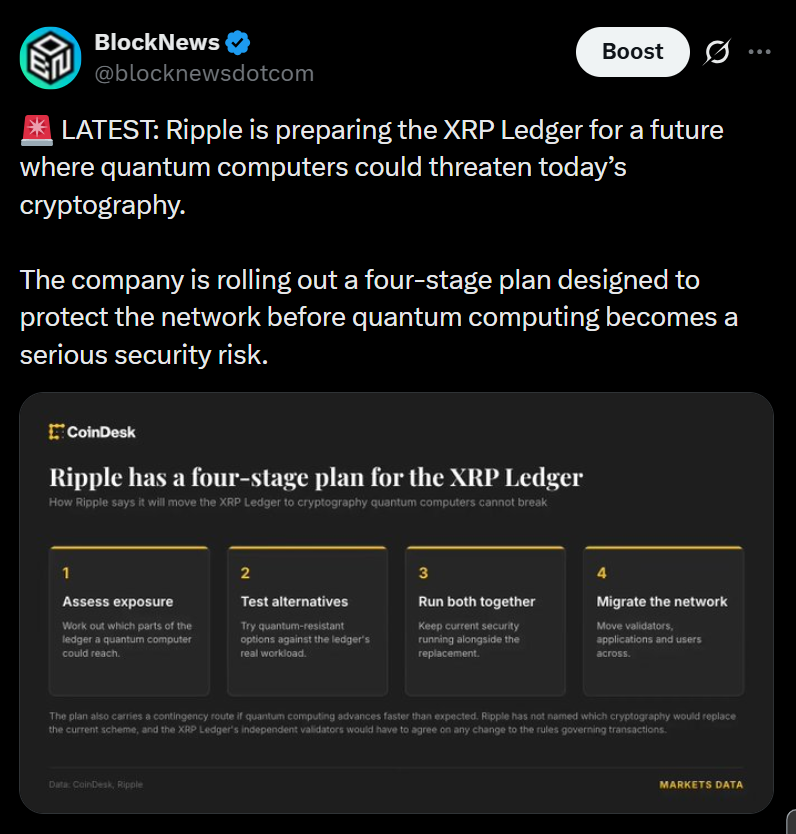
- Ripple is developing a four-stage strategy to prepare the XRP Ledger for a future where quantum computers could threaten today’s cryptographic protections.
- The plan includes assessing vulnerabilities, testing quantum-resistant cryptography, running old and new security systems together and eventually migrating the network.
- XRP Ledger’s ability to replace account keys without changing accounts could make a future transition easier, although validators would need to coordinate broader network upgrades.
Ripple is preparing the XRP Ledger for the potential arrival of quantum computers powerful enough to threaten the cryptography protecting blockchain wallets and transactions.
Rather than waiting until quantum computing becomes an immediate security problem, Ripple is treating the transition toward quantum-resistant security as a long-term infrastructure project.
“The goal is not to wait until quantum computing becomes an immediate threat,” Ripple Senior Director of Engineering Ayo Akinyele said. Instead, Ripple wants critical financial infrastructure to be capable of evolving before existing protections become vulnerable.
A sufficiently advanced quantum computer could theoretically break some cryptographic systems used across blockchain and traditional finance. In certain cases, attackers could potentially derive private keys from publicly available information, giving them control over protected assets.
Researchers commonly refer to the point when such attacks become practical as “Q-Day.”
Ripple Develops a Four-Stage Quantum Plan
Ripple’s strategy covers both the period leading up to a meaningful quantum threat and the transition afterward.
The first stages involve identifying which parts of the XRP Ledger could be vulnerable and testing alternative quantum-resistant cryptographic methods against the network’s existing workloads.
Later stages would allow current cryptography and quantum-resistant alternatives to operate alongside each other before the broader network transitions to the new security standards.
Ripple is also planning an emergency path in case quantum computing develops faster than expected. Such a system could allow the network to respond before attackers gain the ability to exploit older cryptographic protections.

XRP Ledger Could Have a Migration Advantage
One existing XRP Ledger feature could make the transition easier.
XRPL users can replace the keys controlling an account without having to change the underlying account itself. That could simplify the process of moving users toward quantum-resistant keys in the future.
However, a network-wide transition would still require coordination among XRP Ledger’s independent validators.
Akinyele said preparing for quantum computing will require more than simply replacing one cryptographic algorithm. Infrastructure, key management and upgrade processes will also need to evolve without disrupting financial activity running on the network.
AI Adds Another Security Challenge
Quantum computing is not the only emerging technology changing how financial networks approach security.
AI systems are increasingly capable of helping researchers identify cryptographic vulnerabilities faster, potentially reducing the time and resources needed to discover weaknesses.
While AI and quantum computing represent different threats, Ripple believes both are pushing financial infrastructure toward systems capable of adapting more quickly.
AI is also creating new requirements through agentic payments, where autonomous software can transact and pay for services without individual human approval.
Bitcoin and Ethereum developers are similarly exploring ways to replace today’s digital signature systems before sufficiently powerful quantum computers emerge.
For Ripple, beginning the process early is designed to prevent the eventual transition from becoming an emergency response.
“The objective is to make the eventual transition deliberate and orderly, rather than something the ecosystem has to undertake in response to a crisis,” Akinyele said.