

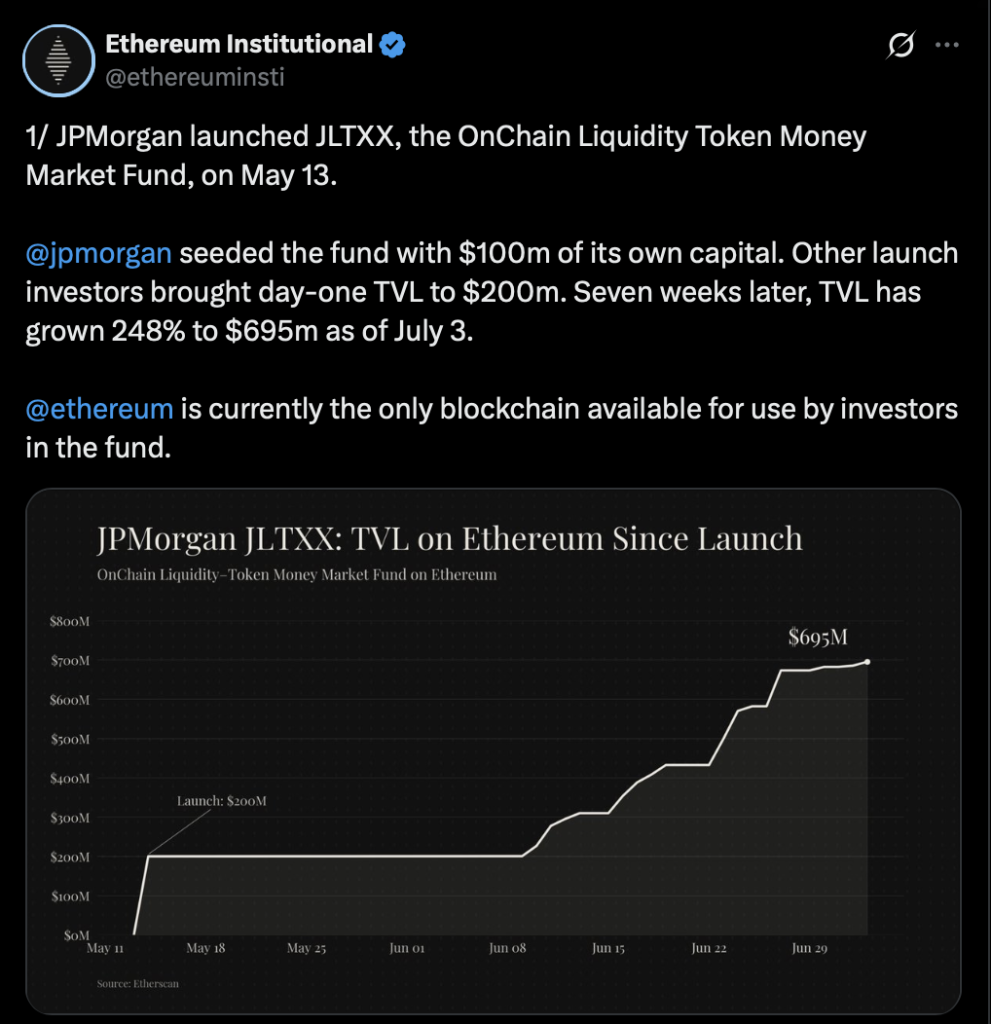
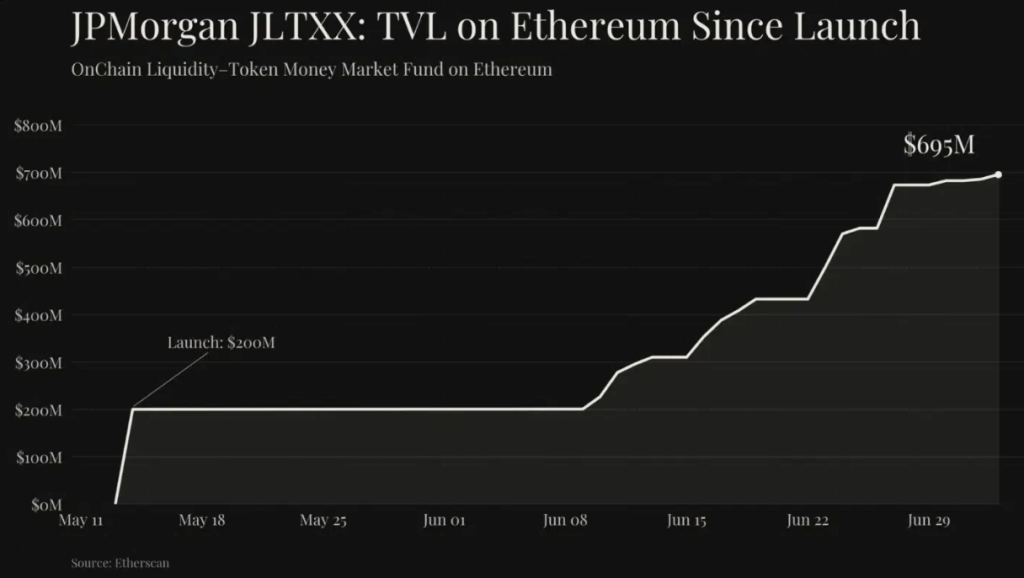
- JPMorgan’s tokenized money market fund has grown from $200 million to $695 million in assets within seven weeks.
- The fund runs exclusively on Ethereum and targets institutional investors seeking yield on tokenized cash.
- The rapid growth highlights rising demand for tokenized real-world assets and could further strengthen Ethereum’s position in institutional finance.
JPMorgan’s latest blockchain initiative is gaining traction much faster than many expected.
On May 13, the banking giant launched JLTXX, its OnChain Liquidity Token Money Market Fund, marking one of the largest tokenized investment funds introduced by a traditional financial institution. At launch, JPMorgan committed $100 million of its own capital, while institutional participants added another $100 million, bringing the fund’s initial total value locked (TVL) to roughly $200 million.
Fast forward just seven weeks.
According to on-chain data as of July 3, the fund has expanded to approximately $695 million, representing an impressive 248% increase in assets under management. That’s a significant jump in a relatively short period, and another sign that tokenized finance continues gaining momentum.
What Is JLTXX?
JLTXX is a permissioned money market fund designed specifically for qualified institutional investors.
Instead of issuing traditional fund shares, JPMorgan issues blockchain-based ownership tokens, allowing eligible investors to hold tokenized shares directly on-chain. At the moment, Ethereum is the only supported blockchain used for settlement.
JPMorgan serves as both the sponsor and transfer agent for the fund, while institutional investors provide liquidity. Ethereum acts as the underlying settlement network, giving investors access to a regulated tokenized financial product built on public blockchain infrastructure.
Unlike stablecoins that primarily focus on payments or transfers, JLTXX is aimed at institutions looking to earn yield on tokenized cash equivalents. The product joins a growing list of institutional offerings, including BlackRock’s BUIDL fund and Franklin Templeton’s BENJI.
Why the Growth Matters
The rapid expansion of JLTXX sends a fairly clear message.
Large financial institutions are becoming increasingly comfortable moving real-world assets onto blockchain networks, particularly when those assets operate within existing regulatory frameworks.
That trend creates opportunities across the broader crypto ecosystem. Developers building compliant tokenization infrastructure could see greater demand, while custodians, settlement providers, and exchanges may benefit as more capital flows through blockchain-based financial products.
Ethereum also stands to gain.
With JLTXX operating exclusively on Ethereum, the network continues reinforcing its reputation as the preferred blockchain for institutional-grade financial applications. As more regulated products launch, Ethereum’s position in tokenized finance could become even stronger.
The broader tokenization market has already been expanding rapidly. Industry research from Messari previously estimated that tokenized real-world assets surpassed $8 billion in total value locked during 2024, and that figure has continued climbing.
What Comes Next?
JLTXX arrives at a time when regulatory clarity around tokenized securities has been improving, particularly as institutions show growing interest in using blockchain-based collateral that can generate yield.
Several possible developments could come next.
JPMorgan may eventually expand the fund beyond Ethereum, introduce secondary market trading, or explore integrations with regulated DeFi infrastructure. Those moves could make tokenized funds more accessible and efficient for institutional investors.
Still, some questions remain unanswered.
Because the fund is permissioned, participation is limited, reducing the open composability often associated with decentralized finance. In addition, JPMorgan has yet to fully explain how redemption mechanics will work for investors over the long term.
Even with those limitations, JLTXX’s rapid growth shows that tokenized finance is no longer just an experiment. Traditional banks are putting real capital on-chain, and institutions appear increasingly willing to follow.