- Elon Musk calls for “universal high income” as AI threatens jobs
- Claims AI-driven abundance could prevent inflation from money printing
- Economists warn the idea could destabilize economies long-term
Elon Musk just dropped another one of those ideas that instantly splits the room. This time, it’s not about rockets or robots, but about money, specifically, the government sending everyone checks because AI might take their jobs.
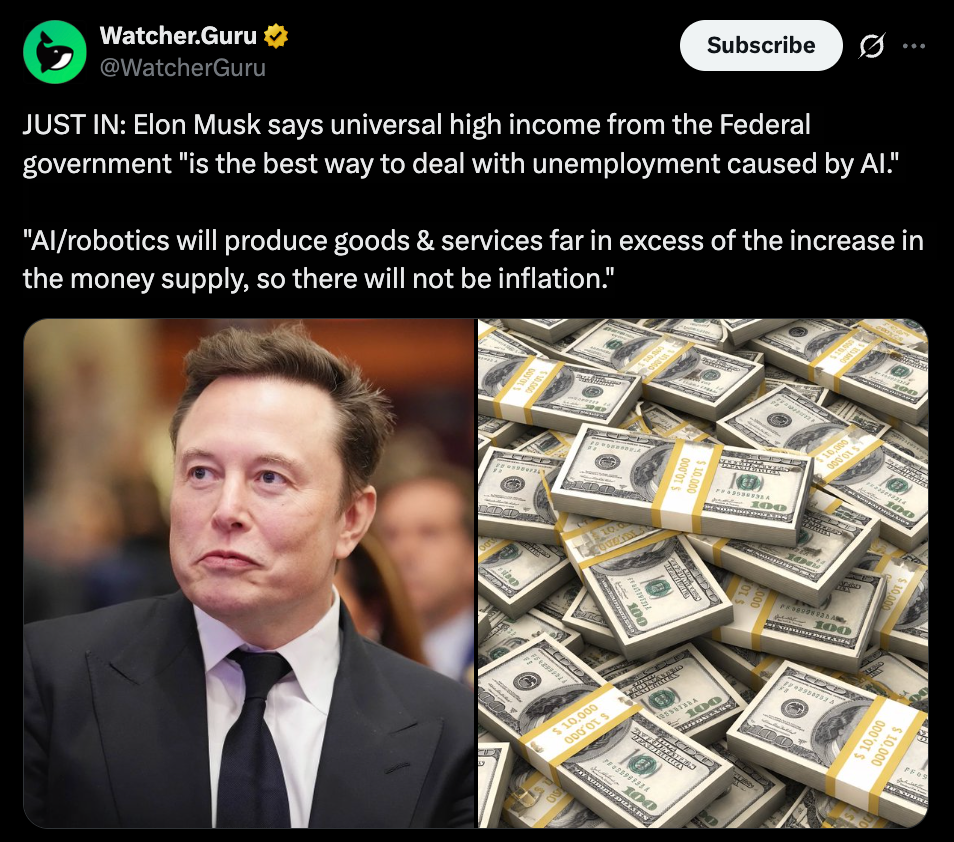
In a post that felt almost too casual for the scale of what he was suggesting, Musk argued that “universal high income” could be the best solution to mass unemployment driven by automation. It’s a bold claim, and honestly, one that sounds simple on the surface but gets complicated very quickly.
Not a New Idea, Just Louder Now
To be fair, Musk has been circling this concept for a while. He’s talked about versions of universal income before, but this framing, “high income,” pushes it further, suggesting not just survival-level support, but something closer to financial comfort for everyone.
His reasoning hinges on the idea that AI and robotics will create so much productivity that traditional economic constraints might not apply the same way. In that world, jobs become optional, and money, at least as we think about it today, starts to lose its meaning.
The Inflation Argument Is Where It Gets Controversial
Musk’s key claim is that printing money wouldn’t necessarily trigger inflation if AI is producing enough goods and services to match demand. That’s where a lot of economists start raising eyebrows, and pretty quickly too.
Critics argue that even with increased production, basic economic principles don’t just disappear. If more money enters the system without perfectly balanced output, prices tend to rise, and that risk doesn’t magically vanish just because AI is involved.
Economists Are Pushing Back Hard
The response from economists hasn’t been subtle. Some have pointed out that while AI will disrupt jobs, it’s also likely to create new ones, just like previous technological shifts have done.
There’s also the concern that a universal high income system could be financially unsustainable, potentially putting enormous strain on government budgets. In other words, even if the idea sounds appealing, making it work at scale is a completely different challenge.
A Conversation That’s Getting More Real
Whether Musk is ahead of the curve or oversimplifying a complex issue is still up for debate. But the fact that this conversation is happening at all, and at this level, says something about where things are heading.
AI isn’t just a tech story anymore, it’s becoming an economic one, and maybe even a political one. And if discussions about government-funded income keep gaining traction, this might just be the beginning of a much bigger shift in how we think about work and money.