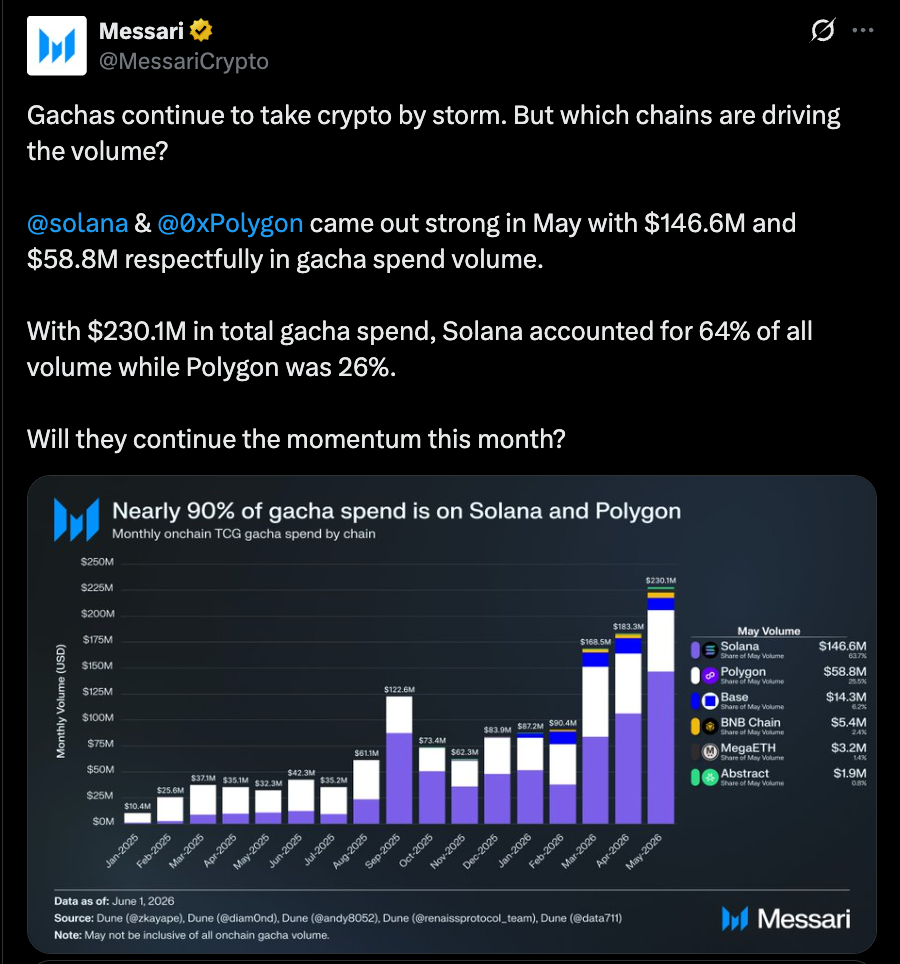
- Solana led onchain gacha activity in May with $146.6 million in spending, capturing 64% of the market.
- Polygon followed with $58.8 million, giving the two networks control of roughly 90% of total gacha volume.
- Combined spending reached $230.1 million, making blockchain-based loot boxes one of crypto’s fastest-growing consumer categories.
Crypto has spent years searching for the application that could attract mainstream users without requiring them to understand wallets, tokenomics, or decentralized finance. Surprisingly, the latest contender looks less like financial innovation and more like a digital vending machine.
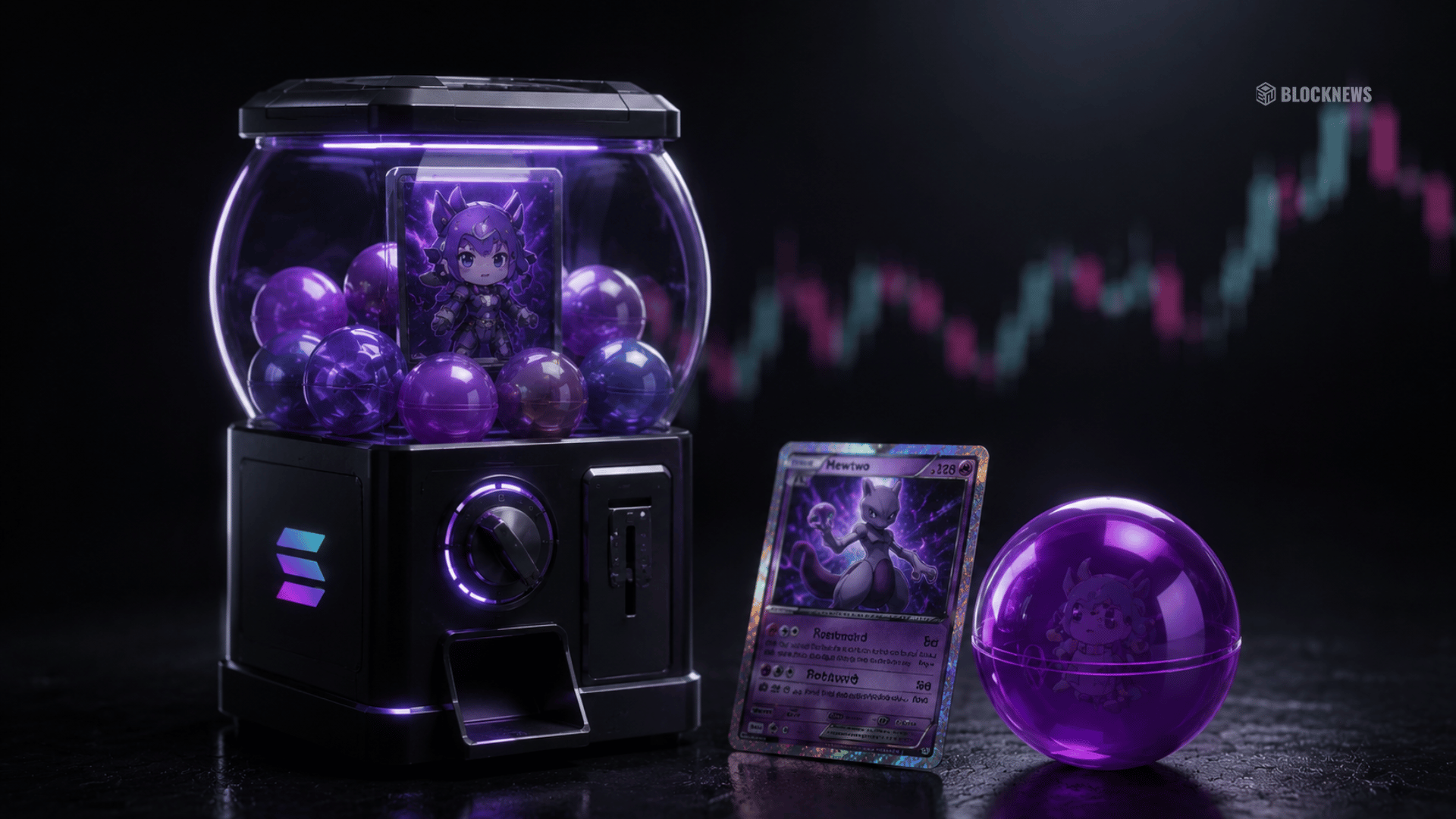
The newest obsession across parts of the crypto industry is gacha. The concept, which originated in Japan’s gaming culture, revolves around users paying a fixed amount for a randomized reward. Think trading card packs, capsule toy machines, or collectible mystery boxes. You know what you’re paying, but you do not know exactly what you’re getting.
Now that same model is finding massive traction on blockchain networks.
What Is An Onchain Gacha?
For many people outside gaming circles, the term “gacha” sounds unfamiliar. The idea itself is not.
Traditional gachas allow users to purchase randomized collectibles with varying levels of rarity. Some rewards are common, while others are extremely difficult to obtain. The uncertainty creates excitement and encourages repeat participation.
Onchain gacha platforms apply the same mechanics to blockchain assets. Users purchase digital packs that may contain NFTs, trading cards, tokenized collectibles, redeemable physical products, or other digital rewards. Ownership is recorded on-chain, allowing items to be traded, sold, or collected long after they are opened.
The result combines elements of collecting, gaming, speculation, and digital ownership into a format that many consumers already understand.
Solana Is Dominating The Market
According to recent industry data, Solana generated approximately $146.6 million in gacha spending during May alone. That figure represents about 64% of all tracked onchain gacha activity.
Polygon secured second place with roughly $58.8 million in volume, accounting for another 26% of the market. Combined, the two networks controlled nearly 90% of total gacha spending.
The gap between Solana and competing ecosystems highlights how effectively the network has positioned itself for consumer-facing applications. Fast transaction speeds and low fees make repeated purchases practical, something that becomes particularly important when users are opening multiple digital packs or participating in high-frequency collectible ecosystems.
Why Solana Has An Advantage
Solana’s success in the gacha category is not happening by accident. Consumer applications tend to require smooth user experiences, low costs, and fast transaction finality. Those characteristics have become some of Solana’s biggest strengths.
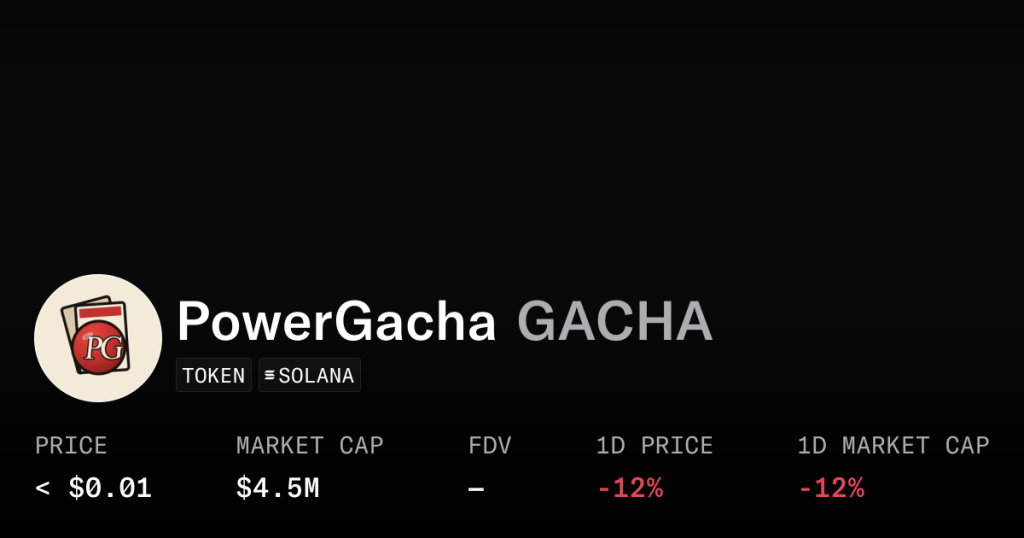
The ecosystem has already demonstrated strong traction in areas such as NFTs, trading cards, gaming assets, and digital collectibles. Several projects operating on the network have generated hundreds of millions of dollars in volume, with some surpassing the billion-dollar mark in cumulative transactions.
Gacha platforms naturally fit into that environment because they rely on frequent interactions rather than occasional high-value purchases.
This Trend Is Bigger Than Speculation
What makes gacha particularly interesting is that it may be solving one of crypto’s biggest challenges: giving users a reason to engage with blockchain technology without caring much about the blockchain itself.
Many crypto sectors remain heavily driven by speculation. Users buy tokens because they expect prices to rise. Gacha platforms work differently. People participate because they enjoy collecting, opening packs, discovering rare items, and interacting with communities built around those experiences.
The blockchain simply acts as the ownership layer beneath the product.
That distinction may be important. Historically, the most successful consumer technologies tend to disappear into the background while users focus on the experience itself.
A New Consumer Category Emerges
With more than $230 million spent in a single month, onchain gacha is beginning to look less like a niche experiment and more like a legitimate crypto sector.
Whether the trend continues growing at the same pace remains to be seen. Critics will undoubtedly question the similarities between gacha mechanics and gambling-style behavior, while supporters will point to the popularity of collectible products that have existed for decades.
What is becoming increasingly difficult to ignore, however, is the demand. Crypto has spent years searching for consumer applications that resonate beyond financial speculation. Gacha platforms appear to have found a formula that blends entertainment, ownership, and collecting in a way users already understand.
Sometimes the next major blockchain use case is not a complex financial protocol. Sometimes it is simply opening a digital pack and hoping something rare is inside.