
- Brian Armstrong says demand for AI capacity could become nearly unlimited as new use cases keep expanding.
- The Coinbase CEO expects most AI workloads to move toward smaller, cheaper models within 12 to 18 months.
- Energy and compute capacity may become the biggest bottlenecks as AI adoption spreads across industries.
Coinbase CEO Brian Armstrong has shared a blunt but interesting view of where artificial intelligence may be heading next. In his opinion, AI demand is not just strong, it is almost limitless. From smarter trading tools and blockchain services to daily automation and consumer apps, he believes nearly every sector will want access to AI in some form.
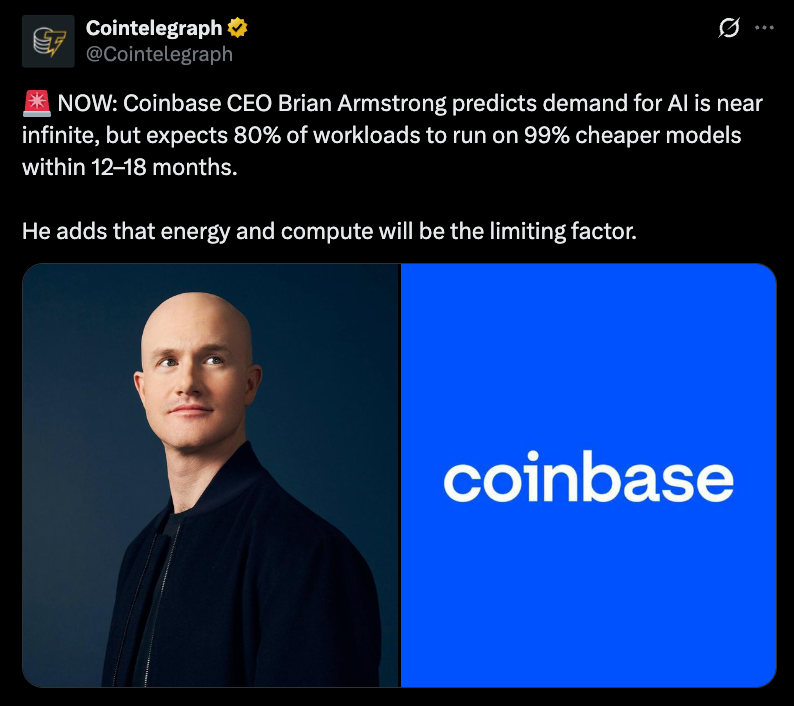
But Armstrong also sees a major shift coming in how that AI demand gets served. While the market is still fascinated by massive, expensive models, he believes the next stage of adoption could be dominated by smaller and cheaper systems. That could change the economics of AI faster than many people expect.
Smaller AI Models Could Take Over
Armstrong predicts that within the next 12 to 18 months, roughly 80% of AI workloads could move away from large, costly models and toward smaller systems that are far cheaper to run. That would mark a major change from the current race to build bigger and more powerful AI tools at almost any cost.
The logic is pretty simple. Not every task needs a giant model with massive training costs and heavy compute requirements. Many AI use cases, such as filtering spam, answering basic customer questions, sorting data, or recommending content, can be handled by smaller models designed for specific jobs. They can be faster, cheaper, and less energy-hungry too.
Compute and Energy Remain the Big Challenge
Armstrong also warned that the real limits may not come from demand itself, but from the infrastructure needed to support it. AI requires huge amounts of compute power, advanced chips, data centers, and electricity. As adoption grows, those resources could become harder and more expensive to secure.

That makes energy and compute capacity central to the future of AI. If companies want to deliver AI tools at massive scale, they will need more efficient hardware, better infrastructure, and cheaper ways to power everything. Otherwise, demand may grow faster than the industry can realistically support.
What This Means for AI Builders and Investors
Armstrong’s comments suggest that the next AI race may not only be about who builds the most powerful model. It may also be about who can deliver useful AI at the lowest cost. That matters for startups, major tech companies, investors, and users who want AI tools that are affordable enough to appear everywhere.
The future of AI could still be enormous, but it may not be dominated by oversized models for every single task. Instead, the winning approach may be leaner, faster, and more specialized. In other words, AI may get much bigger by getting a whole lot smaller.