

BlockNews
FOLLOW ON X
  • BITCOIN
  • CRYPTO
    • ETHEREUM
    • RIPPLE XRP
    • SOLANA
    • CARDANO
    • BINANCE BNB
    • DOGECOIN
    • TRON
    • SUI
    • CHAINLINK
    • LITECOIN
  • FINANCE
  • POLITICS
  • MEMECOINS
  • NFT
  • OPINION
No Result
View All Result
BlockNews
  • BITCOIN
  • CRYPTO
    • ETHEREUM
    • RIPPLE XRP
    • SOLANA
    • CARDANO
    • BINANCE BNB
    • DOGECOIN
    • TRON
    • SUI
    • CHAINLINK
    • LITECOIN
  • FINANCE
  • POLITICS
  • MEMECOINS
  • NFT
  • OPINION
No Result
View All Result
BlockNews
Home CRYPTO

Ethereum Crypto Funding Debate Heats Up – Here Is Why Validators Could Help Fund Development

Gary Ponce by Gary Ponce
June 22, 2026
in CRYPTO, ETHEREUM, FINANCE, OPINION
Share on XShare in TelegramShare on Reddit
  • A new proposal would allow Ethereum validators to redirect up to 10% of staking rewards toward ecosystem development.
  • Supporters argue the plan could provide sustainable funding for public goods and core infrastructure.
  • Critics warn the mechanism could create governance risks and new incentives for validator cartels.

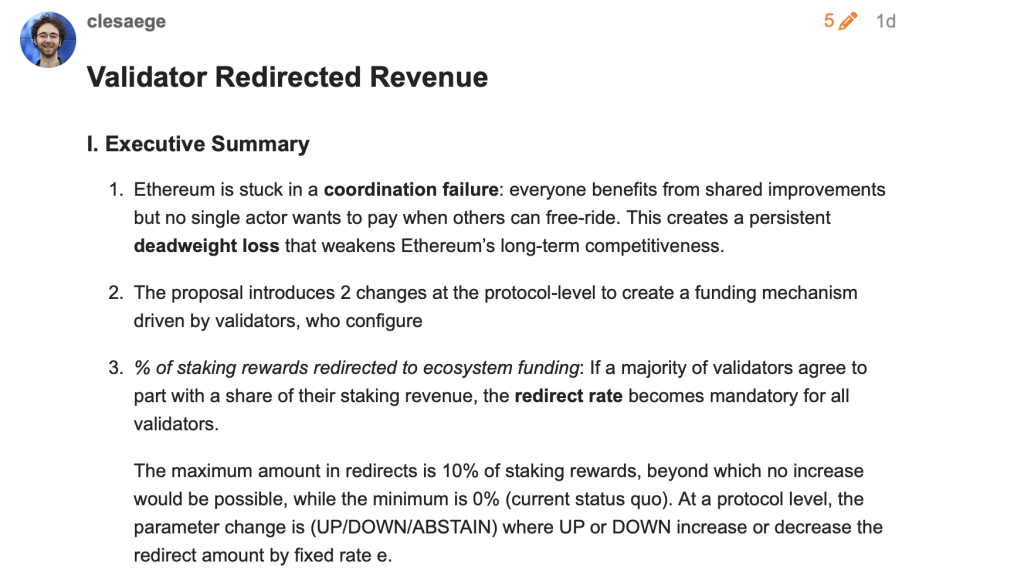
Ethereum’s long-running debate over funding public goods has resurfaced, this time with a proposal that could fundamentally change how ecosystem development is financed. The idea, introduced by Ethereum contributor Clément Lesaege, would allow validators to redirect a portion of their staking rewards toward development initiatives if a majority of validators support the move.

The proposal arrives at a sensitive moment for the Ethereum ecosystem. Questions surrounding long-term funding have become increasingly prominent, especially as some existing support programs approach expiration and spending across parts of the ecosystem begins to tighten. While the idea has attracted support from some corners of the community, it has also sparked concerns about governance, incentives, and unintended consequences.
Ethereum Proposal

Proposal Seeks to Address Ethereum’s Funding Challenge

At the center of the discussion is what Lesaege calls “Validator Redirected Revenue.” Under the proposed framework, validators would be able to signal both the percentage of staking rewards they wish to redirect and the projects or organizations they believe should receive the funds.

The argument behind the proposal is fairly straightforward.

Ethereum relies heavily on public goods, infrastructure projects, research teams, client developers, and other contributors whose work benefits the entire network. Yet many of these efforts struggle with funding because individual participants often have little direct incentive to contribute financially.

According to Lesaege, this creates a coordination problem. Everyone benefits from critical infrastructure, but funding responsibility is often fragmented.

How the System Would Work

The proposal outlines a voting-based mechanism that would activate only if more than 51% of validators support redirecting rewards above zero.

If that threshold is reached, the selected contribution rate would apply across the validator set. The proposal caps the redirect amount at 10% of staking rewards, though validators would retain the ability to vote the rate back down to zero in the future.

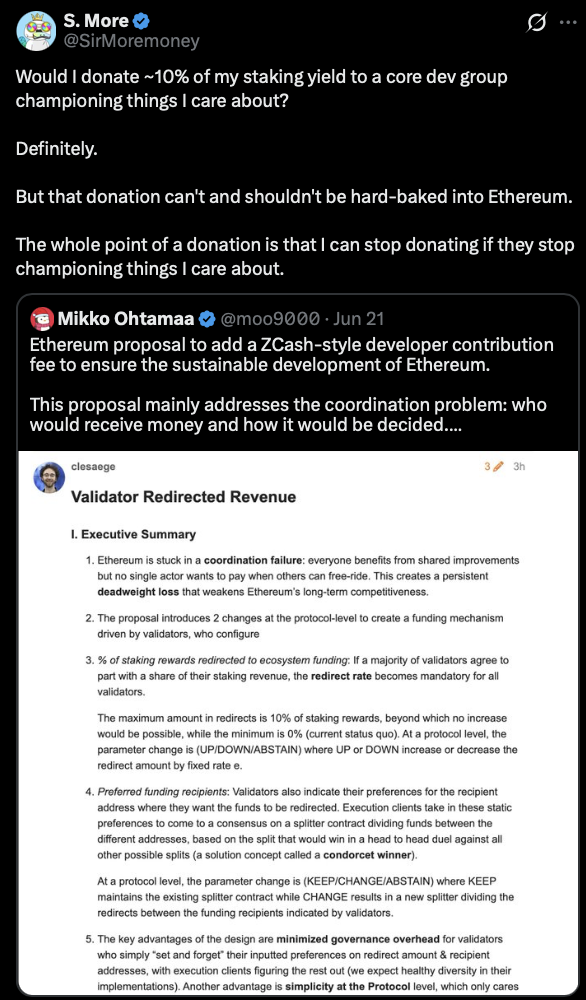
Validators would also be allowed to choose their preferred funding recipients. Those preferences would then be aggregated through execution clients, eventually determining how funds are distributed through a voting-based contract mechanism.

The potential scale is significant.

Ethereum currently has roughly 39.8 million ETH staked. Using the proposal’s estimated annual staking yield of around 1.91%, even a 5% redirect could channel approximately 38,000 ETH per year toward ecosystem development. A 10% allocation would increase that figure to roughly 76,000 ETH annually.

That’s a meaningful amount of capital, particularly for research teams, infrastructure providers, and development groups operating on long funding horizons.

Cartel Risks Become the Main Concern

Not surprisingly, the proposal’s biggest criticism centers on governance risk.

Lesaege himself acknowledged that validator cartel formation represents the most serious threat. In theory, a group controlling 51% of validator participation could vote to redirect the maximum funding allocation back to themselves.

That scenario has become one of the primary concerns raised by critics.

Lesaege argues the risk remains relatively low because the financial gains from such behavior would likely be outweighed by reputational damage and the potential negative impact on Ethereum’s market value. In other words, bad actors would risk harming the very asset they depend on.

Still, not everyone finds that argument convincing.
Ethereum concern

Developers Question Incentive Structures

Ethereum developer Micah Zoltu raised concerns that the proposal creates a uniquely attractive pool of money for potential attackers.

Unlike many existing attack vectors, he argued, this mechanism would establish a clearly defined funding stream that could incentivize coordinated behavior. According to Zoltu, that changes the nature of the risk and introduces challenges that other blockchain ecosystems have largely avoided.

He noted that he was unaware of any fully satisfactory solution to that particular problem.

Lesaege responded by pointing out that both Ethereum and Bitcoin already face theoretical cartel risks that have never actually materialized. He also emphasized the role of Ethereum’s social layer, including community coordination and the possibility of network forks, as a deterrent against abusive behavior.

Whether that reassurance is enough remains a matter of debate.

Some Community Members Prefer Voluntary Solutions

Not all criticism focused on governance concerns. Some developers questioned whether protocol-level funding is even necessary in the first place.

Pseudonymous developer señor doggo argued that Ethereum already supports smart contract-based funding mechanisms and revenue-sharing systems. From this perspective, funding models should compete voluntarily rather than becoming embedded within the protocol itself.

The argument reflects a broader philosophical divide within the crypto space.

Some participants believe public goods funding should emerge organically through market mechanisms. Others argue that critical infrastructure is too important to depend entirely on voluntary contributions.

There doesn’t appear to be consensus on that question yet.

Support Exists, But With Conditions

Despite the concerns, the proposal has found support among some community members.

DeFi builder S. More, for example, expressed willingness to donate a portion of staking rewards toward development groups they personally support. However, they suggested that contributions should remain optional rather than mandatory.

That position may ultimately reflect where much of the community currently stands. There is broad recognition that Ethereum’s infrastructure requires sustainable funding, but less agreement on how that funding should be collected and distributed.

Why the Timing Matters

The proposal’s arrival is particularly notable because of recent warnings from former Ethereum Foundation contributor Trent Van Epps.

Van Epps recently suggested that Ethereum could face growing funding pressure in the coming months as existing support programs expire and organizational spending becomes more constrained. Those comments have intensified discussions about how the network should support researchers, developers, client teams, and public infrastructure over the long term.

For now, the Validator Redirected Revenue proposal remains just that, a proposal. But it has succeeded in drawing attention to a challenge that many believe Ethereum will eventually need to address.

The real debate is no longer whether public goods require funding. It’s about who pays, how much they contribute, and whether the protocol itself should play a role in the process.


Disclaimer: BlockNews provides independent reporting on crypto, blockchain, and digital finance. All content is for informational purposes only and does not constitute financial advice. Readers should do their own research before making investment decisions. Some articles may use AI tools to assist in drafting, but every piece is reviewed and edited by our editorial team of experienced crypto writers and analysts before publication.
Tags: BlockchainDeFiethethereumGovernanceStaking
TweetShareShare
Gary Ponce

Gary Ponce

Gary has been active in the crypto space since 2019, developing hands-on experience in trading, airdrop hunting, and identifying emerging narratives in low-cap tokens. For over four years, he has contributed research and editorial content with Aiur Labs and BlockNews, focusing on market analysis and community insights. His work reflects both transparency and independent reporting, with an emphasis on simplifying complex ideas for readers. Gary is a long-term believer in Bitcoin, Sui, Hype, Litecoin, XRP, AVAX, and select meme tokens, combining personal trading knowledge with professional editorial standards.

DON'T MISS THESE! HOT OFF THE PRESS

Ethereum Crypto Price Struggles Below $1,800 – Here Is Why ETH Bears Still Have Control
CRYPTO

Ethereum Crypto Price Struggles Below $1,800 – Here Is Why ETH Bears Still Have Control

June 22, 2026
Bitcoin Crypto Supply Tightens – Here Is Why Whale Accumulation Is Raising Eyebrows
BITCOIN

Bitcoin Crypto Supply Tightens – Here Is Why Whale Accumulation Is Raising Eyebrows

June 22, 2026
Bitcoin Crypto Holds Above Key Support – Here Is Why Investors Are Watching Closely
BITCOIN

Bitcoin Crypto Holds Above Key Support – Here Is Why Investors Are Watching Closely

June 22, 2026
Bitcoin ETF Outflows Hit Record Streak – Here Is Why Investors Aren’t Panicking Yet
BITCOIN

Bitcoin ETF Outflows Hit Record Streak – Here Is Why Investors Aren’t Panicking Yet

June 22, 2026
Franklin Templeton Launches Franklin Crypto – Here Is Why Wall Street Is Expanding Into Digital Assets
BITCOIN

Franklin Templeton Launches Franklin Crypto – Here Is Why Wall Street Is Expanding Into Digital Assets

June 22, 2026
Bitmine Nears 5% of Ethereum Supply – Here Is Why Its Massive ETH Bet Is Turning Heads
CRYPTO

Bitmine Nears 5% of Ethereum Supply – Here Is Why Its Massive ETH Bet Is Turning Heads

June 22, 2026
Load More

Related News

Ethereum Crypto Funding Debate Heats Up – Here Is Why Validators Could Help Fund Development

Ethereum Crypto Funding Debate Heats Up – Here Is Why Validators Could Help Fund Development

June 22, 2026
Ethereum Crypto Price Struggles Below $1,800 – Here Is Why ETH Bears Still Have Control

Ethereum Crypto Price Struggles Below $1,800 – Here Is Why ETH Bears Still Have Control

June 22, 2026
Bitcoin Crypto Supply Tightens – Here Is Why Whale Accumulation Is Raising Eyebrows

Bitcoin Crypto Supply Tightens – Here Is Why Whale Accumulation Is Raising Eyebrows

June 22, 2026
Bitcoin Crypto Holds Above Key Support – Here Is Why Investors Are Watching Closely

Bitcoin Crypto Holds Above Key Support – Here Is Why Investors Are Watching Closely

June 22, 2026
Bitcoin ETF Outflows Hit Record Streak – Here Is Why Investors Aren’t Panicking Yet

Bitcoin ETF Outflows Hit Record Streak – Here Is Why Investors Aren’t Panicking Yet

June 22, 2026
Twitter Telegram Threads

BLOCKNEWS.COM

BlockNews is your premier source for real-time cryptocurrency, blockchain, political and financial market news.

Stay ahead of the herd with BlockNews

RESOURCES

  • About Us
  • Contact Us
  • Editorial Policies
  • Terms and Conditions
  • Privacy Policy
  • Sitemap

DISCLOSURES AND POLICIES

BlockNews provides independent reporting on crypto, blockchain, and digital finance. Content is for informational purposes only and does not constitute financial advice. Sponsored material is always disclosed. By using this site, you agree to our Terms and Conditions and Privacy Policy.

© 2025 BlockNews

Cookie Consent
To provide the best experiences, we use technologies like cookies to store and/or access device information. Consenting to these technologies will allow us to process data such as browsing behavior or unique IDs on this site. Not consenting or withdrawing consent, may adversely affect certain features and functions.
Functional Always active
The technical storage or access is strictly necessary for the legitimate purpose of enabling the use of a specific service explicitly requested by the subscriber or user, or for the sole purpose of carrying out the transmission of a communication over an electronic communications network.
Preferences
The technical storage or access is necessary for the legitimate purpose of storing preferences that are not requested by the subscriber or user.
Statistics
The technical storage or access that is used exclusively for statistical purposes. The technical storage or access that is used exclusively for anonymous statistical purposes. Without a subpoena, voluntary compliance on the part of your Internet Service Provider, or additional records from a third party, information stored or retrieved for this purpose alone cannot usually be used to identify you.
Marketing
The technical storage or access is required to create user profiles to send advertising, or to track the user on a website or across several websites for similar marketing purposes.
  • Manage options
  • Manage services
  • Manage {vendor_count} vendors
  • Read more about these purposes
View preferences
  • {title}
  • {title}
  • {title}
Cookie Consent
To provide the best experiences, we use technologies like cookies to store and/or access device information. Consenting to these technologies will allow us to process data such as browsing behavior or unique IDs on this site. Not consenting or withdrawing consent, may adversely affect certain features and functions.
Functional Always active
The technical storage or access is strictly necessary for the legitimate purpose of enabling the use of a specific service explicitly requested by the subscriber or user, or for the sole purpose of carrying out the transmission of a communication over an electronic communications network.
Preferences
The technical storage or access is necessary for the legitimate purpose of storing preferences that are not requested by the subscriber or user.
Statistics
The technical storage or access that is used exclusively for statistical purposes. The technical storage or access that is used exclusively for anonymous statistical purposes. Without a subpoena, voluntary compliance on the part of your Internet Service Provider, or additional records from a third party, information stored or retrieved for this purpose alone cannot usually be used to identify you.
Marketing
The technical storage or access is required to create user profiles to send advertising, or to track the user on a website or across several websites for similar marketing purposes.
  • Manage options
  • Manage services
  • Manage {vendor_count} vendors
  • Read more about these purposes
View preferences
  • {title}
  • {title}
  • {title}
No Result
View All Result
  • HOME
  • BITCOIN
  • CRYPTO
    • ETHEREUM
    • RIPPLE XRP
    • SOLANA
    • CARDANO
    • BINANCE BNB
    • DOGECOIN
    • TRON
    • LITECOIN
    • CHAINLINK
    • SUI
  • MEMECOINS
  • POLITICS
  • FINANCE
  • NFT
  • DEFI
  • GUIDES

© 2025 BlockNews