

- Ethereum whale transactions have plunged by more than 86% in just two weeks, signaling growing caution among major holders.
- Geopolitical tensions, inflation concerns, and Federal Reserve uncertainty continue weighing on ETH sentiment.
- Despite short-term weakness, some analysts still see a path toward new all-time highs over the coming years.
Ethereum continues to face a difficult environment as investors navigate a mix of economic uncertainty, geopolitical risks, and fading participation from some of the network’s largest players. While ETH managed to hold around the $1,700 mark, the broader mood surrounding the asset remains cautious, with many traders waiting for clearer signals before making aggressive moves.
One of the more striking developments comes from on-chain activity. According to data shared by crypto analyst Ali Martinez and sourced from Santiment, large Ethereum transactions have fallen off a cliff over the past two weeks. On June 5, the network recorded 2,194 whale-sized transactions. That number has now dropped to just 294, representing an eye-catching decline of roughly 86.6%.
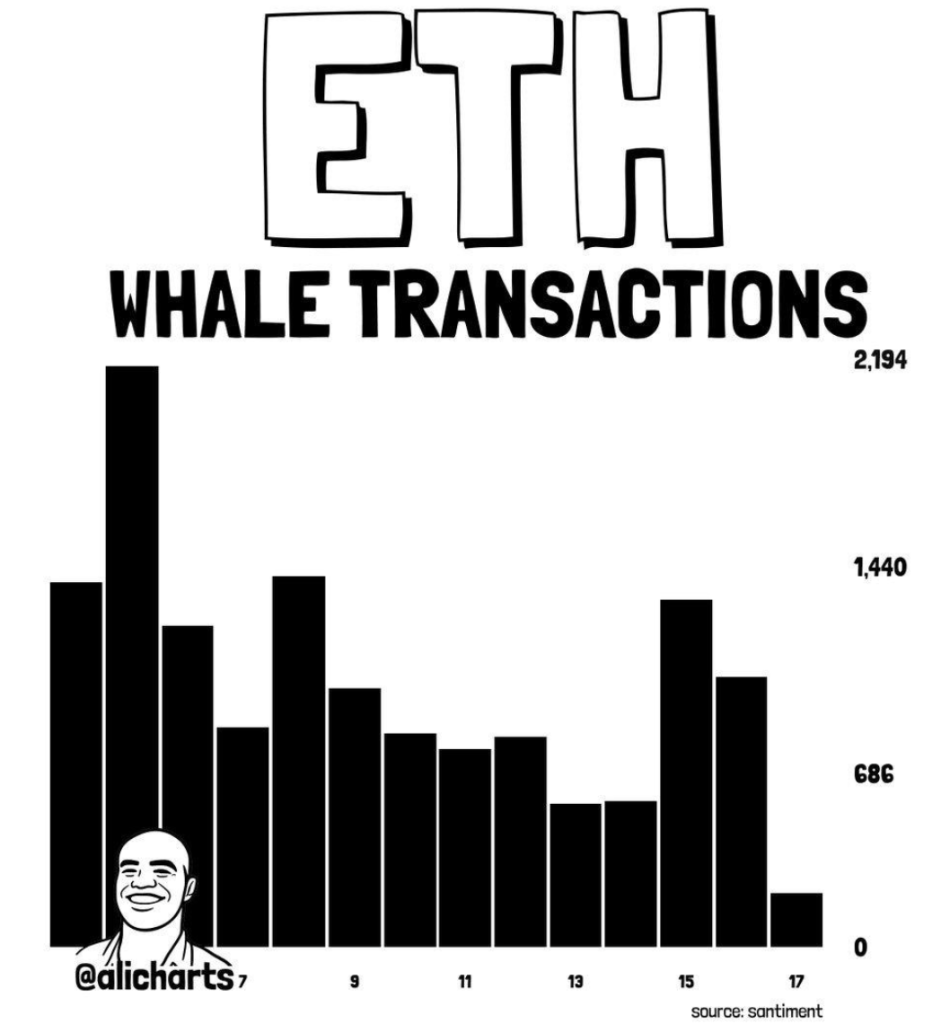
Ethereum Whales Appear To Be Sitting on the Sidelines
Large transactions are often viewed as a window into institutional behavior and broader market conviction. When whales become active, traders typically pay attention because those movements can signal accumulation, distribution, or major shifts in sentiment.
The recent collapse in whale activity doesn’t necessarily mean large investors are selling. In fact, it may suggest the opposite. Many of these market participants appear to be taking a wait-and-see approach while uncertainty continues to dominate headlines. With so many external factors influencing markets right now, sitting on the sidelines may simply be the preferred strategy.
This sharp slowdown stands out because it is one of the most significant drops in whale participation seen in months. Whether that changes in the coming weeks could play a major role in determining Ethereum’s next direction.
Macro Pressure Continues to Weigh on ETH
Ethereum’s weakness isn’t happening in isolation. Broader financial markets have been grappling with renewed geopolitical concerns, particularly surrounding tensions between Israel and Iran. Investors worry that a prolonged conflict could impact global energy supplies and create additional inflationary pressure, both of which tend to reduce appetite for risk assets.
At the same time, stronger-than-expected economic data from the United States has complicated hopes for easier monetary policy. Solid employment numbers have strengthened expectations that the Federal Reserve may keep interest rates elevated for longer than previously anticipated.
Higher rates generally tighten liquidity conditions and make speculative assets less attractive. Cryptocurrencies often feel that pressure quickly, and Ethereum has been no exception. As uncertainty grows, volatility has surged. The Ethereum Volmex Implied Volatility Index jumped roughly 26% over the past week, highlighting the nervous mood across the market.
Technical Signals Keep Bears in Control
From a chart perspective, Ethereum still has work to do before sentiment can improve meaningfully. ETH remains below its 50-day, 100-day, and 200-day moving averages, a setup that continues to favor the bears.
Momentum indicators offer mixed signals. The Relative Strength Index has slipped into oversold territory, which can sometimes hint at a potential bounce. However, the MACD remains pointed downward, suggesting that bearish momentum has not fully disappeared. In short, sellers still hold the advantage, even if downside pressure is beginning to look somewhat stretched.
For many traders, the most important level sits near $1,500. This zone has emerged as a critical support area and could determine Ethereum’s next major move. If buyers successfully defend it, confidence may gradually return. But if that support fails, analysts warn that ETH could face a much deeper decline, with $1,000 becoming the next major psychological target.
Analysts Remain Bullish Despite Near-Term Weakness
Interestingly, not everyone is focused on the current weakness. Several market analysts continue to argue that Ethereum’s long-term structure remains intact despite the challenging backdrop.
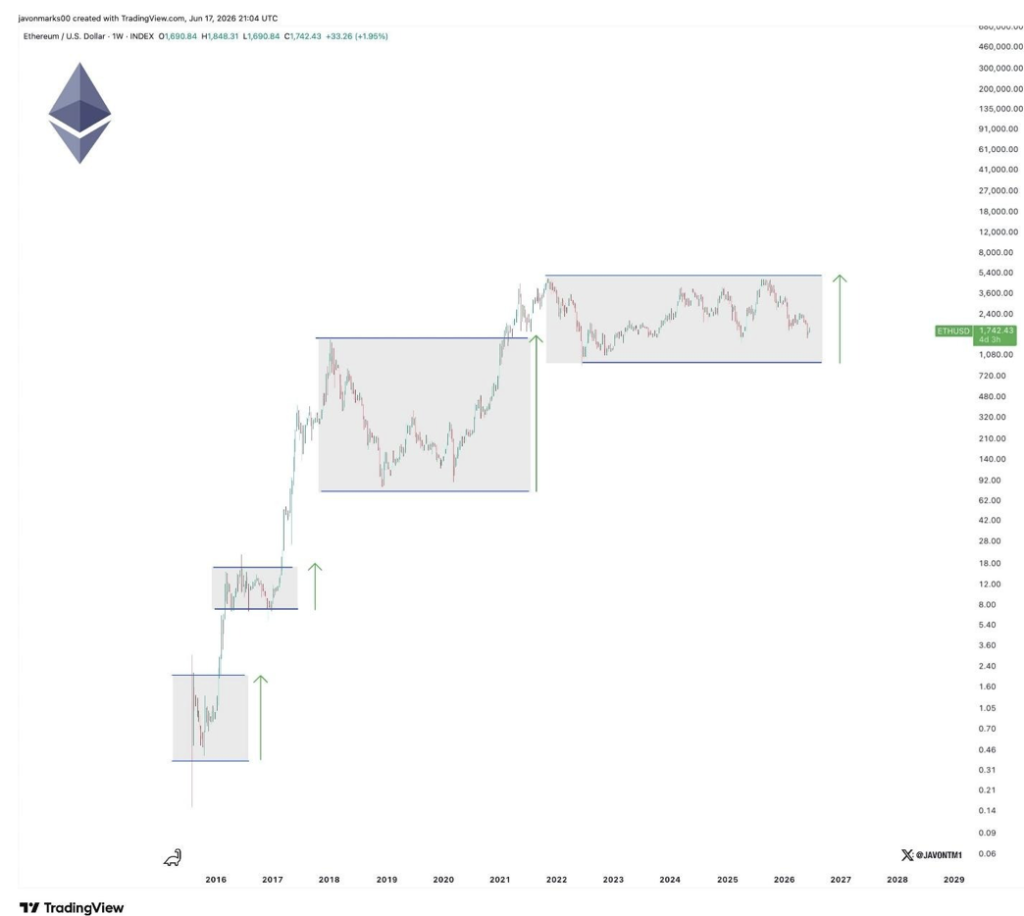
Analyst Javon Marks recently pointed to historical consolidation patterns and breakout formations dating back nearly a decade. According to his analysis, Ethereum still shows what he describes as strong structural integrity. Based on previous market cycles, he believes ETH could eventually revisit the $4,800 to $5,000 range before potentially targeting levels near $8,500 if historical trends continue to repeat.
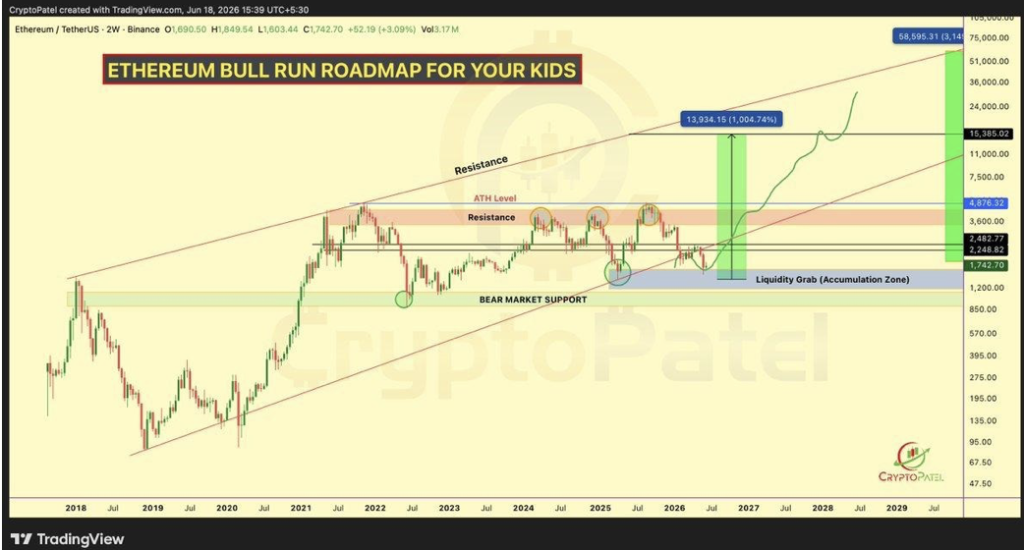
Crypto analyst Patel takes an even more ambitious view. Looking several years ahead, his framework outlines multiple valuation scenarios extending into 2029 and 2030. Under his most conservative outlook, Ethereum could reach roughly $5,000. His base case points toward $12,000, while his most bullish projections suggest ETH could eventually trade somewhere between $30,000 and $60,000.
Those targets may sound aggressive today, especially with Ethereum struggling around $1,700. Still, supporters argue that the asset’s growing role in decentralized finance, tokenization, and digital infrastructure could eventually lead investors to view Ethereum less as a speculative cryptocurrency and more as a global financial network.
For now, though, the market remains focused on the short term. Until whale activity returns and macroeconomic pressures ease, Ethereum may continue fighting an uphill battle.