
- White House officials are meeting with law enforcement groups to address concerns before a potential Senate vote.
- Galaxy Digital has reduced its estimated odds of passage from 75% to 60% due to time constraints and unresolved issues.
- Stablecoin rules, developer protections, and anti-money laundering provisions remain major points of debate.
For much of 2026, the CLARITY Act has been viewed as one of the most significant pieces of cryptocurrency legislation moving through Washington. Supporters see the bill as a chance to establish long-awaited regulatory certainty for digital assets, while critics continue to push for stronger safeguards around compliance and consumer protection.
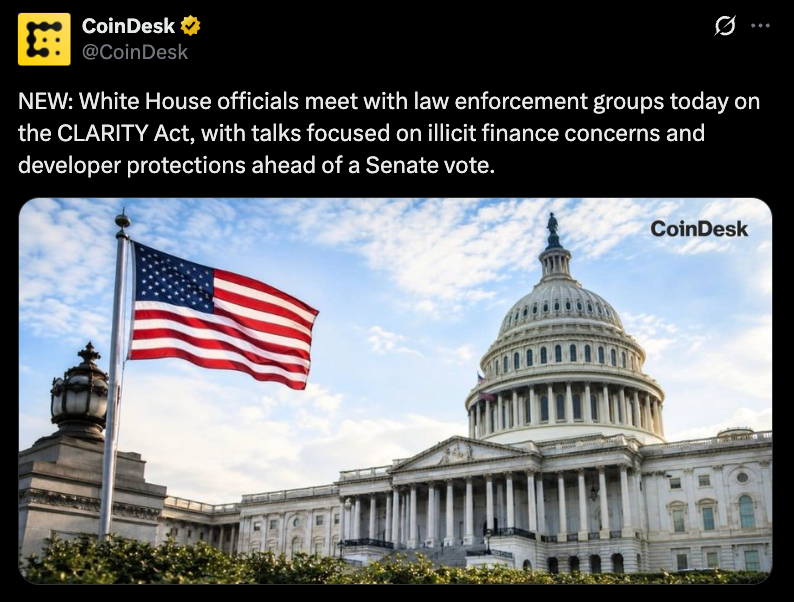
Now, with the Senate calendar tightening and lawmakers facing increasing pressure to resolve key disagreements, the legislation is entering what may be its most important phase yet. White House officials are reportedly meeting with law enforcement organizations to discuss concerns related to illicit finance and software developer protections before a possible Senate floor vote.
Why the Odds of Passage Have Fallen
One of the biggest developments this week came from Galaxy Digital, which lowered its estimated probability of the CLARITY Act becoming law in 2026 from 75% to 60%. The revision was not necessarily driven by growing opposition to the bill but rather by the realities of the legislative calendar.
Congress is rapidly approaching its August recess, leaving fewer opportunities to negotiate, revise, and pass a complex regulatory framework. Several controversial issues remain unresolved, and lawmakers are running out of time to build consensus.
In Washington, legislative momentum can disappear quickly. A bill does not need overwhelming opposition to stall. Sometimes it simply runs out of available time.
Developer Protections Remain a Key Battleground
One of the most closely watched aspects of the CLARITY Act involves legal protections for software developers and blockchain infrastructure providers. Industry advocates argue that developers who create open-source software should not automatically be held responsible for how third parties use that technology.
Critics, however, worry that broad liability protections could make it more difficult for regulators and law enforcement agencies to combat illicit activity. They argue that any framework must balance innovation with accountability.
The ongoing White House discussions suggest policymakers are still attempting to find common ground before the legislation reaches a full Senate debate.
Stablecoins and Compliance Questions Persist
Beyond developer protections, lawmakers continue to wrestle with several other contentious issues. Stablecoin regulations remain one of the largest sticking points, particularly regarding yield-bearing products and how they should be supervised.
Anti-money laundering requirements also continue to generate debate. Lawmakers broadly agree that digital assets should operate within a clear regulatory framework, but disagreement remains over how strict those standards should be and how enforcement responsibilities should be divided among agencies.
Ethics concerns surrounding political ties to the crypto industry have also emerged as another factor complicating negotiations.
Why the Crypto Industry Still Sees Progress
Despite the reduced odds estimated by Galaxy Digital, many industry participants remain optimistic. A 60% chance of passage still represents a meaningful possibility, and the broader conversation itself demonstrates how much crypto policy has evolved in recent years.
Not long ago, lawmakers were debating whether digital assets deserved a regulatory framework at all. Today, the discussion has shifted toward the finer details of market structure, compliance obligations, developer liability, and institutional participation.
That shift alone signals that cryptocurrency is increasingly being treated as a permanent component of the financial system rather than a temporary experiment.
The Coming Weeks Could Be Decisive
The CLARITY Act remains one of the most important legislative initiatives for the digital asset industry, but its path forward is becoming increasingly complicated. With Senate time running short and multiple policy disputes still unresolved, the coming weeks could determine whether the bill reaches the finish line this year or faces further delays.
Regardless of the outcome, one thing is becoming clear: Washington is no longer debating whether crypto matters. The debate has evolved into determining how digital assets should fit within America’s financial and regulatory framework.