- Polymarket traders currently assign a 52% chance that the CLARITY Act becomes law in 2026.
- Lawmakers have a narrow four-week window before Congress breaks again around July 4.
- Delays could push the legislation into a more unpredictable political environment following the 2026 midterm elections.
For years, the crypto industry has asked Washington for one thing above almost everything else: clear rules. After countless hearings, regulatory disputes, lawsuits, and policy debates, lawmakers finally appear closer than ever to delivering meaningful market structure legislation. The challenge now is not whether the conversation is happening. It is whether Congress can move fast enough.
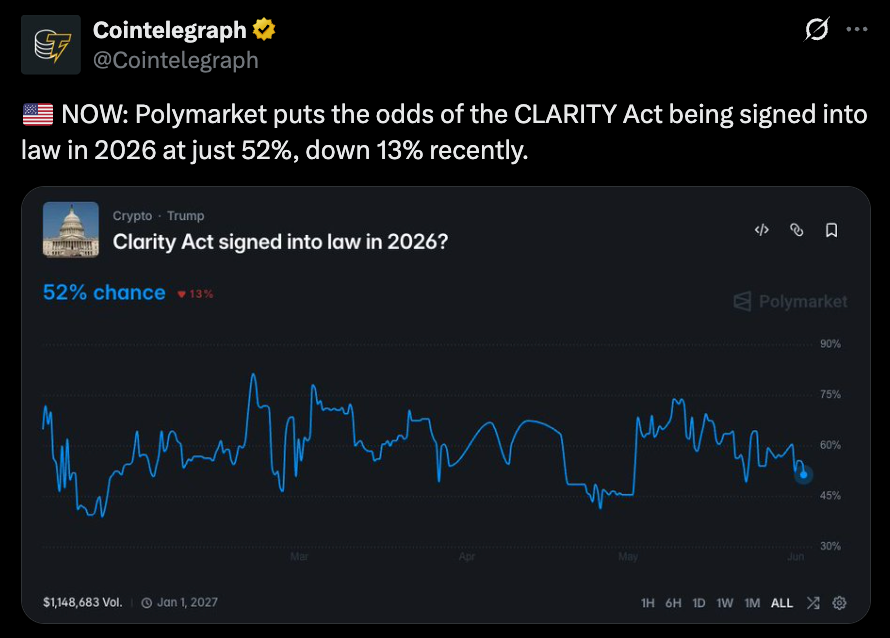
According to Polymarket, traders currently place the odds of the CLARITY Act becoming law in 2026 at approximately 52%. While that still makes passage slightly more likely than not, confidence has weakened noticeably in recent weeks. The decline suggests growing concern that the legislative process may be running short on time.
The Clock Is Starting To Matter
The Senate has now returned from its Memorial Day recess, creating what many observers view as a crucial four-week stretch for the legislation. Lawmakers have limited time to advance the bill before Congress heads into another break around the July 4 holiday.
That timeline matters because major legislation rarely moves quickly. Committee reviews, negotiations, amendments, and procedural hurdles can consume weeks or even months. Every delay increases the risk that the bill becomes entangled in competing political priorities.
For crypto supporters, the current window represents one of the best opportunities to push the legislation forward before the calendar becomes even more complicated.
Why The CLARITY Act Is So Important
The CLARITY Act is widely viewed as one of the most significant crypto regulatory proposals ever introduced in the United States. Its primary goal is to establish a clearer framework for digital asset regulation while defining which agencies oversee different segments of the industry.
For crypto companies, the appeal is obvious. Many businesses have spent years operating in an environment where regulatory responsibilities often overlap and enforcement actions sometimes arrive without clear guidance. Greater certainty could reduce legal risks and encourage long-term investment.
While regulatory legislation may not generate the excitement of a new token launch or ETF approval, clear rules often have a much bigger impact on institutional participation. Large financial firms generally prefer operating in markets where compliance requirements are clearly defined rather than open to interpretation.
Institutional Capital Is Watching
One reason the industry continues pushing for market structure legislation is the potential impact on institutional adoption. Pension funds, asset managers, banks, and public companies often require regulatory clarity before committing significant resources to emerging markets.

The passage of spot Bitcoin ETFs demonstrated how quickly institutional participation can accelerate once regulatory barriers are addressed. Many crypto advocates believe the CLARITY Act could have a similar effect by providing a clearer roadmap for businesses operating across the digital asset ecosystem.
If that happens, the legislation could influence everything from venture capital investment to blockchain development and corporate adoption.
The Midterm Election Risk
Perhaps the biggest concern surrounding the bill is not direct opposition but timing. If lawmakers fail to advance the legislation soon, the process could spill into a political landscape shaped by the 2026 midterm elections.
Election cycles often bring changes in congressional leadership, committee assignments, and legislative priorities. A bill that appears well-positioned today may face a very different environment after voters head to the polls.
That uncertainty is one reason some market participants have become more cautious. The path to passage exists now, but there is no guarantee the same conditions will remain in place next year.
A Defining Moment For Crypto Regulation
The CLARITY Act has entered what may be its most important phase yet. After years of debate about how digital assets should be regulated, lawmakers finally have an opportunity to establish a comprehensive framework for the industry.
Prediction markets still lean slightly toward passage, but the narrowing odds suggest confidence is becoming increasingly fragile. For crypto companies, investors, developers, and institutions waiting on the sidelines, the next few weeks could prove far more important than many realize.
Sometimes the biggest catalyst in a market is not a breakthrough technology or a soaring token price. Sometimes it is legislation moving through Congress at exactly the right moment. If the CLARITY Act advances during this window, it could become one of the most important developments in crypto’s history.