
- Solana remains a technologically advanced blockchain with major speed advantages over Ethereum.
- Daily active wallet addresses have fallen more than 80%, raising concerns about slowing adoption.
- Weak network growth may limit SOL’s upside potential despite its sharp decline from all-time highs.
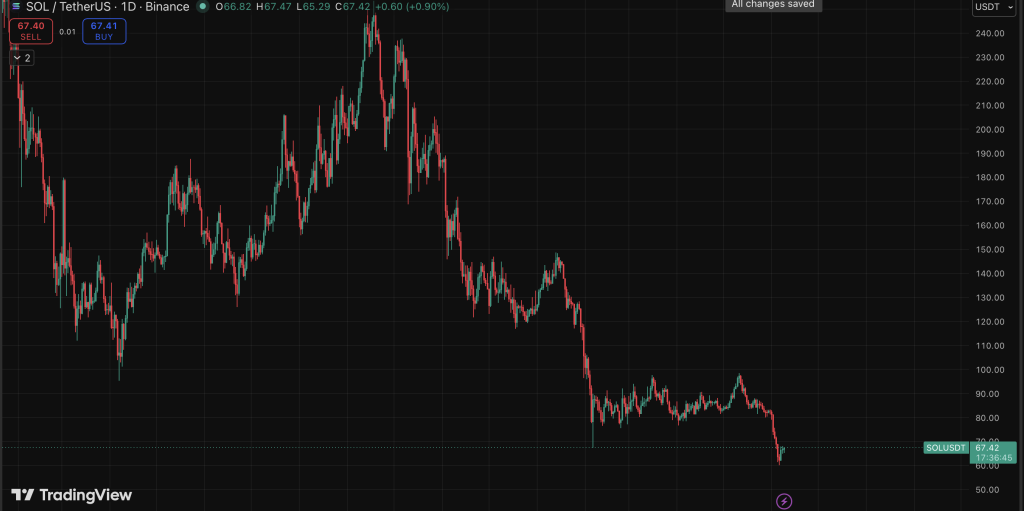
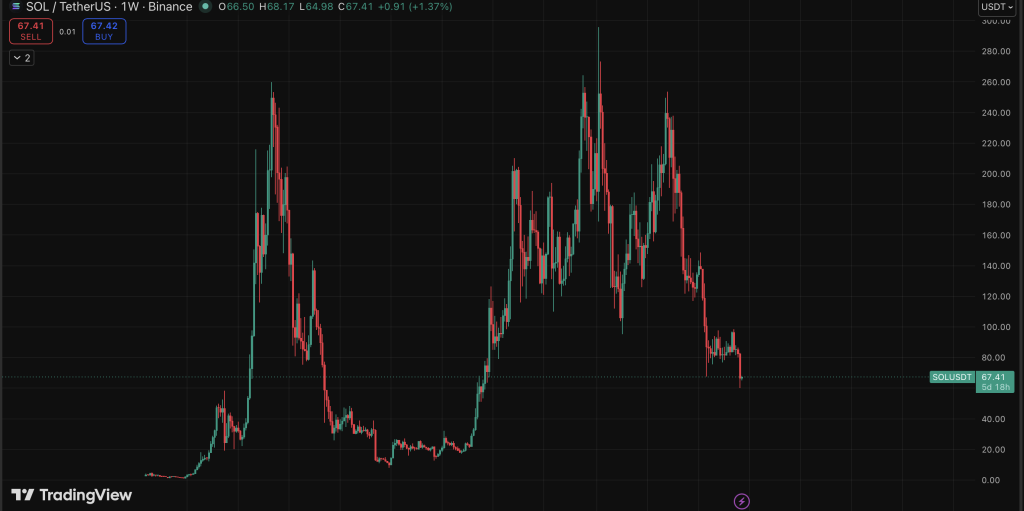
The cryptocurrency market has been brutal this year, and Solana has not escaped the damage. While the total value of the crypto market has been cut roughly in half from its 2025 peak, some individual assets have suffered even steeper losses. Solana is one of them. The token is currently down around 74% from its all-time high, a staggering decline that has left investors wondering whether they are looking at a bargain or a value trap.
At first glance, the selloff might seem excessive. Solana powers one of the largest blockchain ecosystems in the industry and continues to attract developers building decentralized applications. Yet despite its legitimate use case and strong technology, the token remains trapped in the broader crypto downturn. That disconnect is forcing investors to ask a difficult question: does Solana’s lower price create an opportunity, or are there deeper problems underneath the surface?
Solana Still Offers a Strong Alternative to Ethereum
Solana was designed to compete directly with Ethereum, the dominant smart contract platform in crypto. Both networks allow developers to build decentralized applications, commonly known as dApps, which can power everything from financial services and gaming platforms to NFT marketplaces and tokenized assets.
The core idea behind these applications is relatively simple. Instead of relying on a company or central authority, they run through smart contracts, pieces of code that automatically execute predefined rules. Once deployed, those contracts generally cannot be altered, which helps reduce the need for trust between participants.
Like Ethereum, Solana operates through a decentralized network of validators spread across the globe. That structure helps keep the network online even if individual nodes experience problems. No single data center controls the system, which is one of blockchain technology’s biggest selling points.
Speed Remains Solana’s Biggest Advantage
Where Solana really separates itself is performance. Ethereum relies on a proof-of-stake system that secures the network by requiring validators to lock up tokens as collateral. Solana uses a similar approach but adds a second mechanism known as proof-of-history.
Proof-of-history timestamps transactions before they are processed, allowing validators to verify activity much faster. The result is a network capable of handling thousands of transactions per second while maintaining relatively low fees.
That speed advantage matters because every interaction with a decentralized application triggers activity on the blockchain. Whether someone is making a trade, buying an NFT, or using a DeFi protocol, those actions generate transactions. When a network becomes congested, costs rise and the user experience suffers.
Ethereum has made major improvements over the years, but it can still face congestion during periods of heavy activity. Solana, by contrast, was built with scalability in mind from the start. For developers looking to build high-volume applications, that remains an attractive proposition.
The Adoption Problem Is Becoming Harder to Ignore
Technology alone, however, does not guarantee success. A blockchain only creates lasting value if people actually use it.
This is where the current concerns begin. Solana’s daily active wallet addresses peaked at roughly 8.79 million in October 2024. Since then, that figure has dropped dramatically, falling to around 1.48 million by June 2026. That’s an 83% decline, and it suggests user activity has cooled significantly.
The slowdown helps explain why the Solana token has struggled. Every time users interact with applications on the network, fees are paid in SOL. More activity generally means greater demand for the token. When participation declines, that demand weakens.
For investors, the trend raises an uncomfortable possibility. If network growth continues moving in the wrong direction, Solana’s long-term valuation may become increasingly disconnected from its underlying technology.
Mainstream Adoption Remains the Missing Piece
Another challenge is visibility outside the crypto community. While Solana hosts several successful applications, many of its largest projects remain relatively unknown to mainstream audiences.
Platforms such as Jupiter and Magic Eden are widely recognized among crypto enthusiasts, but the average consumer has likely never interacted with them. Without broader adoption, the ecosystem risks becoming dependent on a relatively small group of crypto-native users.
That’s important because the next phase of growth for blockchain networks will likely require attracting people who are not already immersed in digital assets. Until that happens, user growth may remain inconsistent and heavily tied to speculative market cycles.
Is Solana Really a Buy on the Dip?
There is no denying that Solana possesses impressive technology. It remains one of the fastest major blockchains in the market and continues to offer meaningful advantages in terms of speed and transaction costs. Those strengths have not disappeared simply because the token price fell.
At the same time, investors cannot ignore the sharp decline in network activity. Falling wallet participation, slower adoption growth, and a lack of widespread mainstream engagement create real uncertainty around future demand for SOL.
For now, Solana’s price may be driven as much by investor sentiment as by fundamentals. Until network growth begins accelerating again, predicting the token’s long-term trajectory becomes considerably more difficult. That’s why some analysts remain cautious despite the deep discount from previous highs. A lower price alone does not automatically make an asset a compelling buy.