

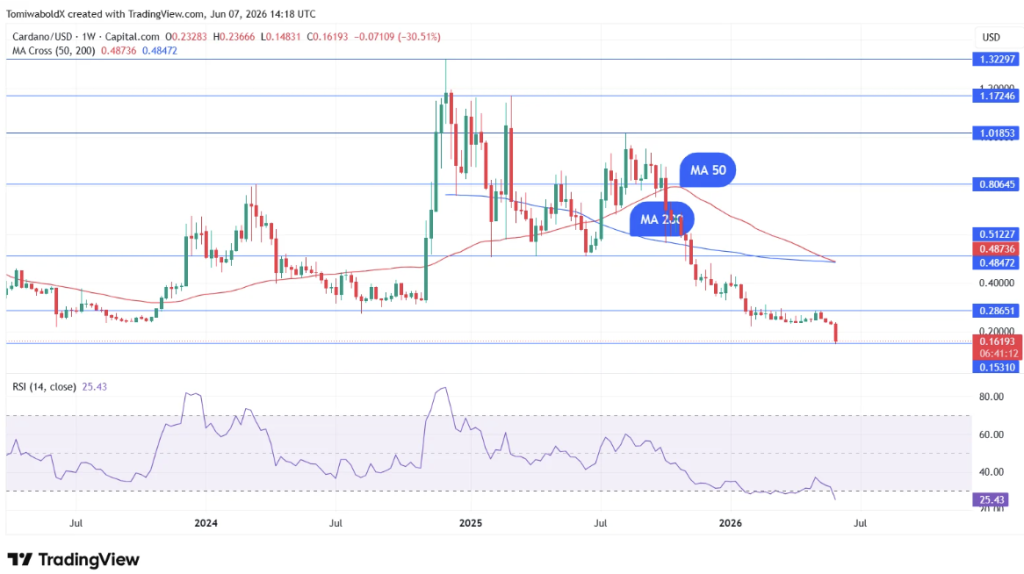
- Cardano is approaching a potential weekly death cross as the 50-week and 200-week moving averages converge.
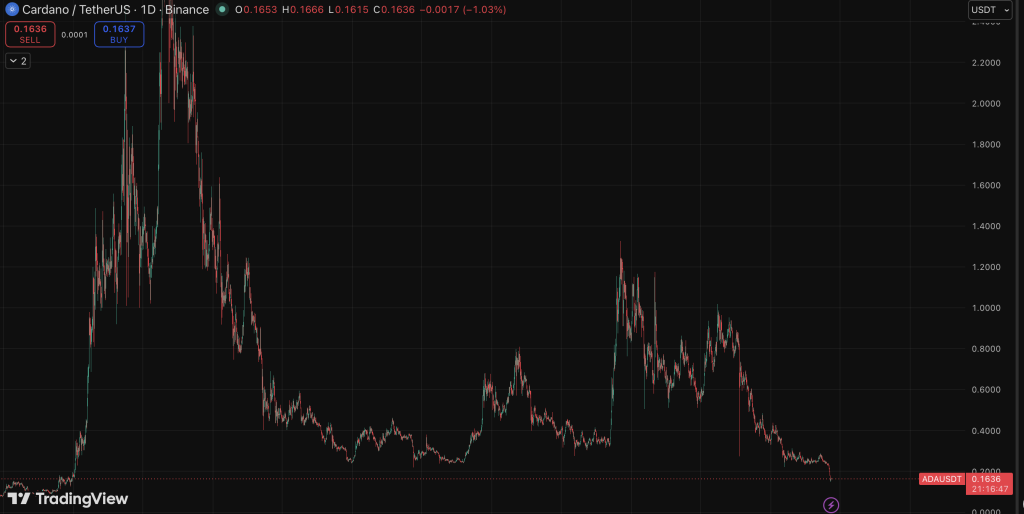
- ADA recently fell to its lowest level since 2020 amid broader crypto market weakness.
- Oversold indicators suggest a possible bottoming process, but further downside remains possible if support levels fail.
Cardano may be approaching a technical event that many traders would rather avoid. On the weekly chart, the 50-week moving average and the 200-week moving average have now converged, setting the stage for a potential death cross in the coming weeks if current conditions persist.
While moving average crossovers don’t guarantee future price direction, they often attract significant attention because they reflect changes in long-term momentum. Right now, Cardano’s 50-week moving average continues drifting lower and appears increasingly likely to cross beneath the 200-week average. If that happens, the network would register its first weekly death cross of 2026.
For a market already dealing with weak sentiment and heavy selling pressure, the timing isn’t exactly ideal.
What a Death Cross Actually Means
A death cross occurs when a shorter-term moving average falls below a longer-term moving average, signaling that recent price performance has weakened relative to the broader trend. The opposite formation, known as a golden cross, is generally viewed as a bullish development because it suggests strengthening momentum.
It’s important to remember, though, that these signals are lagging indicators. They don’t predict future moves. Instead, they reflect what’s already happened.
Cardano’s last weekly death cross appeared in December 2022, following a brutal bear market that saw ADA collapse from its all-time high near $3 reached in September 2021. Interestingly, the death cross arrived after much of the damage had already occurred.
In the months that followed, ADA largely traded sideways. While prices didn’t immediately explode higher, the period ultimately helped establish a longer-term base from which the asset later recovered.
That’s why experienced traders often treat death crosses with caution rather than panic. Sometimes they appear near market bottoms instead of market tops.
Previous Golden Cross Failed to Spark a Lasting Rally
The limitations of moving average signals became clear again in 2025.
Cardano formed a weekly golden cross in July of that year, a development many investors interpreted as confirmation that a larger bullish trend was beginning. Initially, the signal seemed promising. ADA climbed toward $1.02 shortly after the crossover.
But the excitement didn’t last.
Selling pressure eventually returned, erasing much of the advance and pushing Cardano back into a prolonged downtrend. The experience served as a reminder that technical signals work best when supported by strong market fundamentals and improving investor sentiment.
At the moment, neither of those factors appears particularly strong.
ADA Falls to Levels Not Seen Since 2020
The broader market downturn has hit Cardano especially hard.
ADA recently dropped to approximately $0.148, its lowest level since December 2020. The decline reflects both the ongoing weakness across the crypto market and growing concerns surrounding Cardano’s ecosystem.
Investor confidence has been shaken by shrinking ecosystem activity, reduced capital flows, and increasing uncertainty about when meaningful growth might return. While many blockchain networks are struggling during the current market cycle, Cardano’s challenges have become particularly visible.
As prices continue hovering near multi-year lows, traders are searching for any sign that selling pressure may finally be reaching exhaustion.
Hoskinson Warns of Difficult Times Ahead
Adding to the uncertainty, Cardano founder Charles Hoskinson recently delivered a sobering message regarding the state of the ecosystem.
In a video update, Hoskinson warned that the broader crypto industry may face additional failures as the bear market continues. He acknowledged growing challenges across the sector while emphasizing that he remains committed to Cardano despite earlier comments suggesting he was taking a temporary step back.
His remarks reflected both concern and frustration. According to Hoskinson, the ecosystem is approaching a critical moment where difficult decisions may need to be made if growth and adoption fail to accelerate.
The comments quickly spread across the community, reinforcing the sense that Cardano is navigating one of its most difficult periods in recent years.
Is a Bottom Beginning to Form?
Despite the negativity, there are a few reasons some investors remain cautiously optimistic.
Several momentum indicators are now entering deeply oversold territory, suggesting that the recent selloff may be becoming stretched. Historically, extreme oversold conditions have often appeared near important turning points, although they do not guarantee an immediate reversal.
If Cardano follows a pattern similar to previous cycles, a confirmed bottom after the death cross could eventually pave the way for a recovery toward the $0.20 and $0.30 levels. Those areas represent logical upside targets if market conditions begin stabilizing.
However, the bearish scenario remains very much alive.
Should selling pressure continue and support levels fail to hold, attention could shift toward the $0.10 region. At that point, traders would likely begin reassessing where long-term demand may emerge.
Cardano Faces a Defining Period
Cardano currently sits at the intersection of technical weakness, ecosystem concerns, and broader market uncertainty. The potential weekly death cross is unlikely to determine the project’s future on its own, but it does highlight how much momentum has deteriorated over the past year.
For now, the market remains caught between fear and opportunity. Bears point to the ongoing downtrend and weakening fundamentals. Bulls focus on oversold conditions and the possibility that much of the bad news is already priced in.
Either way, the coming weeks could prove crucial for ADA as traders watch closely to see whether the next major signal marks an ending, or a beginning.