
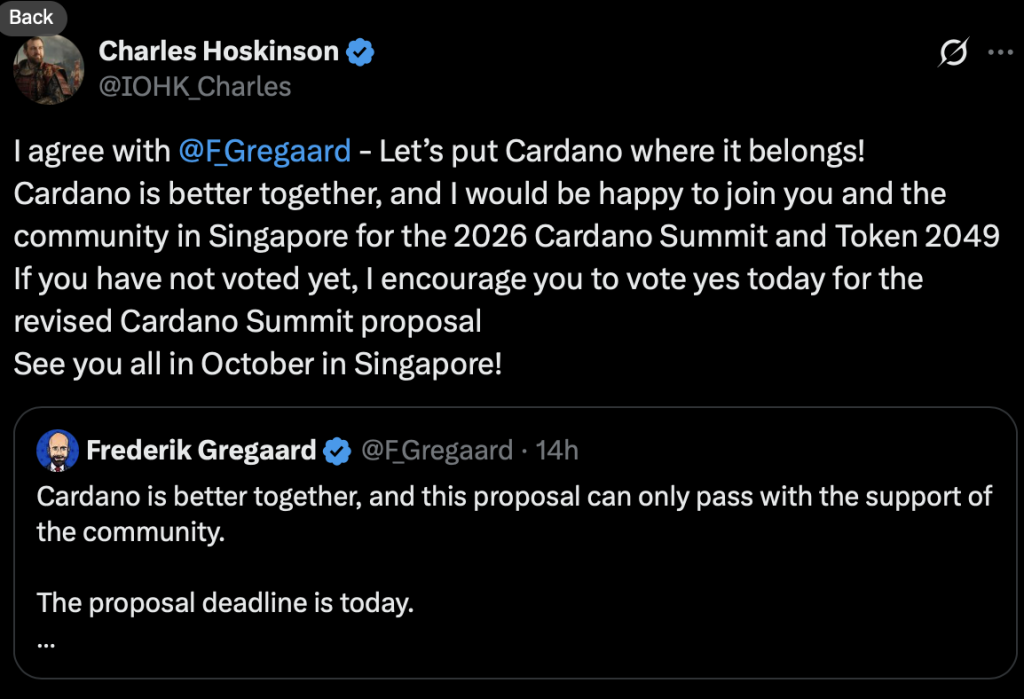
- Charles Hoskinson and Frederik Gregaard publicly backed a proposal seeking 7.8 million ADA for Cardano Summit 2026.
- The revised proposal cuts costs by 22% and introduces audits, milestone payments, and treasury safeguards.
- The vote serves as a major test of Cardano’s on-chain governance system following the Chang hard fork.
Cardano’s governance system found itself under the spotlight as founder Charles Hoskinson and Cardano Foundation CEO Frederik Gregaard publicly urged the community to support a revised proposal seeking treasury funding for the Cardano Summit 2026. Their endorsements arrived just hours before voting closed on May 29, adding extra weight to what had already become one of the ecosystem’s most closely watched governance decisions this year.
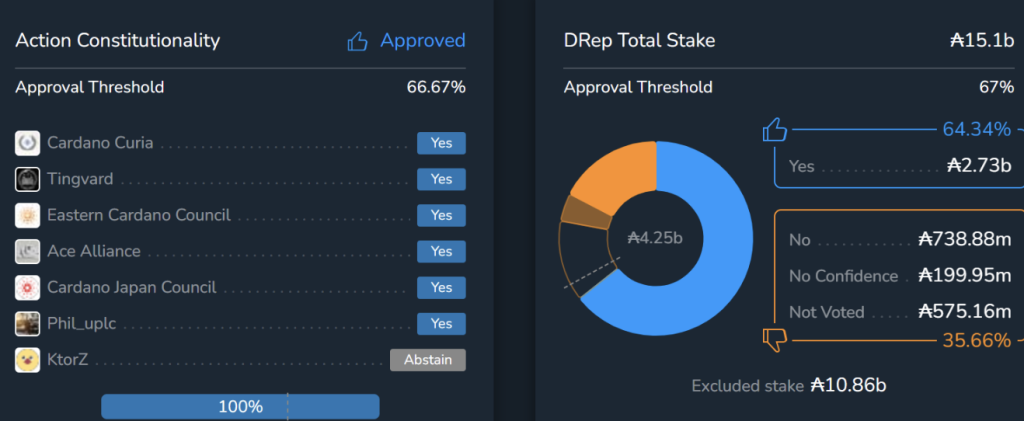
At the center of the debate sits a request for 7.8 million ADA from the Cardano treasury, valued at roughly $2 million based on current market prices. The proposal requires approval from delegated representatives, or DReps, under Cardano’s evolving on-chain governance framework. As the deadline approached, support was hovering near 65%, just below the required 66.67% threshold needed for passage. That left the outcome hanging on a relatively small portion of uncast votes, creating a tense final stretch for both supporters and critics.
Hoskinson made his position clear, encouraging those who had not yet participated to vote in favor of the updated proposal. The push reflected more than just support for an event. It also highlighted the growing importance of governance participation as Cardano transitions toward a more community-driven decision-making model.
Singapore Chosen as Cardano’s Next Global Stage
If approved, the treasury allocation would fund a two-day Cardano Summit scheduled for October 5 and 6, 2026, in Singapore. Organizers view the location as a strategic move designed to strengthen Cardano’s presence across Asia, one of the fastest-growing regions for blockchain innovation, institutional adoption, and digital asset development.
The Cardano Foundation argued that Singapore offers direct access to developers, investors, regulators, and financial institutions that are actively shaping the future of the blockchain industry. Rather than simply hosting another conference, the goal is to position Cardano at the center of conversations happening throughout the region.
The proposal arrives at a time when the community is increasingly scrutinizing how treasury funds are spent. As Cardano’s treasury continues growing, members have become more vocal about ensuring expenditures generate measurable value. That reality forced organizers to rethink the original plan and present a version that many believe better aligns with community expectations.
Revised Proposal Adds Accountability Measures
One of the key reasons the proposal gained support was the addition of stronger oversight and accountability provisions. The revised budget was reduced by approximately 22% compared to the original request, addressing concerns that costs were too high relative to current market conditions.
Organizers also removed a planned sponsorship connection with TOKEN2049 and introduced several mechanisms designed to improve transparency. These include milestone-based payments, independent audits, and a public dashboard that would allow the community to monitor spending throughout the planning process.
Fund management would be handled through a smart contract developed by Sundae Labs, providing automated oversight and reducing the potential for misuse. Any unused ADA would automatically be returned to the treasury rather than remaining under organizer control. In addition, an oversight committee involving Intersect and DQuadrant would monitor progress and ensure compliance with governance requirements established under Cardano’s constitutional framework.
For many voters, these changes transformed the proposal from a simple funding request into a broader experiment in treasury accountability.
Governance Vote Becomes Another Test for Cardano’s Future
Beyond the summit itself, the vote represents another important milestone in Cardano’s governance evolution following the implementation of the Chang hard fork. The network has spent months transitioning toward a system where ADA holders and delegated representatives play a larger role in shaping ecosystem decisions, and this proposal serves as one of the biggest real-world tests of that model so far.
Supporters argue that hosting a flagship event in Asia could strengthen adoption, attract new partnerships, and expand Cardano’s global reach. EMURGO CEO Phillip Pon publicly backed the proposal, citing its alignment with the ecosystem’s broader strategic goals.
Not everyone agreed. Several DReps voted against the measure, arguing that treasury spending should remain conservative given ongoing market uncertainty and competing priorities throughout the ecosystem. Their concerns centered on fiscal discipline, questioning whether now is the right time for a large event expenditure.
The outcome carries meaningful consequences either way. Approval would unlock funding under strict oversight conditions and allow preparations for Cardano’s Asia-Pacific debut to move forward. Rejection, meanwhile, could force organizers to scale back plans significantly or postpone the event altogether.
Regardless of the final result, the vote underscores a larger reality: Cardano’s governance era is no longer theoretical. Decisions involving millions of ADA are now being debated, challenged, and decided directly by the community itself, exactly as the network’s governance roadmap envisioned.