

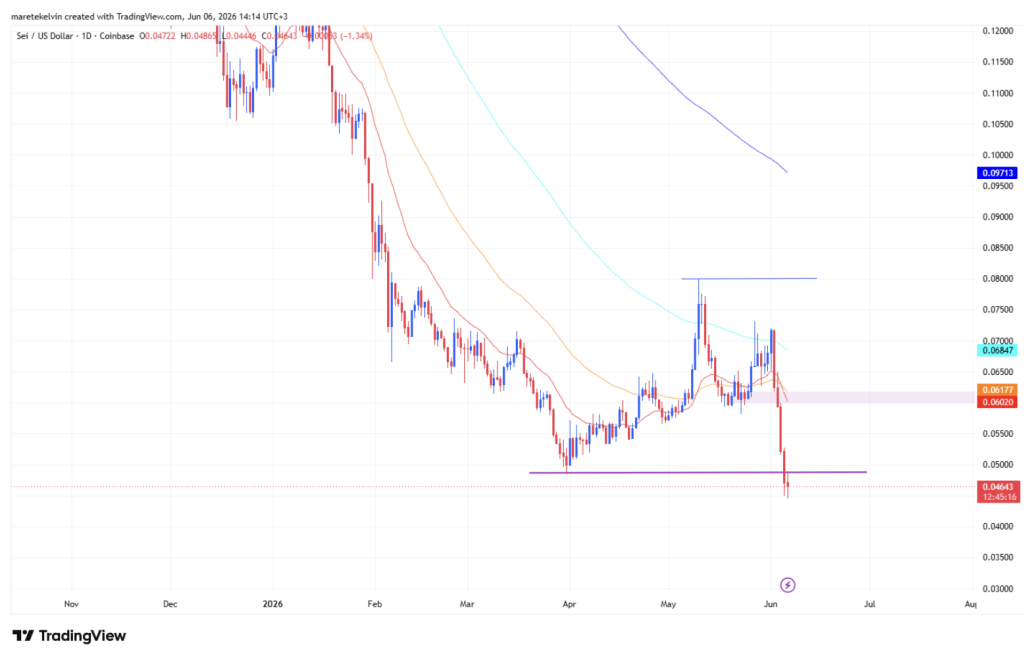
- SEI lost key support near $0.049 as selling pressure continued dominating the market.
- Open Interest fell 7% while long liquidations exceeded $553,000, signaling bullish traders are being forced out.
- A recovery toward $0.06 remains possible, but only if buyers regain control and liquidation pressure eases.
SEI continues to struggle under mounting selling pressure, with the token failing to hold a critical support area near $0.049. What initially looked like a routine pullback is now beginning to resemble something more concerning, as both price action and derivatives data point toward weakening confidence across the market.
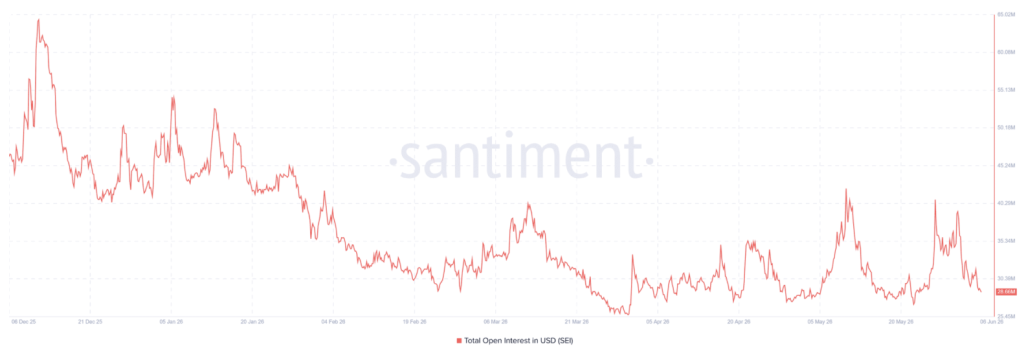
One of the clearest signs comes from Open Interest. At the time of writing, total Open Interest had fallen roughly 7% to around $29 million. On its own, that may not sound alarming. Markets regularly see capital rotate in and out. But when Open Interest declines alongside falling prices, it often suggests traders are exiting positions rather than stepping in to buy discounted assets. Right now, that’s exactly what appears to be happening.
Long Traders Are Taking the Biggest Hit
The more worrying development involves bullish traders who were betting on a recovery. Over the past 24 hours, long liquidations surged to approximately $553,000 as SEI continued moving lower.
In simple terms, traders expecting a bounce were forced out of their positions as prices failed to cooperate. Those liquidations don’t just represent losses. They also create additional market sell pressure because positions are automatically closed, pushing more tokens onto the market at the worst possible moment.
It’s a frustrating cycle. Prices fall, leveraged longs get liquidated, more selling enters the market, and prices fall even further. Over the last several trading sessions, that pattern has become increasingly visible across SEI’s chart.
Meanwhile, short sellers have largely avoided the same level of pain, highlighting which side of the market currently holds the advantage.
Traders Appear Content to Stay on the Sidelines
At the same time, overall participation continues fading.
The steady drop in Open Interest suggests many traders are choosing caution over aggression. Rather than rushing to buy the dip, investors seem willing to wait for stronger confirmation that a bottom has actually formed. That hesitation is important because markets often need fresh demand to interrupt a bearish trend.
Right now, that demand isn’t showing up in a meaningful way.
Instead, many market participants appear to be sitting on their hands, watching from the sidelines while sellers remain firmly in control. Until confidence returns, any recovery attempt risks running into resistance from traders looking to reduce exposure rather than add to it.
Technical Structure Remains Weak
From a chart perspective, SEI’s outlook remains fragile. The token is currently trading below several key Exponential Moving Average (EMA) levels, reinforcing the bearish structure that has developed in recent weeks.
Technical traders often view these moving averages as dynamic support zones. Once they are lost, sentiment tends to deteriorate quickly. That’s especially true when price repeatedly fails to reclaim them, which has been the case for SEI.
The combination of falling Open Interest, rising long liquidations, and broken EMA support creates a difficult backdrop for bullish traders. None of those indicators typically appear during healthy uptrends.
That doesn’t mean a recovery is impossible, of course. Markets can reverse when sentiment becomes overly pessimistic. But for now, the evidence continues to favor caution rather than optimism.
Is There Still a Bullish Scenario?
Despite the current weakness, traders haven’t completely abandoned the possibility of a rebound.
If buyers can begin absorbing supply and liquidation pressure starts easing, SEI could eventually stage a relief rally. One area attracting attention sits near the $0.06 region, where an imbalance zone remains unfilled. Markets often revisit these areas during recovery phases, making it a logical upside target should momentum improve.
The challenge is getting there.
Before bulls can think about reclaiming higher levels, they first need to stabilize the market and stop the ongoing stream of forced selling. Without that shift, any bounce risks becoming temporary.
For now, the focus isn’t on the next major rally. It’s on whether SEI can finally find a reason for investors to stop selling. Until that happens, bears remain in control, and the path of least resistance continues pointing lower.