

- ADA fell more than 30%, reaching its lowest price level since 2020 amid a broader crypto market crash.
- Cardano’s ecosystem metrics continue to weaken, with TVL, trading volume, and fee revenue all declining sharply.
- Charles Hoskinson expressed frustration over his inability to directly influence Cardano’s direction despite remaining its most visible figure.
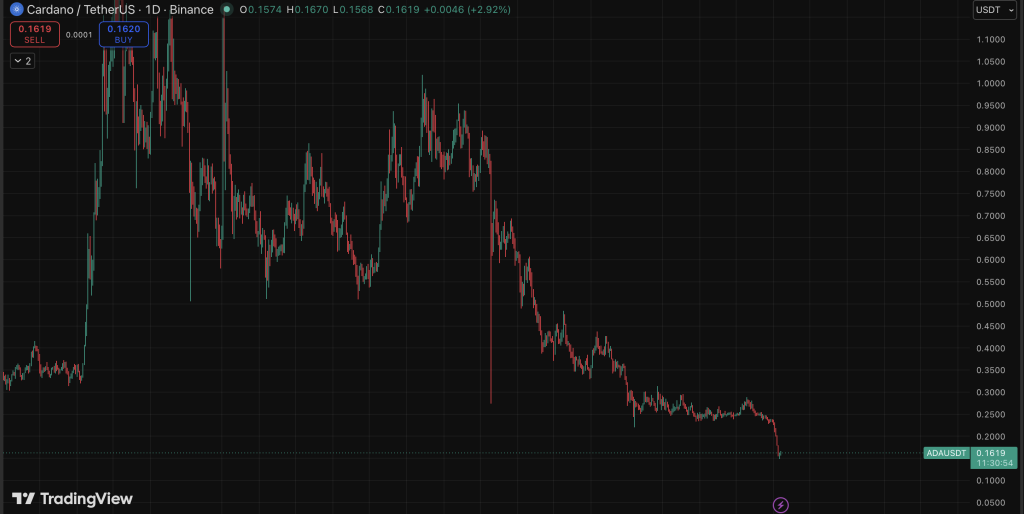
It has been a brutal stretch for Cardano holders. ADA plunged more than 30% over the past week, briefly touching $0.16, a level not seen since 2020. While the broader crypto selloff dragged nearly every major asset lower, Cardano’s collapse carried an extra layer of anxiety. This time, the panic wasn’t just about price action. It was fueled by comments from Cardano founder Charles Hoskinson himself.
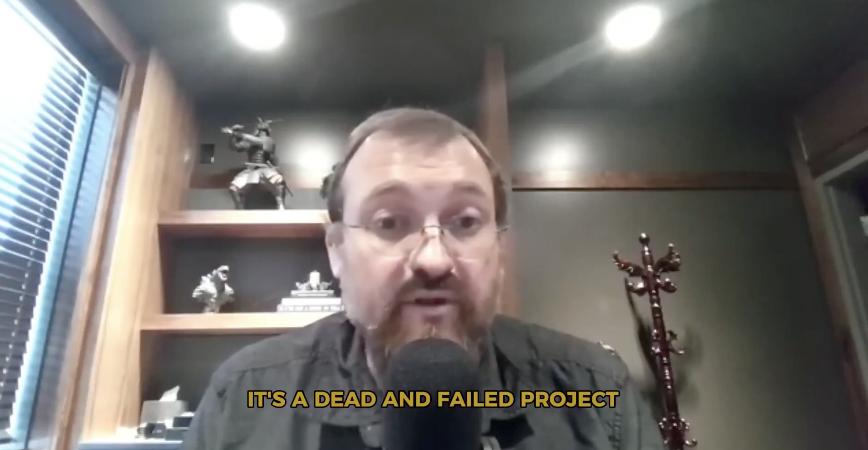
In a candid public discussion, Hoskinson acknowledged something many investors never expected to hear: he no longer has the authority to directly steer the ecosystem’s future. The remarks came shortly after another Cardano-based project announced it was shutting down, reigniting concerns that the network may be entering a prolonged period of decline. For supporters, the question has become increasingly difficult to ignore. Is Cardano simply experiencing another painful bear market, or is the ecosystem facing a deeper structural problem?
Network Activity Rises as Confidence Falls
Oddly enough, Cardano’s collapse has coincided with a surge in user activity. Daily active addresses climbed to a four-month high of roughly 28,500, while ADA’s social media presence reached its strongest level of 2026. During the selloff, approximately one out of every 190 crypto-related conversations online focused on Cardano.
At first glance, that sounds bullish. It isn’t necessarily.
The spike appears driven more by fear and uncertainty than renewed confidence. Traders are checking portfolios, debating Cardano’s future, venting frustrations, and reacting to sharp losses. Activity is rising because people are paying attention, not because capital is flooding back into the ecosystem. The network looks busy on paper, but the underlying sentiment remains fragile.
The Fundamental Metrics Paint a Difficult Picture
The numbers behind Cardano’s ecosystem are arguably more concerning than the price decline itself. Total value locked across Cardano-based decentralized finance applications has fallen dramatically, shrinking from approximately $905 million at its late-2024 peak to around $124-$132 million today. That’s an 85% decline in locked capital.
Trading activity has followed a similar path. Weekly decentralized exchange volume has collapsed from roughly 19 million ADA at its high point in late 2025 to just 1.9 million ADA, one of the weakest readings of the year. Revenue generated by network fees has also dropped sharply, declining around 45% to approximately $724,600.
To put that into perspective, Cardano now generates in an entire week what competing networks such as Solana can produce in only a few hours. That’s not the kind of comparison investors want to see.
Perhaps even more troubling is the behavior of larger market participants. Indicators tracking so-called “smart money” activity have fallen to their lowest levels of 2026. As ADA dropped more than 35% since early May, experienced traders appeared to be reducing exposure rather than accumulating positions.
Governance Strength or Governance Gridlock?
Cardano’s governance system was designed to give the community real decision-making power. This week, it proved that it works. Whether that’s a positive development depends on who you ask.
The Cardano Summit 2026 was canceled after a treasury funding proposal narrowly failed to secure approval. The Cardano Foundation requested 7.8 million ADA, roughly $2 million, to fund the event. While more than 65% of voters supported the proposal, it fell just short of the required two-thirds supermajority.
Supporters argue the result demonstrates true decentralization. The community exercised its voting rights and rejected a proposal it viewed as too expensive. Critics see something else entirely. They argue that Cardano was unable to fund its own flagship conference during a period when visibility, partnerships, and developer outreach matter more than ever.
The debate highlights a growing tension within the ecosystem. Decentralized governance can empower communities, but it can also slow decision-making at critical moments.
Hoskinson’s Frustration Reaches a Boiling Point
Hoskinson’s recent comments reflected mounting frustration. During a livestream, he emphasized that he no longer controls treasury funds, governance mechanisms, trademarks, or many of the ecosystem resources commonly associated with Cardano. Despite that, he remains the public face of the project and often receives the blame whenever things go wrong.
He also outlined several proposals he previously pushed in an effort to strengthen the ecosystem. These included creating a sovereign wealth-style fund backed by ADA, establishing an index fund for ecosystem projects, and acquiring key infrastructure services to support commercialization efforts. According to Hoskinson, each proposal faced criticism or outright rejection.
At one point, he even discussed a radical scenario: rebuilding Cardano from scratch on a new blockchain. Existing ADA would be burned and exchanged for new tokens on a redesigned network. He described the idea as a ghost-town solution that nobody truly wants, but the fact it entered the conversation at all illustrates how frustrated some participants have become.
Where Does ADA Go From Here?
Cardano’s future will likely depend on whether the ecosystem can reverse declining developer activity, attract fresh capital, and rebuild confidence among investors. Right now, the broader market environment isn’t helping. Bitcoin recently fell below key support levels, and historically altcoins tend to suffer even greater losses during these periods.
For bulls, a sustained recovery above $0.26 could signal that the worst phase of the selloff is ending. Combined with stronger on-chain activity and renewed ecosystem growth, that level could open the door toward a move back to $0.30 and beyond.
The bearish scenario remains straightforward. If ADA loses support around $0.16 and remains below it for an extended period, attention could shift toward the next major support zone near $0.12. Beyond that, even $0.10 becomes a realistic target.
A Critical Moment for Cardano
Cardano’s technology continues to earn praise from many developers, and future upgrades such as Leios could improve network performance significantly. But technology alone rarely determines success in crypto. Adoption, capital inflows, developer engagement, and community confidence matter just as much.
At the moment, Cardano finds itself at a crossroads. The ecosystem still has a loyal following, but loyalty by itself cannot reverse shrinking activity and declining investment. For long-term believers, current prices may eventually prove attractive. Yet anyone considering that bet should understand the reality: if a bottom is forming, it’s unlikely to happen overnight.
More often than not, market bottoms are a process. And for Cardano, that process may have only just begun.