
- Solana has reached a record 200,000 tokenized stock holders as on-chain equity adoption accelerates.
- The network currently hosts most of the value tied to tokenized Tesla stock, highlighting growing demand.
- Rising stablecoin liquidity and real-world asset growth could position Solana as a leader in tokenized finance.
Back in late 2024, optimism was everywhere. Following the U.S. election, crypto markets exploded higher, and Solana was one of the biggest beneficiaries. The token surged roughly 82%, eventually climbing to the historic $260 level as investors piled into what many considered the final major leg of the bull market.
Fast forward to 2026, and the mood looks very different.
Crypto has struggled to keep pace with traditional financial markets, particularly U.S. equities. While many expected pro-crypto policies to create a favorable environment for digital assets, actual market performance tells a more complicated story. Stocks have delivered strong double-digit gains since President Donald Trump returned to office, while many major cryptocurrencies have spent much of the year moving in the opposite direction.
That contrast has prompted some analysts to rethink the narrative. One market observer recently described Trump not as a “crypto president” but rather a “pro-stock president.” Looking at the numbers, it’s hard to completely dismiss that argument.
Wall Street Continues to Attract Capital
A major reason for the growing divide comes down to where money is flowing.
Investors have poured capital into U.S. equities, particularly technology and artificial intelligence companies. At the same time, crypto markets have faced a more challenging environment, with risk appetite shifting toward traditional assets offering strong growth stories.
Upcoming IPO activity could reinforce that trend.
SpaceX is widely expected to move closer to a public offering, with some analysts projecting a valuation exceeding $2 trillion. If that happens, it would instantly become one of the largest companies on the planet, attracting enormous investor attention and potentially drawing even more capital into public markets.
For crypto investors hoping that tokenized stocks would bridge the gap, there are still hurdles to overcome. Regulatory uncertainty remains a major concern, especially after the SEC’s recent withdrawal of the so-called innovation exemption. That move reminded markets that tokenized securities may not have a clear path forward just yet.
Yet despite those challenges, Solana appears to be carving out its own lane.
Solana Becomes a Leader in Tokenized Equities
The current market environment is putting blockchain networks to the test. In many ways, this is the moment where Layer-1 chains must prove they can support real-world financial activity beyond speculation.
So far, Solana seems to be doing exactly that.
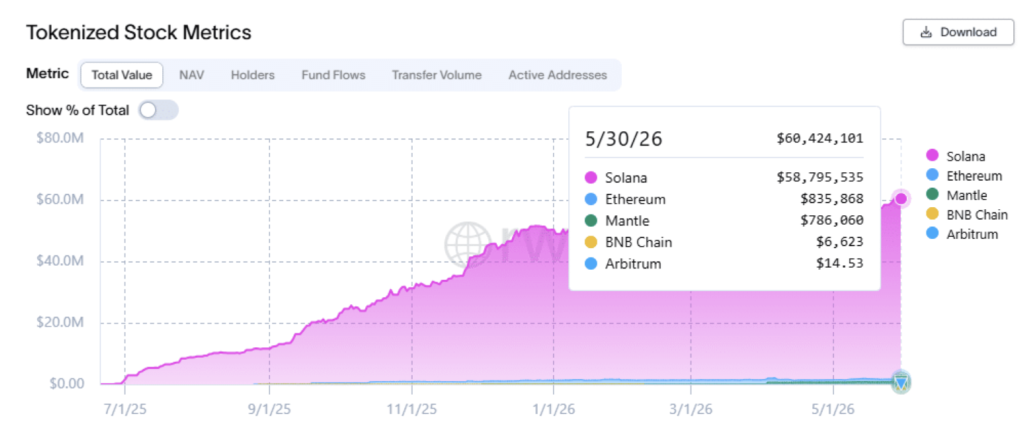
The network recently reached an all-time high of 200,000 holders involved in tokenized stock products, marking a major milestone for on-chain equity adoption. While much of the crypto market remains focused on price action, Solana is quietly building a growing presence in one of blockchain’s most talked-about sectors.
What’s particularly notable is Solana’s dominance within tokenized equity markets. Data shows that approximately 96% of Tesla’s $60 million tokenized stock value currently resides on the Solana blockchain. The asset has also gained more than 11% over the past month while attracting nearly 30,000 holders.
That kind of growth doesn’t happen by accident. It suggests genuine demand is developing beneath the surface, even while broader crypto sentiment remains mixed.
Why the SpaceX IPO Could Matter for Solana
The possibility of a future SpaceX IPO adds another interesting angle.
If tokenized equities continue gaining traction, major public offerings could eventually create additional demand for blockchain-based investment products. Solana’s growing dominance in this space positions it as a potential beneficiary should investors increasingly seek on-chain exposure to high-profile companies.
The network’s recent 200,000-holder milestone already highlights how quickly adoption is growing. Add rising tokenized stock activity to the mix, and Solana is beginning to establish itself as one of the primary infrastructure layers for this emerging market.
At the same time, ETF flows have started telling a different story than what we’re seeing with Bitcoin. While Bitcoin has experienced periods of relative weakness, Solana has continued attracting stronger capital inflows, signaling that investors may be looking beyond the largest cryptocurrency for growth opportunities.
Stablecoins and RWAs Strengthen the Bull Case
Another factor supporting Solana’s long-term outlook is the rapid expansion of stablecoins and real-world assets on the network.
According to recent analyst commentary, stablecoin supply on Solana has now surpassed $16 billion. That’s a significant pool of capital sitting within the ecosystem, and some market participants believe a portion of that liquidity could eventually flow into tokenized equities and other real-world asset products.
The combination of growing stablecoin reserves, increasing tokenized stock adoption, and accelerating real-world asset activity creates a compelling narrative. It also gives Solana something many blockchain projects still lack: measurable usage beyond speculation.
Of course, broader market conditions still matter. Crypto remains highly sensitive to macroeconomic trends and investor sentiment. But if tokenized equities continue expanding and capital keeps flowing toward real-world blockchain applications, Solana could find itself holding a meaningful structural advantage over many of its competitors.
For now, at least, the network appears to be benefiting from a shift that goes beyond hype. It’s becoming part of a much bigger conversation about how traditional finance and blockchain technology may eventually merge.