
- Morgan Stanley files for spot Bitcoin ETF under ticker MSBT
- Potential inflows could reach $160B from wealth management clients
- Approval could intensify competition across crypto ETF markets
Morgan Stanley is making a serious move into crypto, and this time it’s not subtle. NYSE Arca has accepted the firm’s filing for its proposed spot Bitcoin ETF, signaling that a launch could be getting closer than many expected. For a major US institution to push a branded Bitcoin ETF directly to investors… that’s a shift, and markets are paying attention.
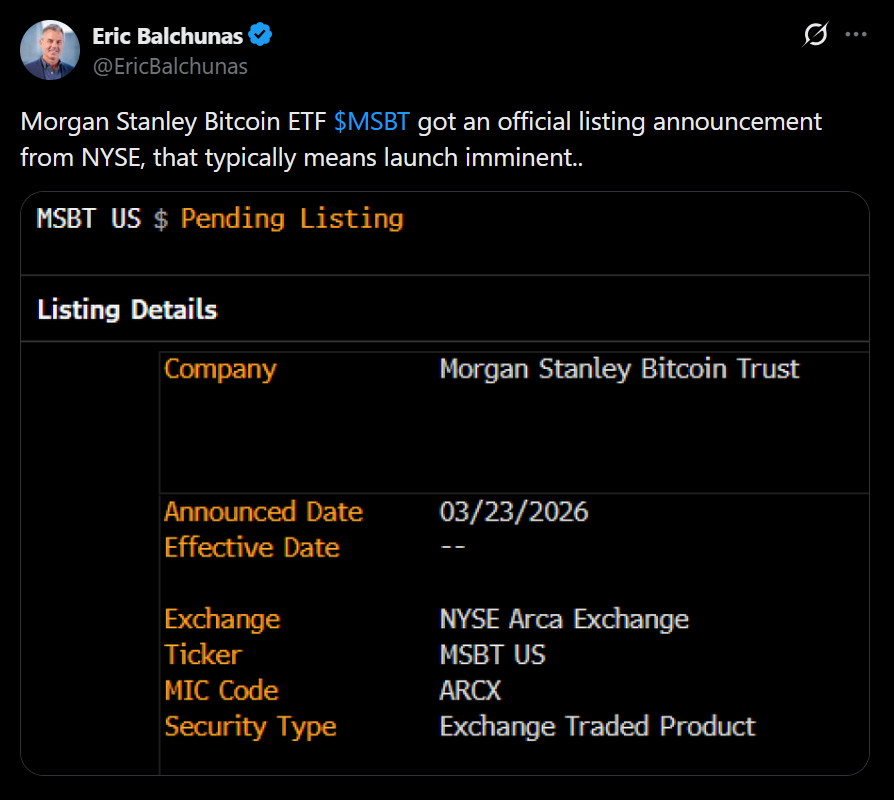
The proposed fund, expected to trade under the ticker MSBT, would hold physical Bitcoin and track its price without using leverage or derivatives. That places it squarely alongside existing spot ETFs that have already attracted strong institutional demand since early 2024. But unlike earlier entrants, this one carries the weight of Morgan Stanley’s distribution network behind it, which could change the scale of adoption.
A New Heavyweight Enters the Bitcoin ETF Race
Morgan Stanley’s filing follows an amended S-1 submitted to the SEC, outlining an initial structure that includes 10,000 shares and roughly $1 million in seed capital. The firm also filed Form 8-A to list the ETF on NYSE Arca, another step that suggests preparation is already underway, not just early exploration.
Fidelity is expected to serve as the Bitcoin custodian, while BNY Mellon will handle administrative operations. These partnerships reflect a familiar structure seen in other major Bitcoin ETFs, but the difference here lies in distribution power. Morgan Stanley’s reach into wealth management could unlock a new layer of demand.
Fee Pressure Could Intensify Across Crypto ETFs
While MSBT’s exact fee hasn’t been disclosed yet, competition in the Bitcoin ETF space has already pushed expense ratios into a tight range between 0.2% and 0.25%. BlackRock’s IBIT, currently one of the largest funds, sits at 0.25%, setting a benchmark for pricing across the sector.
Some analysts expect Morgan Stanley to slightly undercut competitors, potentially pricing around 0.24%. That may seem minor, but in a market where billions are allocated, even small fee differences can influence capital flows. Fee compression could become even more aggressive if more traditional finance players enter the space.

Massive Capital Inflows Could Reshape Bitcoin Demand
The real story might not be the product itself, but the distribution behind it. Morgan Stanley Wealth Management oversees a massive client base supported by more than 15,000 financial advisors. The firm already recommends Bitcoin allocations of up to 4% for certain clients, which gives this ETF a built-in pathway to adoption.
Even a modest 2% allocation across its client base could translate into roughly $160 billion in inflows. That figure would dwarf current ETF benchmarks and potentially reshape Bitcoin’s demand dynamics. It’s a big number… maybe too big to ignore if momentum builds.
Approval Timeline and What Comes Next
Regulatory conditions have become more favorable since the SEC approved standardized rules for commodity-based trust shares in late 2025. That change streamlined the pathway for new crypto ETFs, making approvals more predictable, at least compared to earlier cycles.
Still, the MSBT fund must complete SEC review before trading begins, with a final decision expected between late Q2 and early Q3 2026. Until then, markets will likely treat this as a developing catalyst rather than a confirmed trigger.
Morgan Stanley’s Bigger Crypto Strategy
This ETF is only one piece of a broader digital asset push. Morgan Stanley is reportedly working on additional spot ETFs tied to Ethereum and Solana, while also preparing to expand retail crypto trading through its E*Trade platform. That signals a long-term commitment, not just a one-off product launch.
The firm is even exploring tokenized equities, with plans to bring them onto its alternative trading system sometime in the second half of 2026. If that vision materializes, it could blur the line between traditional finance and blockchain infrastructure even further.