- LINK surged over 14% to $9.35 following integration news with the Canton Network and rising institutional interest.
- The partnership strengthens Chainlink’s role in real-world asset tokenization through CCIP and Proof of Reserve services.
- A sustained move above $10 could open the path to $11–$12, while failure may return LINK to consolidation.
Chainlink finally moved. After weeks of sideways grind that felt like watching paint dry, LINK jumped more than 14% in a single session, tagging $9.35 — its highest level since early February. Market cap snapped back above $6.6 billion, and for the first time in a while, holders could breathe a little.
But when a token prints a double-digit daily candle, the excitement is usually followed by suspicion. Is this the start of something real, or just a reflex bounce riding Bitcoin’s recovery? Crypto has a habit of teasing breakouts that fade just as quickly. This time, though, there’s more under the hood than just market momentum.
The Canton Network Catalyst
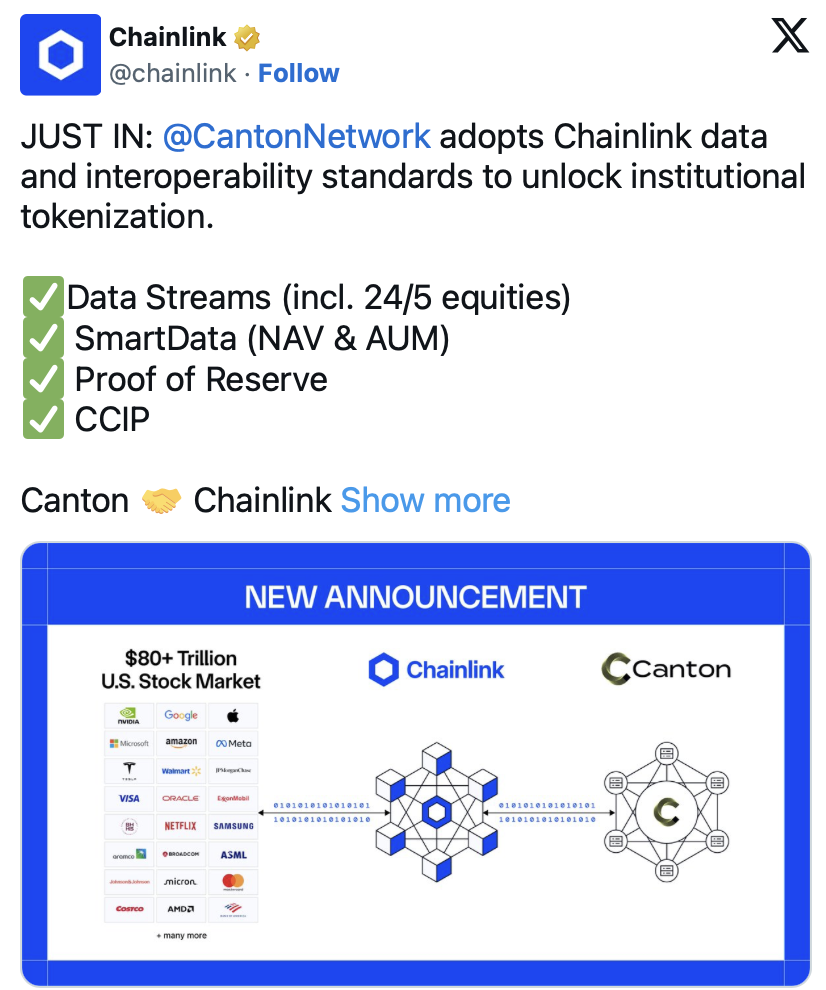
The timing of the move lines up with Chainlink’s integration into the Canton Network. And that’s not just another random partnership announcement buried in a press release.
Think of the Canton Network as infrastructure built specifically for institutions — banks, asset managers, the type that don’t tweet rocket emojis. It’s designed for tokenizing real-world assets under strict privacy controls. By integrating with Canton, Chainlink effectively becomes the data bridge connecting these private financial systems to broader blockchain ecosystems.
The integration uses Chainlink’s Cross-Chain Interoperability Protocol (CCIP) along with its Proof of Reserve services. In practical terms, LINK is helping verify that tokenized assets actually exist and are properly backed. That’s critical. The vision of a multi-trillion-dollar tokenized asset economy doesn’t function without reliable external data feeds. Without oracles, smart contracts are blind.
This narrative shift matters. It positions Chainlink less as a speculative altcoin and more as infrastructure — plumbing, not decoration.
Institutions Are Quietly Accumulating
The institutional angle isn’t theoretical either. Data shows that spot LINK ETFs, including products from Grayscale and Bitwise, have pulled in over $10 million in assets this month alone. That’s not explosive, but it’s steady. Sticky capital tends to move slower — and stick longer.
While some altcoins have seen inconsistent institutional flows, LINK appears to be attracting measured accumulation. It’s not meme-driven. It’s infrastructure-driven. There’s a difference.
And then there’s the regulatory subplot. Chainlink’s former deputy general counsel, Taylor Lindman, was recently appointed Chief Counsel for the SEC’s Crypto Task Force. No, that doesn’t guarantee favorable treatment. But it signals that Chainlink is seen as serious enough to produce regulatory talent. In this environment, credibility counts.
Can LINK Actually Break $10?
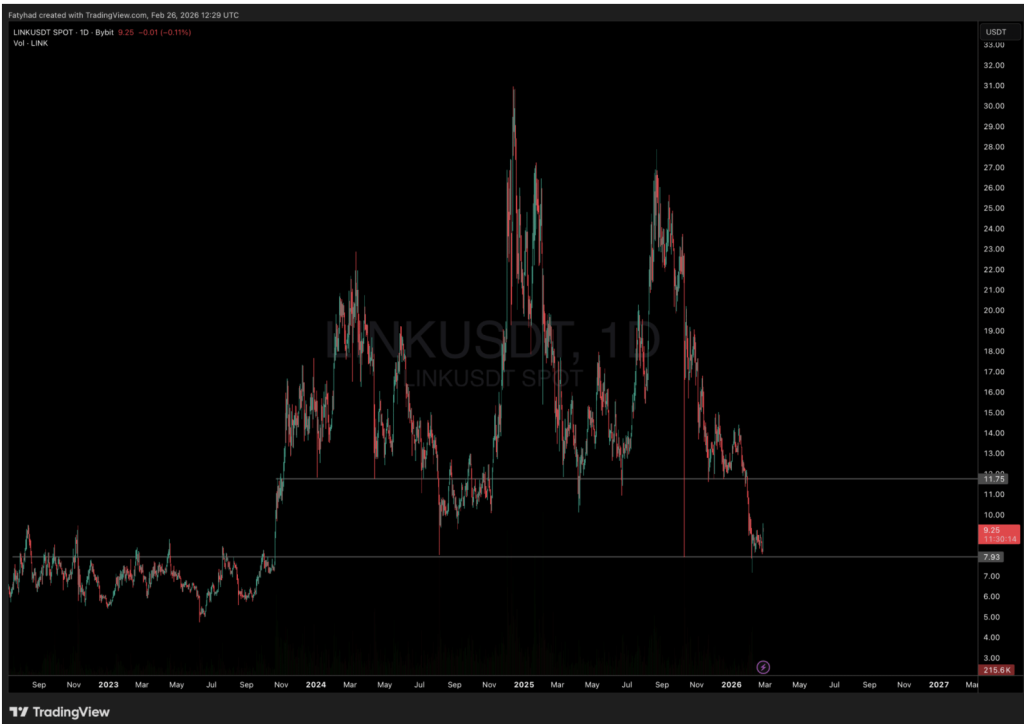
Technically speaking, the $10 level is the immediate psychological barrier. At around $9.25–$9.35, the math isn’t extreme. Momentum just needs to sustain for a few daily closes. That’s doable — assuming broader market conditions cooperate.
The real test sits higher, around $11 to $12. That zone previously acted as support before breaking down, and now it’s resistance. For this rally to prove it’s more than a bounce, LINK needs to reclaim and hold those levels. Flipping resistance into support is the difference between continuation and rejection.
Open Interest has climbed toward $170 million alongside price, which suggests new capital is entering rather than just short sellers covering. That’s constructive. Still, LINK doesn’t trade in isolation. If Bitcoin loses its footing — especially below key macro levels — LINK’s momentum could stall quickly.
Right now, the move looks supported by both narrative and positioning. But sustainability depends on follow-through. Hold above $9 and build. Clear $10 and consolidate. If that happens, $11 opens up. If not, we’re likely back to the sideways grind that defined the past few weeks.
For now, though, Chainlink has woken up. And this time, it feels like more than just noise.