

- Trump ordered federal agencies to review barriers facing crypto and fintech firms
- The Federal Reserve will evaluate broader payment system access for digital asset companies
- Direct Fed access could allow crypto platforms to bypass traditional banking intermediaries
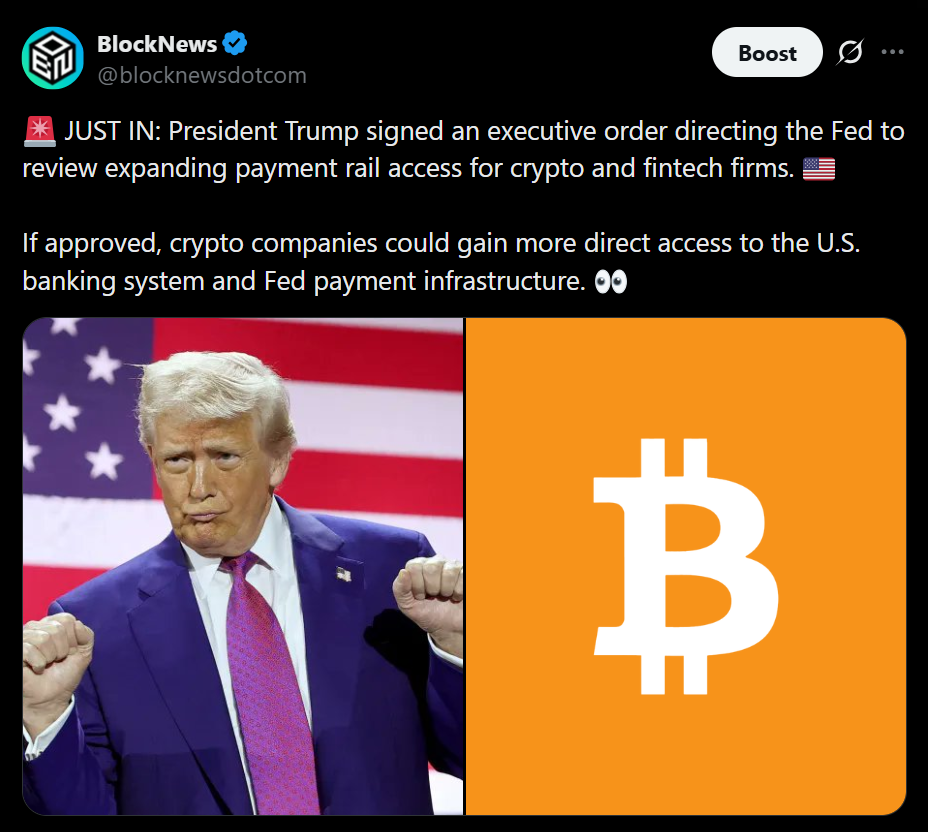
President Donald Trump has signed a new executive order aimed at pulling fintech and crypto firms deeper into the core U.S. financial system. The directive, titled “Integrating Financial Technology Innovation Into Regulatory Frameworks,” orders federal regulators to review existing rules and licensing structures that may be slowing innovation or blocking partnerships between digital asset firms and traditional financial institutions.
The move signals a broader shift in Washington’s approach toward crypto infrastructure. Instead of focusing entirely on enforcement and restrictions, the administration now appears increasingly interested in reducing friction between fintech companies and the regulated banking system itself.
The Fed Is Being Asked To Reconsider Payment Access
One of the biggest parts of the order involves the Federal Reserve directly. Trump instructed the Fed to review the legal and regulatory framework surrounding payment account access for uninsured institutions and non-bank financial firms, including companies involved in digital assets.
That review could become a pretty major turning point for the industry. Right now, most crypto firms still rely heavily on intermediary banks to access dollar payment systems, which adds cost, delays, and operational risk whenever funds move between crypto platforms and traditional finance.
If broader access gets approved, qualifying firms could potentially receive direct connections to Federal Reserve payment rails through master accounts. That would allow faster settlement, smoother institutional transfers, and significantly less dependence on legacy banking partners.
Regulators Now Face Tight Deadlines
Under the executive order, agencies including the SEC, FDIC, OCC, CFPB, CFTC, and NCUA have 90 days to identify rules that may be limiting fintech innovation. Within 180 days, regulators are expected to begin implementing reforms designed to encourage financial technology development.
The Federal Reserve separately has 120 days to submit recommendations covering legal authority, risk concerns, and inconsistencies between regional Reserve Banks regarding payment access decisions. If broader access is legally permissible, the order also pushes for transparent application procedures and 90-day processing timelines for completed submissions.
That’s important because the current system has often looked fragmented and unpredictable, especially for crypto firms trying to navigate different interpretations across the Fed’s 12 regional banks. Some companies have spent years chasing licenses simply to qualify for access.
Kraken Already Opened The Door A Little
The debate intensified earlier this year after the Kansas City Federal Reserve approved a limited-purpose master account for Payward, the parent company of Kraken. The arrangement gave Kraken direct access to certain high-value settlement systems, though with restrictions attached.
That approval triggered immediate backlash from traditional banking groups, particularly the Bank Policy Institute, which warned that granting access without a standardized framework could create uneven regulation and broader systemic risks. Large banks remain deeply cautious about opening core payment infrastructure to firms operating outside traditional banking supervision.
Crypto companies, on the other hand, argue the current process discourages investment and innovation by leaving approvals entirely uncertain. The lack of clear statutory guidance has become one of the industry’s biggest complaints in Washington.
Congress Is Starting To Move Too
At the same time, lawmakers are beginning to push parallel legislation through Congress. Representatives Sam Liccardo and Young Kim recently introduced the bipartisan PACE Act, which would establish formal pathways for qualifying non-bank payment providers to access Federal Reserve services directly.
The bill remains early in the legislative process, but it’s already receiving support from crypto advocacy groups that have spent years lobbying for clearer access rules. Combined with Trump’s executive order, momentum around fintech integration into the U.S. banking system suddenly feels much more serious than it did even a few months ago.
Whether regulators fully embrace broader crypto access or tighten restrictions after review remains unclear. But for now, the conversation has clearly shifted from whether crypto belongs near the financial system to how deeply integrated it should become inside it.