

- XRP continues trading near $1.34 after failing to break above major resistance levels.
- Spot XRP ETFs attracted nearly $12 million in inflows despite broader market fear and uncertainty.
- The $1.30 support level and upcoming CLARITY Act vote remain the two most important factors shaping XRP’s near-term outlook.
Last week, expectations for XRP were fairly straightforward. The token looked likely to remain trapped between support near $1.30 and resistance around $1.45 unless buyers could generate enough momentum to force a breakout. At the same time, there were concerns that losing the $1.30 floor could expose XRP to a sharper decline toward $1.24.
That’s almost exactly how things played out.
XRP managed a brief push higher during the week, but the move lacked follow-through. Buyers couldn’t maintain control, and the asset gradually drifted back into the same range it has occupied for much of the past several sessions. At the time of writing, XRP is trading around $1.34, sitting almost right in the middle of that battleground.
The broader crypto market has also calmed somewhat after last week’s volatility. Total market capitalization has recovered to roughly $2.51 trillion after briefly slipping toward $2.45 trillion. Even so, investors aren’t exactly rushing back in. Geopolitical tensions involving the United States and Iran remain unresolved, while the highly anticipated CLARITY Act still awaits a final Senate vote. Those uncertainties continue keeping many traders on the sidelines.
Institutional Demand Continues Supporting XRP
One area where XRP continues to shine is institutional interest. While retail participation has been uneven, larger investors keep showing up.
On May 29 alone, spot XRP ETFs recorded approximately $11.88 million in inflows. That pushed the total value of XRP held across ETF products to roughly $1.12 billion. What’s interesting is that these purchases came from multiple issuers, including Bitwise, Canary, and Franklin Templeton, highlighting broad participation rather than reliance on a single fund.
The timing matters too. These inflows arrived while the Crypto Fear & Greed Index remained deep in “Extreme Fear” territory. Normally, fear tends to suppress investment activity. Yet institutions continued adding exposure regardless of the market mood. That’s often viewed as a positive signal because ETF purchases create direct demand for XRP and can help stabilize prices during periods when retail traders are hesitant.
It’s not a guarantee of future gains, of course, but steady institutional accumulation tends to provide a stronger foundation than hype-driven buying alone.
On-Chain Data Paints a More Complicated Picture
While ETF demand looks encouraging, on-chain metrics are sending a mixed message.
According to CryptoQuant data, XRP balances on exchanges have declined as investors continue moving coins into private wallets. Generally speaking, that’s considered bullish because fewer tokens sitting on exchanges often means reduced immediate selling pressure.
However, another metric is flashing caution. XRP’s Network Value to Transactions (NVT) ratio climbed roughly 20.3% over the past week. In simple terms, the asset’s market value is increasing faster than actual activity taking place on the network.
That doesn’t automatically mean trouble is ahead, but elevated NVT readings can sometimes suggest that enthusiasm is running ahead of fundamentals. Investors are becoming more optimistic, yet transaction growth isn’t keeping pace. Markets can sustain those conditions for a while, though eventually network activity usually needs to catch up.
As a result, XRP currently sits between two narratives. Institutional demand remains strong, but underlying network usage hasn’t accelerated at the same rate.
The CLARITY Act Remains a Major Wild Card
Regulation continues to be one of the most important factors influencing XRP’s outlook.
The CLARITY Act advanced through the Senate Banking Committee on May 14 and is now awaiting a full Senate vote. If passed, the legislation would establish a clearer regulatory framework for digital assets and could classify XRP as a commodity rather than a security.
For many investors, that distinction is huge.
A clearer legal framework would make it easier for banks, asset managers, and other financial institutions to engage with XRP without worrying about regulatory uncertainty. The White House has reportedly targeted July 4 as a potential signing date, making the coming weeks especially important for the asset.
Because of that, many traders appear reluctant to make aggressive moves before more clarity emerges. The market is essentially waiting for policymakers to decide the next chapter.
XRP’s Chart Continues to Favor Consolidation
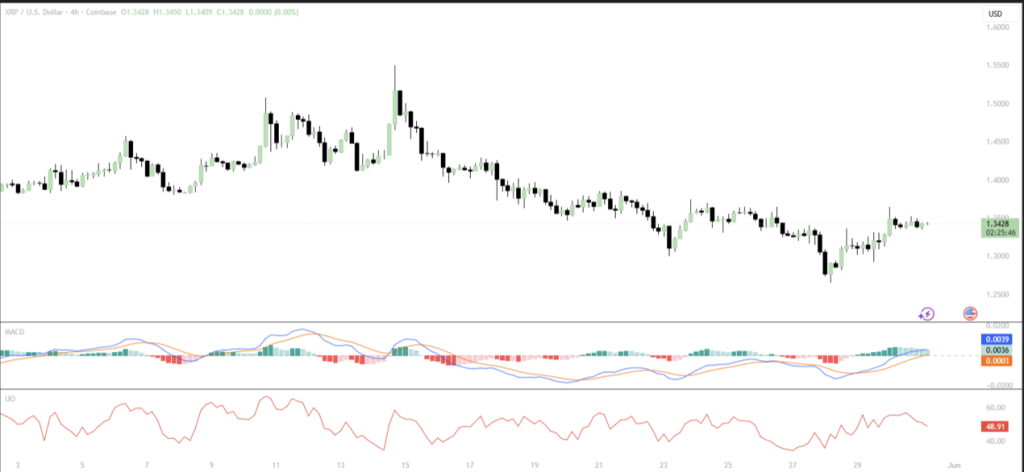
Looking strictly at price action, XRP remains trapped inside a broader downtrend that began after the rally toward $1.55 in mid-May. While the trend hasn’t turned bullish yet, buyers deserve some credit for successfully defending support.
The $1.28 to $1.30 zone has held multiple times over the past week. Following the sharp sell-off on May 28, buyers stepped back in and helped push XRP toward its current levels near $1.34.
Momentum indicators remain somewhat neutral. The MACD continues holding above its signal line, suggesting buyers still retain a slight edge in the short term. At the same time, the Ultimate Oscillator sits near 49, which reflects a balanced market rather than one dominated by aggressive buying.
In other words, XRP isn’t showing strong bullish momentum, but it isn’t collapsing either. It’s simply consolidating.
Here’s What Could Happen Next
For now, the most likely scenario remains continued range-bound trading. Unless a major catalyst emerges or Bitcoin experiences a significant move, XRP could spend the coming days bouncing between support near $1.30 and resistance around $1.40.
The bullish case begins with a decisive break above $1.40. If buyers can reclaim that level and transform it into support, attention would likely shift toward $1.45, followed by potential targets near $1.50 and $1.55. Strong ETF inflows combined with positive developments surrounding the CLARITY Act could provide the fuel needed for that move.
The bearish scenario is equally clear. If XRP loses the $1.30 support region, downside targets near $1.24 would come into focus rather quickly. A deeper slide toward $1.20 could follow if broader market sentiment weakens or regulatory progress stalls.
At the moment, XRP sits right in the middle of those possibilities. Institutional demand remains encouraging, support continues holding, and regulatory developments are moving forward. Yet network activity remains mixed, and resistance levels continue limiting upside progress.
For traders, the key levels haven’t changed. Watch $1.30 on the downside and $1.40 on the upside. The next meaningful move will likely begin when one of those barriers finally gives way.