- Stellar surged nearly 30% after DTCC announced plans to connect its tokenized securities platform to the Stellar blockchain.
- XRP remained in positive territory as traders revisited Ripple’s long-standing institutional relationships and DTCC ties.
- Analysts and investors increasingly believe multiple blockchain networks could coexist within the future financial system rather than one dominant winner.
The broader crypto market struggled again today, with total market value slipping more than 3% as investors reacted to renewed economic uncertainty and another wave of selling across risk assets. Bitcoin and several major altcoins moved lower, but not every digital asset followed the same path. XRP managed to stay in positive territory, while Stellar’s XLM delivered one of the strongest performances seen across large-cap cryptocurrencies in recent months.
XRP climbed more than 0.5% to trade near $1.32, supported by a sharp increase in trading activity. Volume surged over 50% as traders continued monitoring developments tied to institutional blockchain adoption. But the real attention belonged to Stellar. XLM exploded nearly 30% in a single day, making it the best-performing major cryptocurrency of the session. Trading volume followed suit, jumping more than 400% as investors rushed to reposition around a major piece of infrastructure news.
The catalyst behind Stellar’s breakout came from the Depository Trust & Clearing Corporation, better known as the DTCC. The financial giant, which processes more than $114 trillion worth of securities annually, announced plans to connect its tokenized securities platform to the Stellar blockchain by the first half of 2027. Unsurprisingly, that announcement caught the market’s attention almost immediately.
Stellar Gains Ground in the Tokenization Race
The DTCC announcement strengthened Stellar’s position in one of crypto’s fastest-growing sectors: real-world asset tokenization. As traditional finance increasingly explores blockchain technology, networks capable of supporting tokenized stocks, bonds, ETFs, and settlement systems are becoming more attractive to institutional players.
For Stellar, the partnership represents more than just positive publicity. It places the network directly into conversations surrounding the future of financial infrastructure. Investors quickly recognized that potential, driving demand for XLM as traders began pricing in future adoption opportunities.
The enthusiasm surrounding Stellar also reignited comparisons with Ripple and the XRP Ledger. While the market celebrated XLM’s momentum, many XRP supporters pointed out that Ripple has maintained ties to DTCC-related initiatives for years. As a result, the discussion quickly shifted from Stellar’s success to whether both networks could benefit from the broader institutional push toward blockchain-based finance.
That conversation became especially active after traders revisited Ripple’s long-standing relationship with key financial infrastructure players. Some investors argue that Stellar’s recent breakthrough highlights opportunities that Ripple has quietly been positioning for over the last decade.
XRP Supporters Point to Ripple’s Institutional Strategy
Part of that argument centers on Ripple’s decision back in 2015 to appoint former DTCC CEO Donald Donahue as an advisor. At the time, the move received relatively little attention outside financial circles. Looking back, however, many XRP investors now view it as part of Ripple’s broader strategy to build relationships within traditional finance.
Ripple’s involvement in tokenization projects has also added fuel to the debate. The company’s prime brokerage division participated in a DTCC tokenization pilot alongside major financial institutions including BlackRock and JPMorgan. For XRP supporters, those connections reinforce the belief that Ripple remains deeply integrated into the ongoing modernization of financial markets.
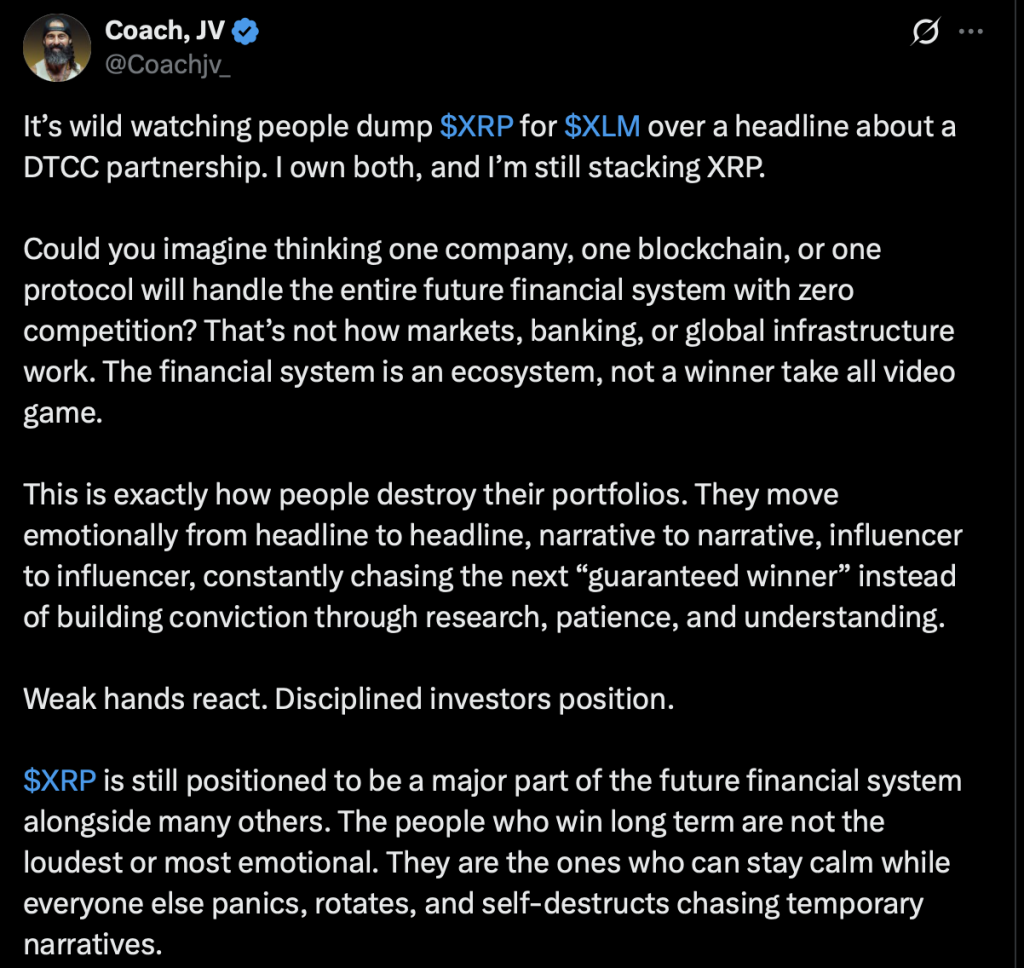
Investor Coach JV recently weighed in on the growing XRP versus XLM discussion. In a widely shared post, he criticized traders who immediately sold XRP to chase Stellar’s rally. According to him, many investors repeatedly damage their portfolios by abandoning long-term convictions every time a new narrative gains momentum.
His broader point was simple: the future financial system is unlikely to rely on a single blockchain. Instead, multiple networks will probably coexist, each serving different purposes within a much larger ecosystem.
XRP and Stellar May Both Benefit From Institutional Adoption
When viewed through that lens, the rivalry between XRP and XLM may be somewhat overstated. Traditional finance today operates through numerous payment rails, settlement systems, and clearing networks working together rather than competing for total dominance. Blockchain infrastructure could evolve in much the same way.
Ripple continues focusing on cross-border payments, liquidity solutions, and institutional settlement services through its expanding network of financial partners. Stellar, meanwhile, has carved out a reputation for low-cost transfers, tokenized asset infrastructure, and financial inclusion initiatives. While their missions overlap in some areas, they aren’t necessarily chasing identical opportunities.
The recent XLM rally doesn’t automatically weaken XRP’s long-term position. If anything, growing institutional interest in Stellar may help validate broader adoption trends across blockchain finance. Both networks are attracting attention from major organizations, just through slightly different channels.
Of course, short-term traders often move quickly from one narrative to another, creating dramatic swings in price and sentiment. That’s nothing new in crypto. But over the longer horizon, the industry’s future may belong to a collection of interoperable blockchain networks rather than a single winner controlling every payment, settlement, and tokenization process around the world.