
- Santiment data shows the average active XRP trader is down roughly 47%
- XRP’s 30-day MVRV just hit its lowest level since December 2020
- Historically, similar capitulation zones have often preceded strong recoveries
XRP traders are hurting right now, at least according to new onchain data from Santiment. The analytics platform reported that the average XRP wallet active over the last 30 days is currently sitting on losses of roughly 47%, placing sentiment near some of the most pessimistic levels seen in years.
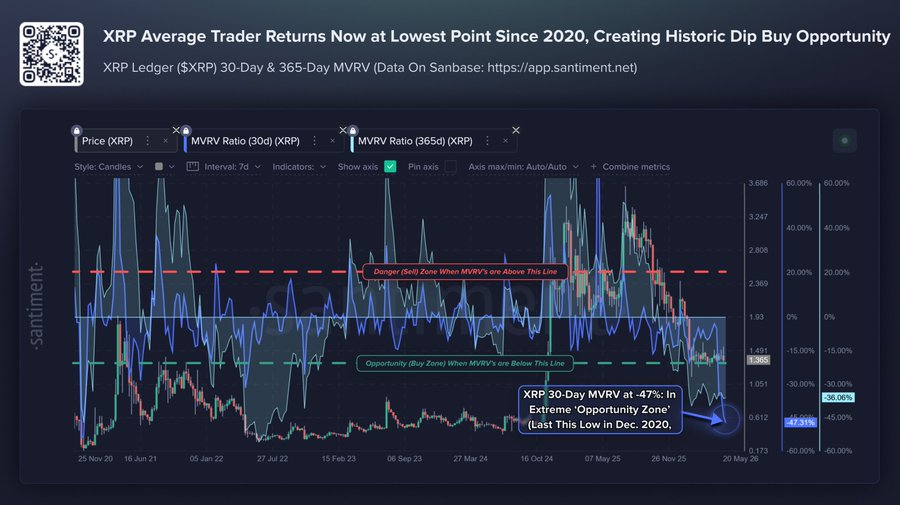
Accompanying the report was a chart tracking XRP’s 30-day and 365-day Market Value to Realized Value ratio, better known as MVRV. The data showed XRP’s short-term MVRV falling to its lowest point since December 2020, a period that happened just before XRP eventually staged a major recovery afterward.
That doesn’t guarantee history repeats, obviously. But crypto traders are paying attention anyway.
XRP Holders Are Showing Signs Of Capitulation
MVRV essentially measures the average profitability of recent holders. When the ratio turns deeply negative, it suggests large portions of the market are underwater, meaning traders are holding positions worth substantially less than their purchase prices.
Right now, XRP’s 30-day MVRV sits near -47%, which Santiment describes as an “extreme undervalued zone.” Historically, these deeply negative readings tend to emerge during periods where retail traders become emotionally exhausted and begin capitulating after extended selloffs.
In simpler terms, many short-term XRP traders appear to have sold near the bottom out of frustration, fear, or simple exhaustion after months of weak price action.
And honestly, crypto markets have a habit of reversing precisely when most retail participants stop believing they will.
Extreme Fear Has Historically Created Reversal Conditions
Santiment pointed out that MVRV readings tend to normalize back toward zero over time. That means periods of deeply negative returns often create conditions where downside risk gradually becomes more limited compared to potential upside, especially if even small positive catalysts emerge afterward.

The logic is fairly straightforward. Once most panic selling already happened, there are simply fewer emotionally driven sellers left in the market.
That does not automatically trigger immediate rallies, but historically these types of capitulation zones often appeared near important local bottoms across crypto markets.
And XRP specifically has seen this pattern before. Major rallies in late 2024 and early 2025 pulled in waves of momentum traders near local highs before broader market weakness erased much of those gains afterward. Many newer holders are now deeply underwater as a result.
XRP Still Has Several Long-Term Catalysts In Play
Despite the painful drawdown, some investors remain optimistic about XRP’s longer-term outlook. Ongoing speculation around potential XRP ETFs, broader crypto regulation, and Ripple’s continued institutional expansion efforts continue supporting the narrative for many holders.
Meanwhile, XRP Ledger itself continues evolving technically underneath the surface. The recently activated fixCleanup3_1_3 amendment introduced several important infrastructure fixes tied to NFTs, vault systems, permissioned domains, and decentralized lending functionality on XRPL.
The XRP Ledger Foundation also published a new standard for AMM v2, introducing StableSwap and concentrated liquidity pool curves designed to improve capital efficiency for stablecoins, foreign exchange markets, tokenized real-world assets, and other financial applications operating on XRPL.
None of those upgrades instantly fix market sentiment, of course. But they do reinforce that development activity around the ecosystem continues moving forward despite weak price performance.
XRP’s Market Structure Still Looks Emotionally Fragile
For now, though, sentiment around XRP clearly remains extremely fragile. The combination of negative MVRV readings, falling trader confidence, and broader macro uncertainty continues weighing heavily on short-term momentum.
At the same time, deeply negative positioning itself can sometimes become the setup for stronger rebounds later if broader crypto conditions improve.
That’s the uncomfortable reality of crypto cycles. Markets often feel most hopeless right before sentiment shifts aggressively in the opposite direction again. Whether XRP is actually nearing that kind of turning point remains uncertain, but the current data definitely suggests frustration among traders has reached unusually elevated levels.