

- Vitalik Buterin has revealed an updated roadmap that will overhaul nearly every major part of Ethereum over the next several years.
- The plan prioritizes quantum resistance, privacy, scalability, and major protocol upgrades while minimizing disruption for users.
- Ethereum’s announcement comes as ETH has climbed more than 12% over the past week.
Ethereum co-founder Vitalik Buterin has unveiled an updated vision for what he calls the network’s biggest transformation since the 2022 Merge. The revised “Lean Ethereum” roadmap outlines a multi-year effort to rebuild nearly every major component of the blockchain while keeping existing applications running with minimal disruption.

According to Buterin, the overhaul represents Ethereum‘s third major evolution. The ambitious plan is expected to unfold over the next three to four years, positioning the network for greater scalability, stronger security, and improved long-term sustainability as blockchain adoption continues to grow.
Quantum Security Becomes a Top Priority
One of the most significant changes in the updated roadmap is Ethereum’s increased focus on quantum resistance. Buterin said the network now considers replacing every quantum-vulnerable component with quantum-safe alternatives a major priority.
Although practical quantum computers capable of breaking blockchain encryption may still be years away, Ethereum wants to prepare well in advance. The roadmap includes redesigning several core systems, including the data storage infrastructure used by Layer-2 rollups, to ensure they remain secure against future technological threats.
Privacy and Scalability Take Center Stage
Privacy has also become a core objective under the Lean Ethereum roadmap. Rather than treating privacy as an optional feature, Ethereum intends to build network components that support private transactions by default without relying on centralized intermediaries.
The network also plans to improve transaction verification through recursive STARKs, an advanced cryptographic proof system. Instead of requiring every node to independently process every transaction, nodes will verify compact mathematical proofs that confirm the work has already been completed correctly. The change is expected to improve efficiency while reducing hardware requirements for network participants.
Ethereum Plans a Major Infrastructure Upgrade
Perhaps the most ambitious part of the roadmap involves redesigning Ethereum’s blockchain state, which stores account balances, smart contract data, token ownership, and other network information. As Ethereum grows, maintaining this data becomes increasingly demanding for node operators.
The proposal introduces new methods for storing blockchain state that allow Ethereum to scale dramatically while reducing the burden placed on individual nodes. Buterin believes the approach could expand Ethereum’s storage capacity from roughly 2 terabytes today to well over 100 terabytes by 2030 without sacrificing decentralization.
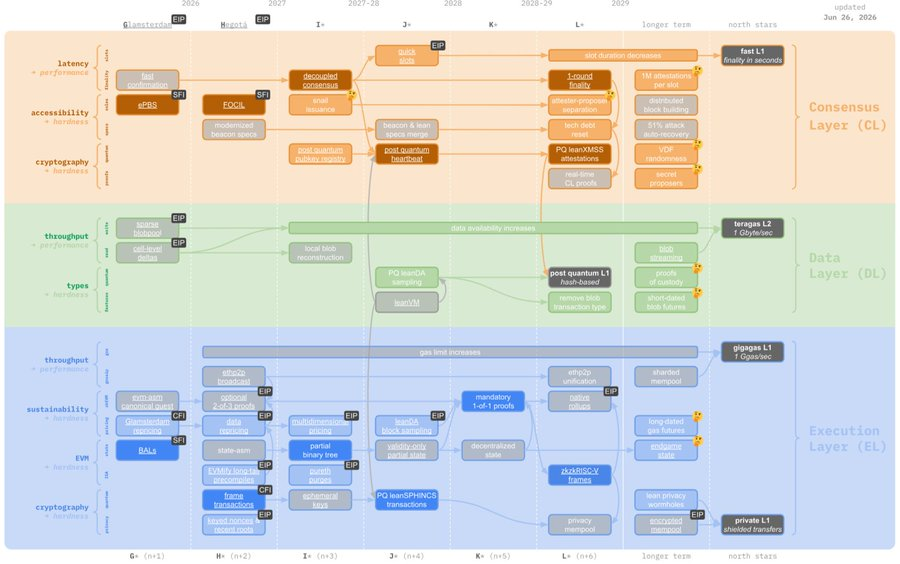
Ethereum may also eventually move beyond its current Ethereum Virtual Machine (EVM). Buterin identified the open-source RISC-V architecture as one possible long-term replacement, although he emphasized that such a transition remains years away.
Ethereum’s Long-Term Vision Continues to Expand
The updated roadmap also outlines plans to steadily increase transaction throughput, shorten block times, and expand network capacity through a series of future upgrades. According to Buterin, the upcoming Glamsterdam upgrade will significantly improve Ethereum’s capacity, while the following Hegotá upgrade could become the final major hard fork before the Lean Ethereum era begins.
Although most of these changes remain several years away, the roadmap demonstrates Ethereum’s commitment to preparing for the next generation of blockchain technology. The announcement arrives as Ether has gained more than 12% over the past week, reflecting renewed optimism among investors as the network continues building toward its long-term vision.