

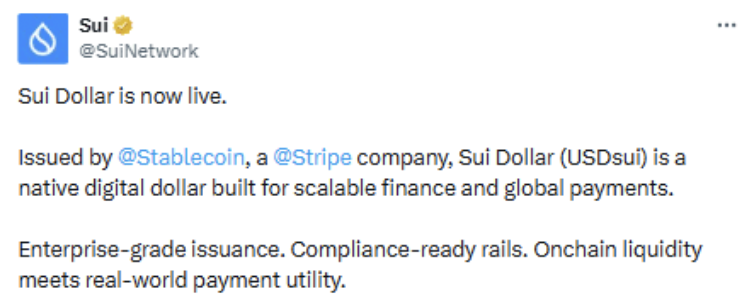
- Sui Network has launched USDsui, its first native stablecoin aimed at expanding its DeFi ecosystem.
- The stablecoin channels yield into SUI token buybacks, potentially strengthening the network’s tokenomics.
- The launch arrives as stablecoin regulation discussions and liquidity shifts reshape the DeFi landscape.
The race to dominate decentralized finance is heating up again, and networks are scrambling to secure liquidity wherever they can. Stablecoins sit right in the middle of that battle. They act as the bridge between traditional finance and crypto-native markets, so whoever controls stablecoin liquidity often gains a major advantage in the broader DeFi ecosystem.
With that in mind, the Sui Network has introduced its first native stablecoin, USDsui. Developers say the new asset is designed to support scalable finance and global payment infrastructure, which signals that Sui is pushing more aggressively into the DeFi arena. And in a landscape where liquidity determines survival, that kind of move carries weight.
USDsui Adds a Strategic Layer to Sui’s Tokenomics
At first glance, launching a stablecoin might look like a simple expansion of payment infrastructure. But according to analysts watching the project, USDsui appears to be built around a deeper strategic model.
Instead of merely acting as a transactional asset or mirroring traditional financial rails, the stablecoin’s design incorporates a feedback mechanism tied directly to SUI’s token economics. Yield generated from the issuance of USDsui isn’t just sitting idle. Instead, that yield is redirected into buying back SUI tokens from the market.
In practical terms, every dollar worth of USDsui issued contributes to two things at once. It facilitates everyday DeFi activity while simultaneously reducing the circulating supply of SUI through token buybacks. It’s a subtle mechanism—but potentially powerful if adoption grows.
Token Buybacks Create a Long-Term Value Loop
Token buyback strategies are not new in financial markets, yet they tend to generate strong interest among investors when applied to blockchain ecosystems. The logic is fairly straightforward. When supply is gradually removed from circulation while usage increases, the underlying token often benefits from stronger long-term value pressure.
That’s essentially the feedback loop Sui appears to be trying to create. As USDsui circulates through lending markets, liquidity pools, and payment rails, the yield generated by that system feeds back into SUI itself. If the model works as intended, network activity could indirectly strengthen the token’s economic foundation.
The big question, of course, is whether adoption follows.
Timing Aligns With Regulatory Momentum
The timing of the USDsui launch also seems carefully chosen. In the United States, regulatory momentum around stablecoins has been building, particularly with growing discussion around the CLARITY Act. Market observers currently estimate roughly a 70% chance that some form of regulatory framework could emerge later this year.
Even major financial institutions are paying attention. JPMorgan analysts have signaled growing confidence that stablecoin regulation may arrive by mid-year, potentially creating a more stable environment for blockchain-based payment systems.
If regulatory clarity does arrive, networks that already have stablecoin infrastructure in place may find themselves ahead of the curve. And that appears to be exactly the position Sui is trying to secure.
Liquidity Challenges Add Urgency
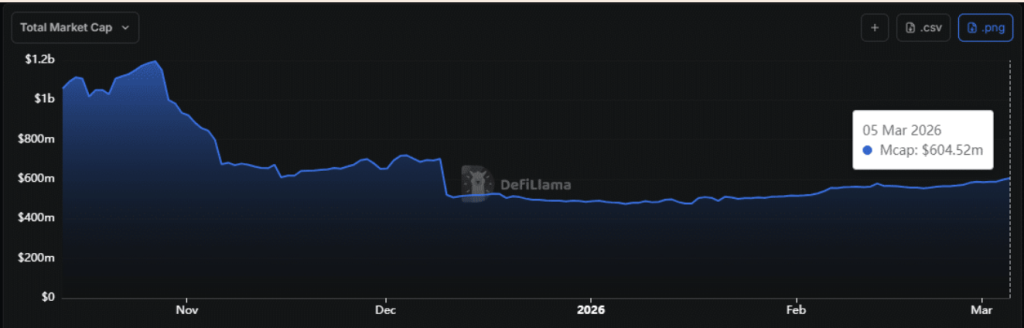
There’s another reason the stablecoin launch matters right now. Sui’s network liquidity has actually declined quite sharply since the late-2025 cycle. Estimates suggest that total liquidity has fallen by nearly 40%, roughly $400 million in value leaving the ecosystem.
This drop has also affected the network’s stablecoin supply. Compared with other major Layer-1 blockchains, Sui currently sits among the lowest in terms of total stablecoin liquidity. In DeFi, that metric matters a lot—stablecoins often act as the base layer for lending, trading, and liquidity pools.
The shrinking liquidity environment has also reflected in SUI’s market performance. On a quarterly basis, the token has been among the weaker performers, falling roughly 30% after already dropping 57% during the previous quarter. Prices are now hovering near levels last seen during the Q3 2024 cycle.
Could USDsui Become a Turning Point?
Muted capital flows across several growth narratives—particularly real-world asset tokenization—have also weighed on the network’s momentum. Without strong liquidity entering those sectors, ecosystems can struggle to maintain developer activity and user engagement.
Against that backdrop, the introduction of USDsui may represent something of an inflection point. A native stablecoin could help stabilize liquidity flows while creating a new mechanism that directly supports SUI’s tokenomics.
If regulatory clarity arrives and DeFi capital begins rotating back into the sector, Sui’s early positioning with USDsui might turn out to be a timely move. Not guaranteed, of course. But in DeFi, timing and liquidity often decide which ecosystems rise… and which quietly fade away.