
- Yakovenko and Buterin highlight a deeper debate over iteration versus long-term decentralization
- Solana’s real-world asset market has crossed $1 billion, driven by institutional adoption
- SOL price remains capped below key resistance, with momentum present but constrained
Solana’s latest milestone arrives at an interesting moment, right as a philosophical split at the top of crypto comes into sharper focus. Solana Labs CEO Anatoly Yakovenko has pushed back against Ethereum founder Vitalik Buterin’s idea of a long-term “walkaway test,” while Solana itself quietly crossed a major threshold in real-world asset adoption. Together, the two threads raise a bigger question about what really sustains a blockchain over time.
A Philosophical Divide on How Blockchains Should Evolve
Yakovenko’s position is fairly direct. In his view, blockchains don’t survive by standing still. Networks need to keep iterating, upgrading, and adjusting to what developers and users actually need, even if that process never really ends. In a recent post on X, he argued that Solana must continue changing to remain relevant, warning that stagnation is effectively a slow death.
That stance contrasts with Buterin’s long-term vision for Ethereum. The Ethereum founder has previously suggested that a truly decentralized network should eventually be able to function for decades without active developer intervention. The emphasis there is durability and minimising reliance on any one group, even if that means slower change. It’s less about speed, more about resilience.
Real-World Assets Are Gaining Ground on Solana
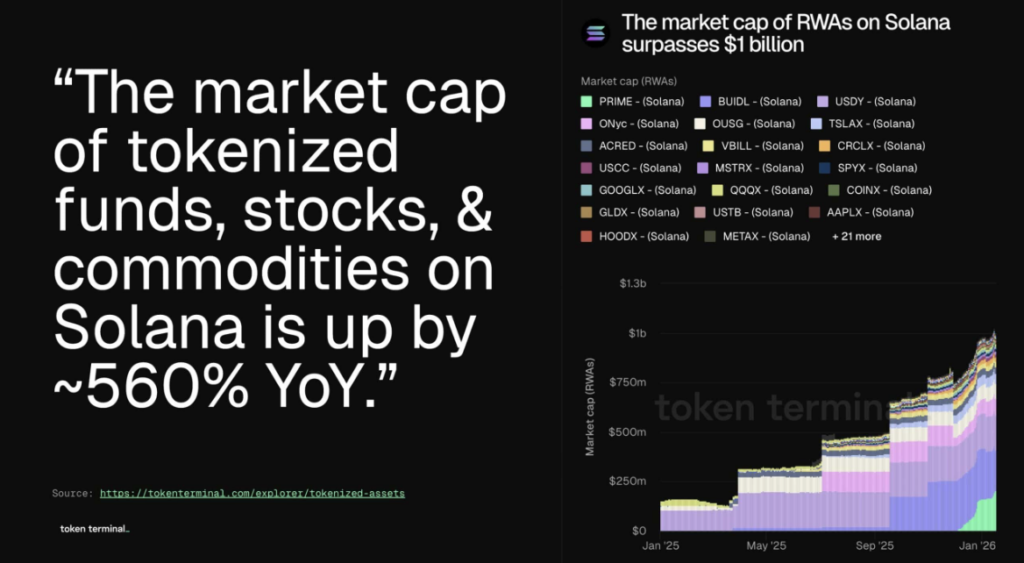
While that debate plays out, Solana is showing tangible growth elsewhere. According to Token Terminal data, real-world assets on Solana have now surpassed $1 billion in total market capitalization. That includes tokenized funds, equities, and commodities, and it represents a roughly 560% year-on-year increase.
This matters because it signals adoption well beyond memecoins or consumer-facing apps. Builders and institutions appear increasingly comfortable deploying real financial products on Solana’s infrastructure. In practical terms, that suggests trust in the network’s performance and tooling, even as discussions about decentralization and governance continue in the background.
SOL Price Tries to Catch Up With the Narrative
From a price perspective, SOL is still working through a consolidation phase. At the time of writing, it was trading in the mid-$140s after failing to hold a recent push higher. On the daily chart, price remains above its short-term moving averages, but it’s still capped below the 100- and 200-day EMAs, which continues to limit upside momentum.
Momentum indicators reflect that balance. RSI sits in neutral territory, showing neither exhaustion nor excess enthusiasm, while MACD has flattened after a recent bullish stretch. A clean break above the $148 to $150 resistance zone could reopen the path to higher levels. If current support gives way instead, a pullback may be needed before any sustained rally can take shape.