- The SEC has proposed updating transfer agent rules that have remained largely unchanged since the late 1970s.
- The proposal formally addresses technologies including blockchain, tokenized securities, smart contracts and electronic recordkeeping.
- Transfer agents working with blockchain and AI would face requirements around data integrity, security, operational controls and oversight.
The U.S. Securities and Exchange Commission is proposing a major overhaul of its transfer agent rules as blockchain, tokenization and artificial intelligence become more common across financial markets.
Transfer agents maintain official securities ownership records and handle processes including dividend distributions, mergers, clearing and settlement.
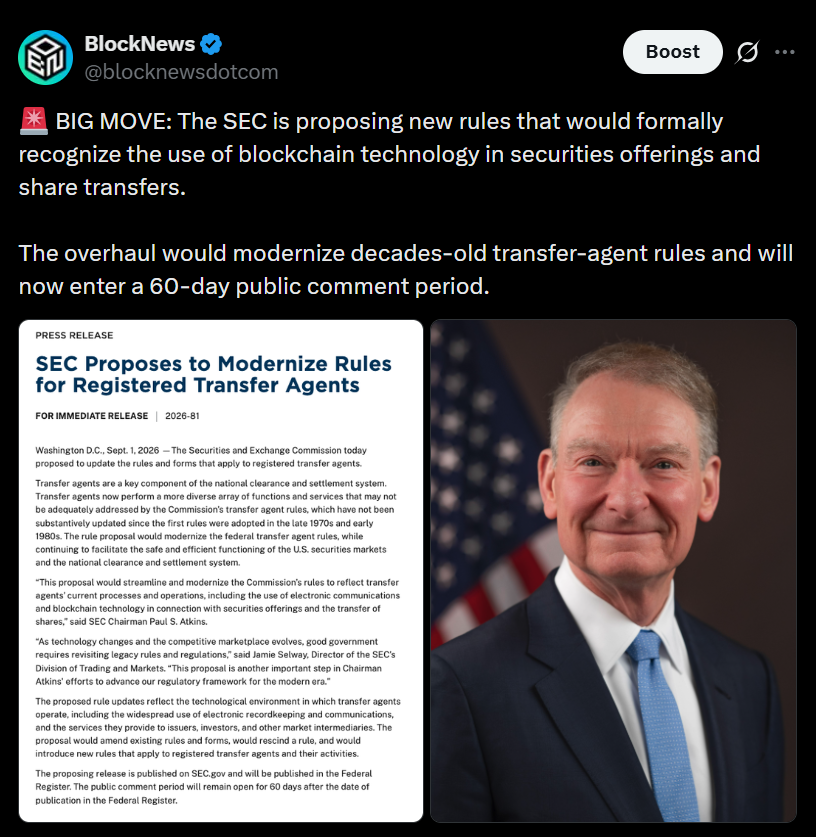
The SEC said its rules governing these firms have not been significantly updated since they were introduced in the late 1970s, leaving parts of the existing framework increasingly outdated as financial infrastructure becomes more digital.
SEC Chair Paul Atkins said the proposal would modernize the rules to reflect how transfer agents operate today, including their use of electronic communications and blockchain technology for securities offerings and share transfers.
SEC Addresses Blockchain and Tokenized Securities
The proposal would update terminology and requirements surrounding electronic systems while directly addressing emerging technologies.
The SEC noted that some market participants are already exploring blockchain-based systems for maintaining securities ownership records.
Transfer agents working with tokenized securities, distributed ledgers and smart contracts would need to manage risks surrounding blockchain data integrity, security and the operational structure of distributed networks.
The changes could provide a clearer regulatory framework for companies looking to move traditional securities infrastructure onchain.

AI Systems Would Also Face New Oversight
Blockchain is only one part of the SEC’s proposed modernization.
The 421-page proposal also addresses transfer agents using artificial intelligence and automated technologies.
The SEC said firms adopting these systems would need appropriate controls, accurate representations of their capabilities and effective oversight of automated processes.
The changes reflect the growing role of automation across financial infrastructure while attempting to ensure that new technologies do not weaken existing investor protections or recordkeeping standards.
Tokenization Infrastructure Continues Expanding
Several companies are already operating as SEC-registered transfer agents while developing tokenized securities infrastructure.
Injective recently became an SEC-registered transfer agent, giving it a regulated framework for tracking ownership and transfers of tokenized assets.
Securitize and tZERO are also registered transfer agents and have been expanding their involvement in onchain securities markets.
SEC Commissioner Hester Peirce supported the proposal and said she was pleased to see it introduced before her upcoming departure from the agency.
The proposal now moves into the public comment process as the SEC considers how traditional securities infrastructure should evolve alongside blockchain, tokenization and AI.