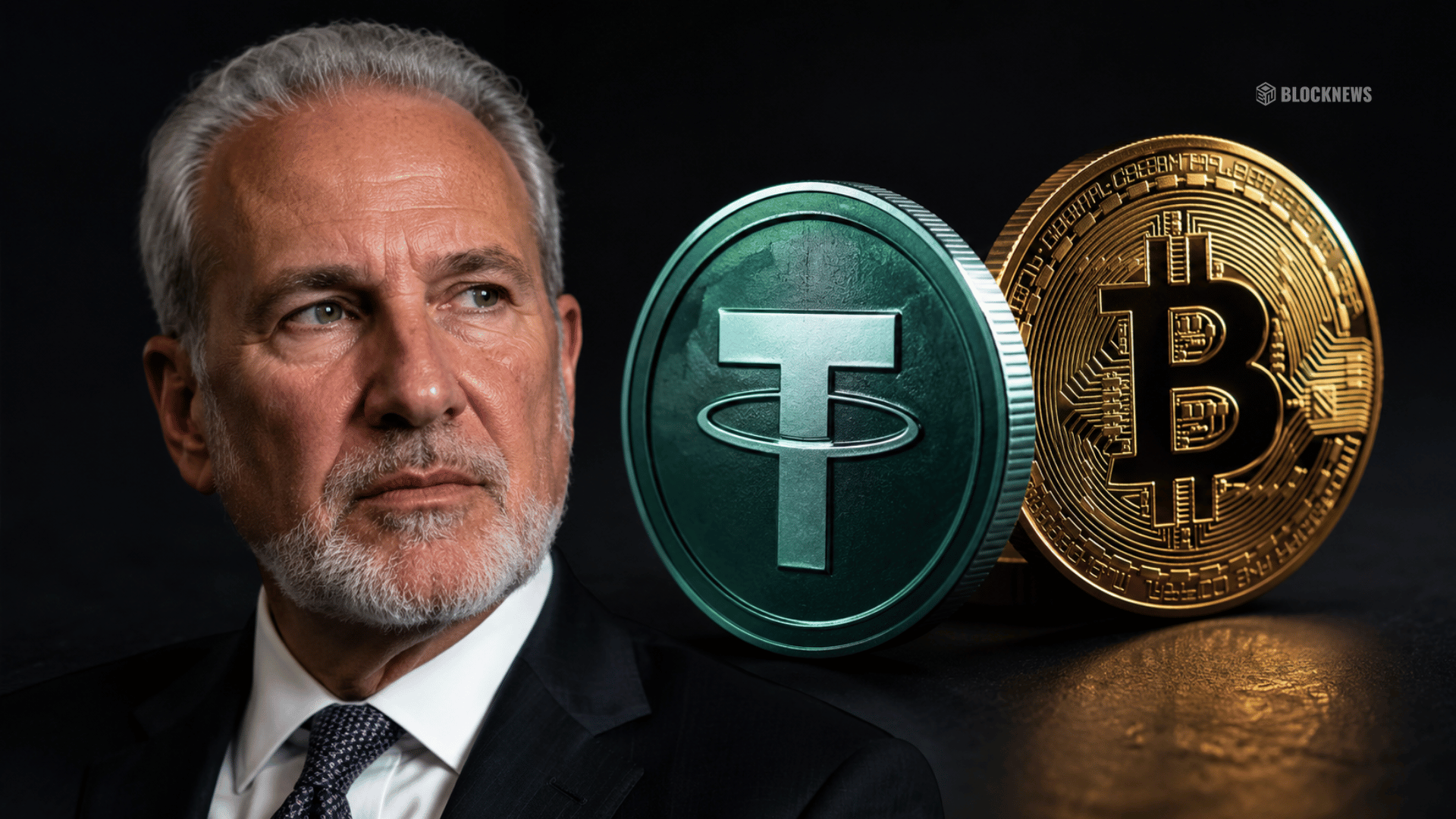
- Peter Schiff believes Tether’s market capitalization could eventually surpass Ethereum and potentially even Bitcoin.
- Stablecoins are seeing record adoption from banks, payment companies, fintech platforms, and governments worldwide.
- If Schiff’s prediction comes true, it could signal trillions of dollars flowing through blockchain infrastructure every day.
Few people have built a reputation around criticizing Bitcoin quite like Peter Schiff. For years, the economist and gold advocate has warned investors about cryptocurrency risks while dismissing Bitcoin’s long-term value proposition. That is exactly why his latest prediction caught the attention of both crypto supporters and critics alike.

Speaking recently about the future of digital assets, Schiff suggested that Tether’s market capitalization could eventually grow larger than Ethereum‘s and may even surpass Bitcoin’s one day. On the surface, the statement sounds like another criticism of crypto, implying that investors ultimately prefer stable dollars over volatile digital assets. Yet beneath that argument sits an unexpectedly bullish implication for the broader blockchain industry.
If Tether ever becomes larger than Bitcoin, it would likely mean digital assets have achieved a level of global adoption that few investors currently imagine.
Stablecoins Are Becoming Financial Infrastructure
The stablecoin market has evolved dramatically over the last few years.
What was once viewed primarily as a tool for crypto traders has increasingly become part of mainstream financial infrastructure. Payment giants, fintech firms, exchanges, and banks are actively integrating stablecoin solutions into their products and services. Companies including Visa, Mastercard, Stripe, PayPal, Coinbase, and Robinhood have all expanded their involvement with digital dollar infrastructure as demand continues to grow.
The trend is difficult to ignore. Stablecoins now process enormous transaction volumes, facilitate cross-border payments, support global settlements, and increasingly serve as a bridge between traditional finance and blockchain networks.
That level of adoption is one reason analysts believe the sector may still be in its early stages.
Tether’s Remarkable Growth Story
Tether has quietly become one of the most influential companies in the digital asset industry.
USDT remains the dominant stablecoin by market capitalization and trading volume, serving as the primary source of liquidity across global crypto markets. The company has also generated billions of dollars in annual profits, making it one of the most profitable businesses in the world on a per-employee basis.
Its role extends far beyond crypto speculation.
Traders use USDT to move capital efficiently between exchanges. Businesses utilize stablecoins for international payments. Investors increasingly rely on digital dollars as a way to access blockchain-based financial services without exposure to extreme volatility.
As adoption expands, Tether’s importance within the broader financial ecosystem continues to grow.
Could Tether Actually Surpass Ethereum?
Ethereum remains one of the most valuable blockchain networks because it powers decentralized applications, tokenization, decentralized finance, and a large portion of the crypto economy. That makes Schiff’s prediction sound ambitious at first glance.
However, stablecoin growth and Ethereum growth are not necessarily opposing forces.

Every stablecoin transaction requires blockchain infrastructure operating underneath the surface. Whether transactions occur on Ethereum, Solana, Tron, or other networks, stablecoin adoption generally increases demand for blockchain settlement systems rather than replacing them. As more capital moves on-chain, the networks supporting those transfers may benefit alongside the stablecoins themselves.
In many ways, stablecoins and blockchain infrastructure grow together.
That relationship makes the conversation far more complex than a simple competition between assets.
The Bigger Trend Investors Should Watch
The most important takeaway may not be whether Tether surpasses Bitcoin or Ethereum.
Instead, Schiff’s comments highlight how quickly stablecoins are becoming integrated into the global financial system. Regulatory frameworks continue to develop, institutional adoption continues to accelerate, and major financial firms are increasingly building products around digital dollars.
For years, many investors viewed stablecoins as a niche crypto product. Today, they are increasingly viewed as a foundational layer for payments, settlements, remittances, and financial services.
That transition could become one of the defining trends of the next decade.
Crypto’s Most Unexpected Bull Case
There is a certain irony in Schiff’s prediction.
A statement intended to highlight the growing importance of stable dollars may actually reinforce one of the strongest arguments for blockchain technology. If Tether grows large enough to challenge Bitcoin or Ethereum, it would likely require unprecedented adoption of digital asset infrastructure across global finance.
That outcome would mean blockchain networks are processing enormous volumes of economic activity every day. It would mean businesses, institutions, governments, and consumers are relying on digital assets at a scale that currently seems difficult to imagine.
In other words, Peter Schiff’s bearish argument may accidentally be one of the most bullish cases for crypto infrastructure ever made.
The Future May Not Be About Choosing Winners
Will Tether eventually surpass Bitcoin? That remains a difficult prediction to make.
Bitcoin still benefits from its role as digital gold, while Ethereum continues to dominate large segments of decentralized finance and tokenization. Both assets possess unique value propositions that extend beyond simple transaction volume.
What Schiff’s prediction does reveal is a growing reality: stablecoins are no longer a side story within crypto. They are becoming a central pillar of the industry’s future.
If digital dollars continue replacing parts of the traditional payments system, the biggest winners may not be limited to Tether alone. Bitcoin, Ethereum, stablecoins, and the networks supporting them could all benefit from a future where financial activity increasingly moves on-chain.