

- Hyperliquid launched a policy arm in Washington instead of staying offshore
- Jake Chervinsky will lead efforts to shape US crypto regulation
- Perpetual futures regulation could redefine DeFi’s role in US markets
In less than three years, Hyperliquid has evolved from an experimental DeFi protocol into a derivatives venue that regularly rivals major centralized exchanges in volume. That kind of scale attracts attention, and attention in crypto inevitably leads to regulators. Launching the Hyperliquid Policy Center in Washington is not cosmetic, it’s strategic.
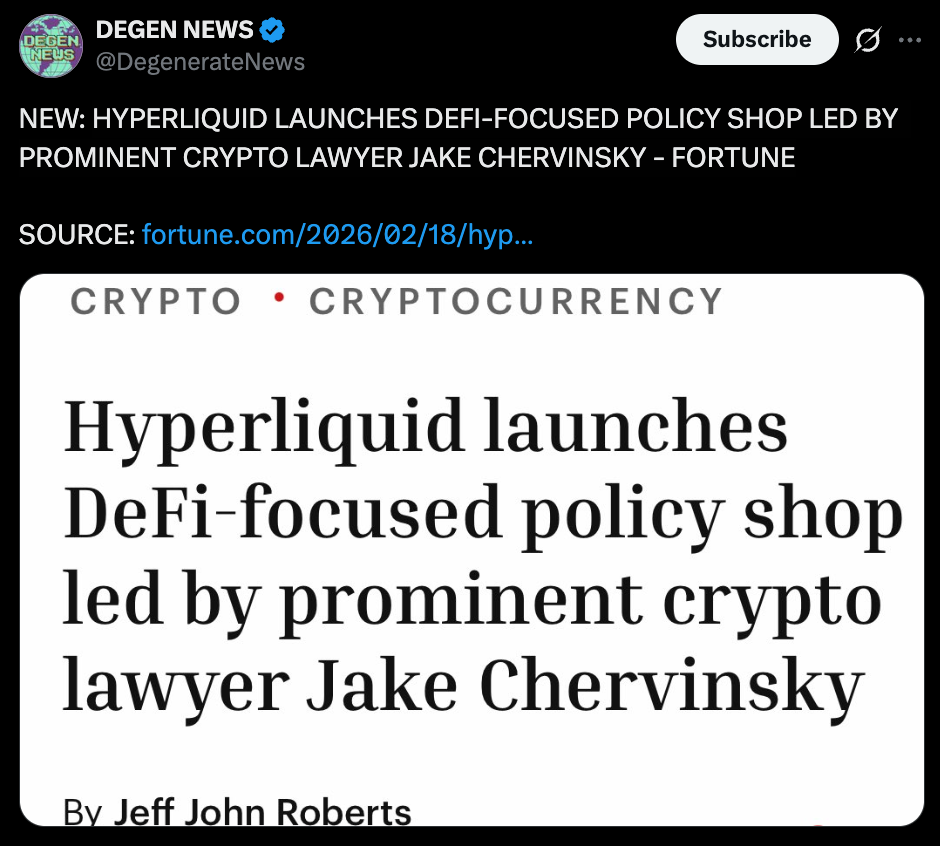
For years, many DeFi platforms operated as if distance from US soil was a shield. Hyperliquid is taking the opposite route. Instead of hiding offshore, it is formalizing its presence and building a policy arm designed to engage lawmakers directly. That signals something important: DeFi no longer believes it can ignore Washington.
Jake Chervinsky Signals a Serious Regulatory Play
Appointing Jake Chervinsky to lead the policy effort is not random. Chervinsky understands the mechanics of Congress, the SEC, and the CFTC. He has seen firsthand where crypto advocacy has failed and where it has gained traction. His core argument is straightforward, existing financial rules were written for centralized intermediaries, not autonomous smart contract systems.
That framing matters because it shifts the debate. Instead of asking for exemptions, the strategy appears to focus on modernization. If regulators continue forcing decentralized protocols into outdated categories, innovation stalls. Hyperliquid’s move suggests DeFi is ready to help write updated rules rather than just protest enforcement actions.
Perpetual Futures Are the Real Prize
The most critical detail in this development is the focus on perpetual futures. Perps dominate global crypto trading because they are simple, liquid, and accessible. Offshore exchanges built massive businesses around them, while US regulators largely kept them out of reach due to classification issues.

Hyperliquid’s Washington presence implies a push to carve out a legal path for perpetual derivatives in the United States. If that happens, it would be a structural shift. Perps would move from regulatory gray zone to regulated integration, and DeFi would gain legitimacy without sacrificing its core mechanics.
DeFi Is Moving From Protest to Participation
This moment feels different from prior cycles of crypto lobbying. Instead of reactive defense, the posture looks proactive. Lawyers are involved. Policy papers are being drafted. Engagement is happening before enforcement headlines, not after.
Hyperliquid appears to be betting that writing rules is more effective than fighting them. If DeFi secures a regulatory lane for high-volume products like perpetual futures, the entire sector changes. It stops being an outsider experiment and starts functioning as part of the financial system, whether critics like it or not.