
- The U.S. House has passed the Stop Insider Trading Act, which would restrict members of Congress and their families from buying and selling individual stocks.
- The bill passed 232-198, though many Democrats opposed it, arguing it does not go far enough.
- The legislation now faces an uncertain future in the Senate, where a broader proposal covering the president and vice president has gained bipartisan attention.
The U.S. House of Representatives has approved legislation aimed at limiting stock trading by members of Congress, marking the first time a congressional stock trading ban has received a full House floor vote.
The Stop Insider Trading Act passed by a 232-198 vote, with support coming primarily from Republicans and a small group of Democratic lawmakers.
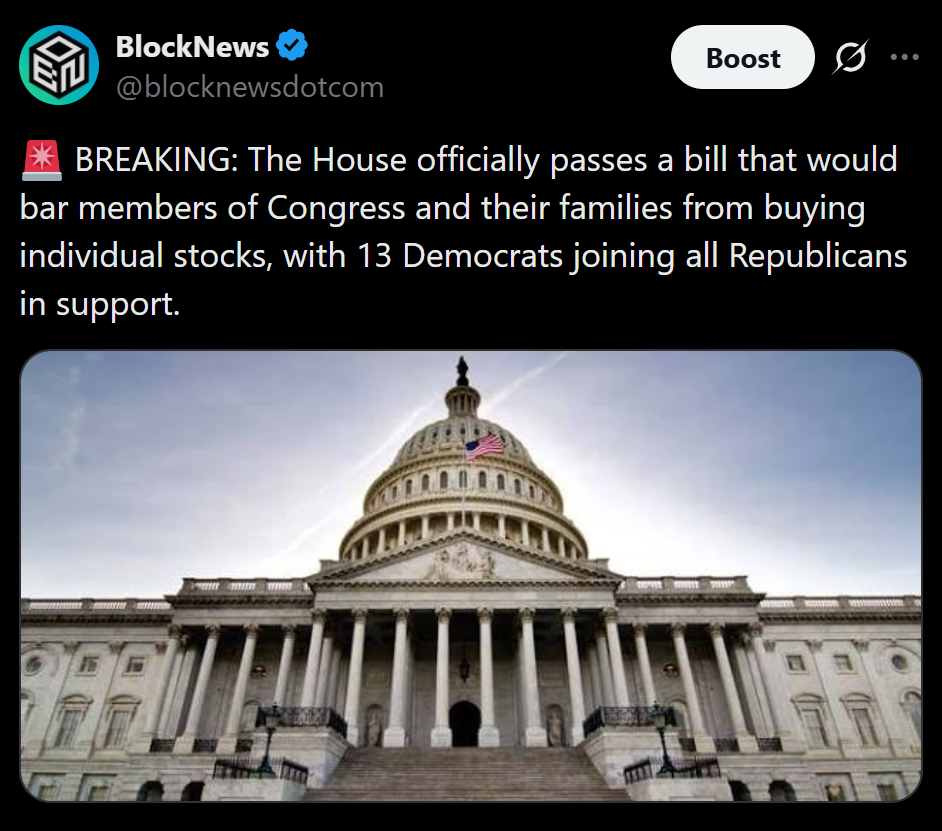
While supporters described the bill as a major ethics reform, critics argued that it leaves significant loopholes and falls short of fully addressing conflicts of interest.
Bill Restricts Future Stock Trading
The legislation would prohibit members of Congress and their immediate families from purchasing and selling individual company stocks.
Supporters say the goal is to eliminate even the appearance that lawmakers could profit from non-public information obtained through their official duties.
Representative Bryan Steil, the bill’s lead sponsor, said the measure is intended to strengthen public confidence in Congress by reducing potential conflicts of interest.
Democrats Say the Bill Falls Short
Many Democrats opposed the legislation because it does not require lawmakers or their families to sell stock holdings they already own.
Some lawmakers instead backed an alternative proposal that would require members to fully divest from individually held stocks, arguing that a complete ban would provide stronger ethics protections.
That broader proposal, despite bipartisan support, was not brought to the House floor for a vote.

Voter ID Amendment Sparks Controversy
Debate over the legislation intensified after Republicans added a voter identification provision tied to the SAVE America Act before the final vote.
The amendment would require proof of citizenship to register for federal elections and impose stricter photo identification requirements for voters.
Democratic lawmakers criticized the addition as unrelated to congressional ethics, arguing it complicated support for the broader stock trading restrictions.
Senate Outlook Remains Uncertain
The legislation must still clear the Senate before becoming law, where its prospects remain unclear.
Senators are considering separate legislation that would go even further by extending stock trading restrictions to the president, vice president, and their immediate families, in addition to members of Congress.
With competing proposals under discussion, negotiations are expected to continue as lawmakers debate how broad future ethics restrictions on federal officials should be.