- Congress approved a major housing bill that includes a temporary ban on a U.S. central bank digital currency until 2030.
- The legislation also protects private stablecoins and other dollar-backed digital assets.
- Even if President Trump refuses to sign the bill, it could still become law automatically within 10 days.
A significant victory for the cryptocurrency industry is moving closer to reality after Congress passed legislation that would temporarily block the Federal Reserve from issuing a central bank digital currency (CBDC). The provision was included in the bipartisan 21st Century ROAD to Housing Act, a sweeping housing package that cleared the Senate in an 85-5 vote and later passed the House by a commanding 358-32 margin.
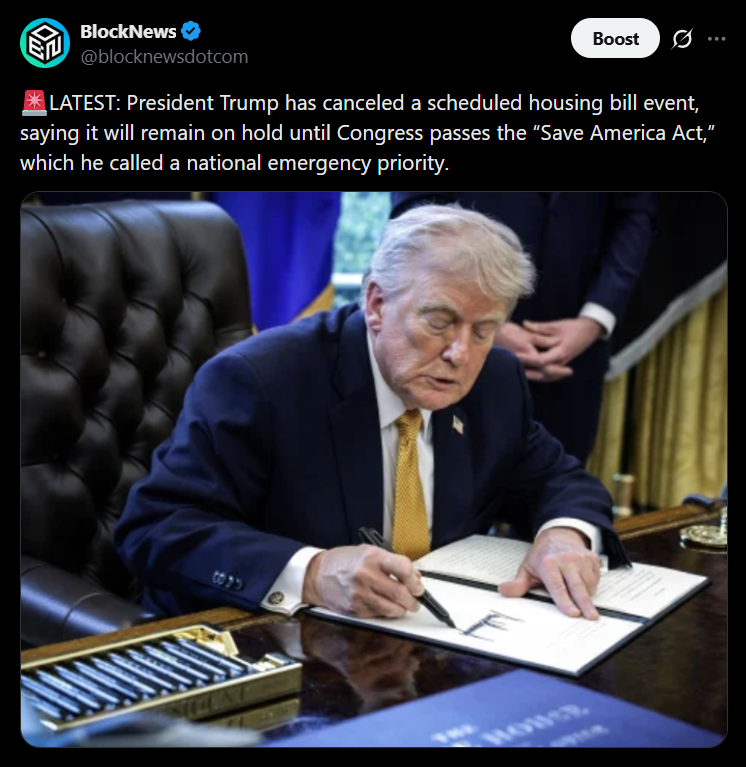
While the housing bill was expected to receive a ceremonial signing from President Donald Trump, the situation became more complicated after Trump publicly criticized the legislation and signaled hesitation about signing it.
CBDC Ban Becomes One of the Bill’s Biggest Crypto Provisions
Hidden within the broader housing legislation is a provision that directly impacts the future of digital currencies in the United States.
The bill prohibits the Federal Reserve and any Federal Reserve Bank from issuing, creating, or circulating a central bank digital currency through December 31, 2030. The restriction applies whether the CBDC is distributed directly or through intermediaries.
For years, crypto advocates have warned that a government-backed digital dollar could threaten privacy and compete with private-sector blockchain innovation. The temporary ban addresses many of those concerns and has been widely welcomed throughout the cryptocurrency industry.
Private Stablecoins Receive Protection
The legislation does more than just block a CBDC.
It also includes language protecting private dollar-denominated digital assets, specifically shielding open, permissionless, and private digital currencies. Many industry participants view this as a positive development for stablecoins such as USDT and USDC, which have become critical pillars of the broader crypto ecosystem.
The inclusion of stablecoin protections signals that lawmakers are increasingly distinguishing between privately issued digital assets and government-controlled digital currencies.
That distinction could shape future crypto regulation across the United States.
Housing Reform Bill Gains Broad Bipartisan Support
The CBDC language was attached to one of the most significant housing bills considered in decades.
The legislation seeks to address housing affordability through multiple reforms, including reducing regulatory barriers, accelerating construction projects, expanding manufactured housing options, and encouraging the conversion of vacant commercial properties into residential units.
Another high-profile provision limits certain institutional investors from purchasing existing single-family homes while preserving exemptions for newly constructed housing.
The bill attracted support from both parties by combining supply-side reforms with affordability-focused measures.
Trump’s Opposition Creates Uncertainty
Despite overwhelming congressional support, Trump unexpectedly complicated the bill’s path.
Shortly before a planned signing event, the president dismissed the legislation as being of “minor importance” and criticized the involvement of Senator Elizabeth Warren. Reports indicate Trump is attempting to use the housing package as leverage to advance separate election-related priorities, including the SAVE America Act.
That has temporarily placed the bill in political limbo.
However, the legislation’s future may not depend entirely on presidential approval.
The Bill Could Become Law Automatically
Under the U.S. Constitution, a bill becomes law automatically if the president neither signs nor vetoes it within ten days while Congress remains in session.
Because Congress is not scheduled to recess for several weeks and because both chambers passed the legislation with margins exceeding the threshold required to override a veto, the CBDC ban appears likely to survive regardless of Trump’s final decision.
For crypto investors, the outcome is becoming increasingly clear.
Whether through a presidential signature or automatic enactment, the temporary CBDC prohibition and stablecoin protections are now closer than ever to becoming federal law.
What It Means for Crypto
If enacted, the legislation would effectively freeze federal CBDC efforts until at least 2031 while providing stronger legal recognition for private digital dollar alternatives.
The move would represent one of the most important crypto policy developments in recent years and could strengthen confidence among stablecoin issuers, blockchain developers, and digital asset investors.
As lawmakers continue debating broader cryptocurrency legislation, the CBDC restriction signals growing support for private-sector innovation over government-issued digital currencies.