

- Ethereum climbed back above $2,300 after the Senate Banking Committee approved the CLARITY Act.
- On-chain data showed profit-taking and weakening staking growth before the regulatory catalyst emerged.
- ETH now faces important resistance near $2,350 while traders monitor whether the relief rally can continue.
Ethereum [ETH] pushed back above the $2,300 level after the U.S. Senate Banking Committee approved the CLARITY Act, helping trigger a broader relief rally across crypto markets. The move improved short-term sentiment almost immediately, with Bitcoin, major altcoins, and crypto-related equities all moving higher as traders reacted positively to the regulatory progress coming out of Washington.
Before the vote, ETH had been struggling near the $2,240 zone, where price action remained sluggish and uncertain for several sessions. The rebound following the Senate decision suggests traders are now focusing more on improving regulatory clarity rather than the cautious on-chain signals that dominated market discussions earlier in the week.
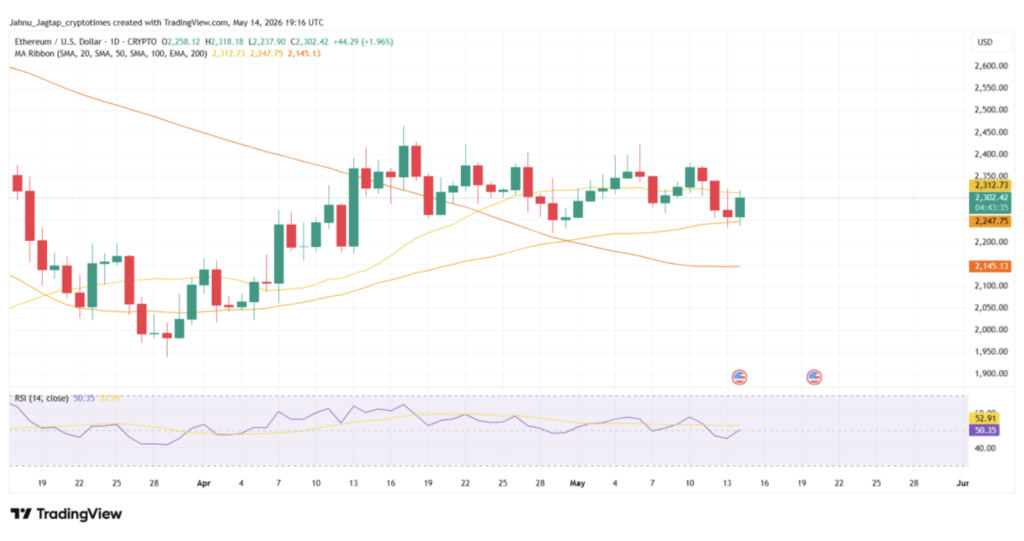
Technically, Ethereum managed to reclaim its 50-day simple moving average around $2,247 before climbing back toward the 20-day SMA near $2,313. That level now matters quite a bit because holding above it could open the path toward additional upside targets near $2,350, followed by the larger resistance areas around $2,400 and $2,450.
On-Chain Data Had Already Turned Cautious Before the Rally
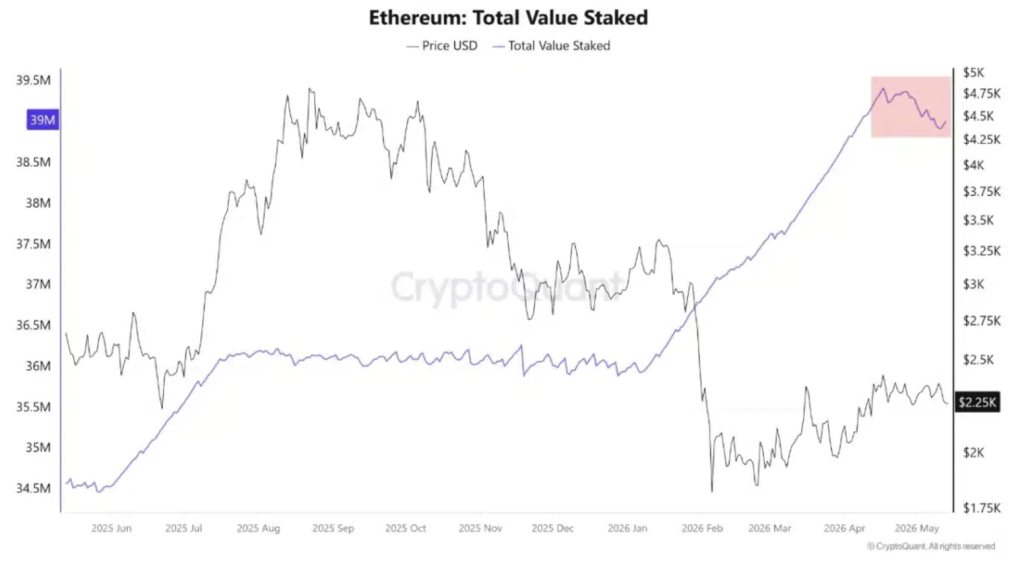
Interestingly, several on-chain indicators had already started flashing warning signs before the CLARITY Act vote changed market sentiment. Data from CryptoQuant showed total staked ETH climbing close to 39 million ETH during 2026, which still reflects strong long-term confidence from holders overall.
However, staking growth began slowing noticeably throughout May. In fact, the staking curve even showed a slight decline before the Senate vote, suggesting some investors were unlocking ETH either for liquidity purposes, portfolio rebalancing, or broader risk management during uncertain market conditions.
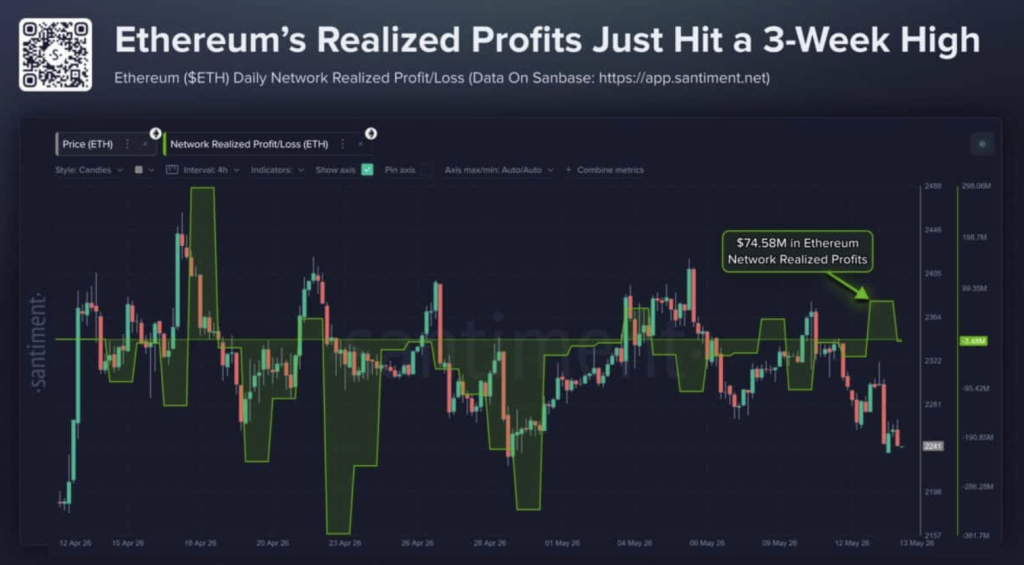
Santiment data also revealed that Ethereum network realized profits surged to roughly $74.58 million, marking the highest level seen in around three weeks. That increase suggested traders who accumulated ETH below the $2,000 region earlier this year had started locking in gains before the regulatory catalyst emerged.
At the same time, Glassnode’s HODL Waves data showed a decline in ETH held by one-to-three-month investors. That group dropped to around 4.8% of circulating supply after sitting above 6% in late April and nearly 16% back in January. Since short-term holders tend to react more aggressively during periods of uncertainty, the data implied many recent buyers had already reduced exposure ahead of the Senate decision.
The CLARITY Act Became Ethereum’s Main Market Catalyst
Once the Senate Banking Committee approved the CLARITY Act, the market narrative shifted quickly. Instead of focusing on distribution, profit-taking, and weakening staking growth, traders began concentrating on the possibility of clearer crypto regulation in the United States.
For Ethereum, the timing actually worked out surprisingly well. Much of the earlier selling pressure may have already been absorbed before the vote happened. So when regulatory optimism entered the market, ETH was able to rebound without facing the same heavy downside momentum that previously dominated sentiment.
That doesn’t mean the earlier bearish on-chain signals suddenly disappeared. They still matter. But the context changed. Rather than signaling fresh weakness after the rally, those metrics now look more like part of the setup that existed before buyers regained control temporarily.
ETF Demand Still Looks Relatively Cautious
Ethereum spot ETF flows also continue painting a mixed picture. According to CoinGlass data, ETH ETFs experienced their strongest inflow periods during earlier rallies when Ethereum traded well above the $3,000 and $4,000 levels.
More recently though, ETF activity has become less consistent. Throughout late 2025 and early 2026, inflows weakened considerably as ETH traded closer to the $2,000 to $2,300 range. Several periods even showed notable outflows instead of aggressive accumulation.
That’s important because the latest rebound doesn’t appear to be driven primarily by institutional ETF demand. Instead, the move seems tied more closely to improving crypto sentiment, renewed regulatory optimism, and short-term positioning from traders reacting to the CLARITY Act news.
Institutions still appear cautious overall. They’re watching the market carefully, but they haven’t fully committed to chasing Ethereum higher yet.
Short Liquidations Helped Fuel ETH’s Recovery
The rebound also triggered a noticeable wave of short liquidations across Ethereum futures markets. CoinGlass data showed total ETH liquidations reaching roughly $43 million within 24 hours, with short positions slightly outweighing longs.
Around $22.9 million in short liquidations were recorded compared to roughly $20.4 million in long liquidations. That imbalance suggests traders betting on continued downside were caught off guard once ETH reclaimed the $2,300 level following the Senate vote.
Even so, the derivatives market doesn’t appear overly euphoric yet. CoinGlass still categorized Ethereum’s environment as “clear deleveraging,” meaning the market is reducing excessive leverage rather than entering a highly speculative phase.
Ethereum Price Outlook Remains Focused on $2,300 Support
Going forward, Ethereum now needs to defend the $2,300 region to keep the current relief rally intact. If ETH holds above the 20-day SMA near $2,313 and successfully clears the $2,350 resistance zone, traders will likely begin targeting $2,400 and eventually $2,450 next.
A stronger breakout could even bring the psychological $2,500 level back into focus.
On the downside, however, losing support near $2,247 would weaken the short-term recovery structure considerably. That could expose ETH to another drop toward $2,200, while a deeper correction may eventually retest the 200-day EMA sitting near $2,145.
For now though, Ethereum’s momentum has clearly improved after the CLARITY Act vote, with regulatory optimism temporarily outweighing the bearish signals that pressured the market earlier.