

- New on-chain data suggests Bitcoin’s latest wave of selling is far weaker than the first major correction of the year.
- CryptoQuant believes many panic sellers may have already exited the market, reducing downside pressure.
- Meanwhile, Franklin Templeton is pushing forward with new Bitcoin-focused ETF products tied to dividend reinvestment strategies.
Bitcoin may be entering the later stages of its current correction as signs of seller exhaustion begin to emerge across the market. While BTC continues to trade under pressure, recent on-chain data suggests that the intensity of the sell-off has weakened considerably compared to earlier declines. For investors trying to determine whether the worst is over, that shift could be an important clue.
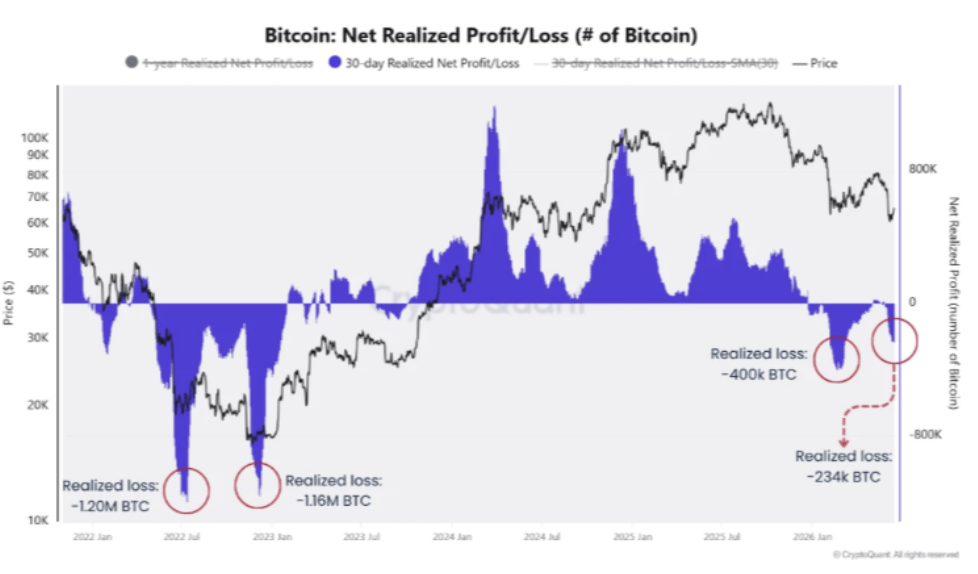
According to a new CryptoQuant report, the latest round of realized losses looks noticeably different from the first major drop seen earlier this year. Even though Bitcoin is trading around similar price levels, the number of coins being sold at a loss has fallen sharply. That suggests fewer investors are panicking, and in many cases, the weakest hands may have already left the market.
Realized Losses Show Signs of Seller Exhaustion
CryptoQuant’s 30-day Net Realized Profit and Loss metric shows that the most recent wave of realized losses totaled roughly 234,000 BTC. Earlier in the year, during the first major leg down, realized losses climbed close to 400,000 BTC. The difference is significant and points toward a market where fear-driven selling is gradually fading.
Analyst MorenoDV noted that the size of the marginal seller appears to be shrinking. In simple terms, there are fewer participants willing to dump their holdings at current levels compared to previous declines. That doesn’t guarantee a recovery tomorrow, of course, but it does indicate that a large portion of panic-induced selling pressure may already be behind us.
Capitulation Signals Remain Incomplete
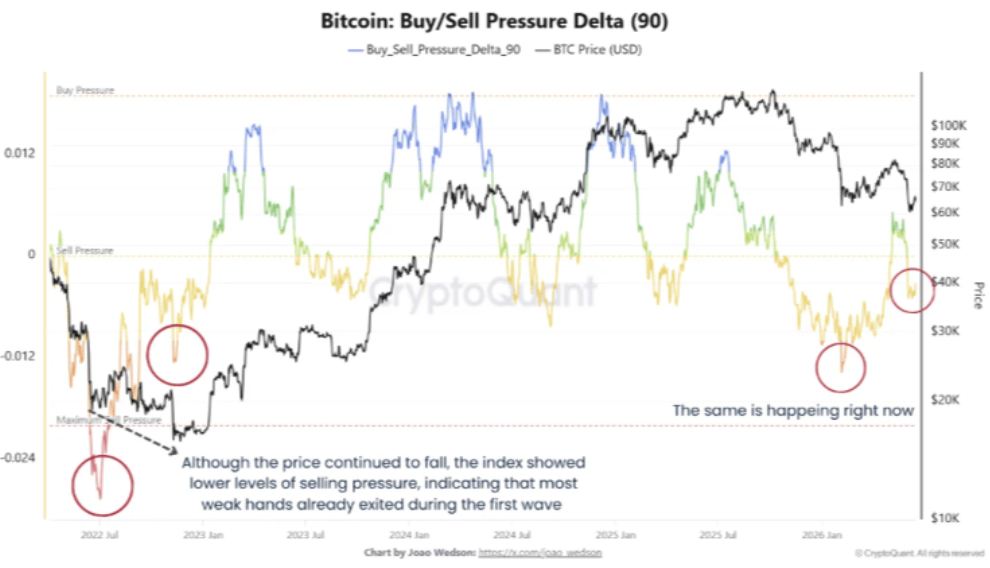
Even so, the market may not be entirely out of the woods yet. CryptoQuant’s Buy/Sell Pressure Delta shows that selling activity remains elevated, though it has not reached the extreme levels typically associated with full-scale capitulation events. Historically, this type of market structure often appears after weak hands have been flushed out but before the final stage of a correction is complete.
The report suggests Bitcoin could still require one more stress test before a durable bottom is confirmed. Often, markets need a final shakeout to force remaining holders sitting on large unrealized losses to exit their positions. Until that process fully plays out, analysts remain cautious despite the improving data.
Bitcoin Bottom Still Awaiting Confirmation
Another key metric, CryptoQuant’s one-year Net Realized Profit and Loss indicator, remains below zero. While that reflects ongoing market stress, losses have not yet reached the extreme levels typically seen during previous cycle bottoms. In other words, the data is improving, but it hasn’t delivered a definitive signal that the correction is over.
Analysts stress that this does not necessarily mean Bitcoin must experience another dramatic collapse. Instead, the market appears to be moving through a late-stage stress phase where selling intensity gradually fades while confidence slowly rebuilds. If realized losses continue declining and prices stabilize, it would strengthen the case that the correction is nearing completion. On the other hand, a fresh drop accompanied by rising realized losses could indicate one final capitulation event before recovery begins.
Franklin Templeton Expands Bitcoin ETF Ambitions
While on-chain data paints a cautious picture, institutional adoption continues moving forward. Franklin Templeton recently submitted an amended filing with the U.S. Securities and Exchange Commission seeking approval for two innovative Bitcoin-linked ETFs.
The proposed funds would combine traditional equity exposure with systematic Bitcoin accumulation. Roughly 95% of each portfolio would be allocated to U.S. stocks, while approximately 5% would be invested in Bitcoin-related assets at launch. What makes the products unique is their Dividend Reinvestment Plan, or DRIP, strategy. Rather than distributing cash dividends to investors, those dividends would automatically be used to increase Bitcoin exposure over time.
The approach offers a gradual path toward crypto allocation while maintaining traditional stock holdings as the core investment. As institutional firms continue building new Bitcoin-focused products, long-term confidence in the asset remains surprisingly strong despite ongoing market volatility.